C-core ( Eng. Core , pronounced ce-core ) is the optimality principle in the theory of cooperative games , which is a set of effective payoff distributions that are resistant to deviations of any coalition of players, that is, many vectors such that:

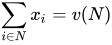
and for any coalition done:

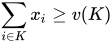
Where - characteristic function of the game.

Properties
- Equivalent is the definition of the C-kernel of a cooperative game in terms of blocking the distribution of winnings by coalitions. The coalition K is said to block the payoff distribution x if there is another payoff distribution y such that
and for any participant done .
Then the C-core of a cooperative game is the set of payoff distributions that cannot be blocked by any coalition.
- The c-core is defined by a system of linear equations and non-strict linear inequalities, in connection with which it is a convex polyhedron .
- C-core may be empty. Sufficient conditions for the nonemptiness of the nucleus were formulated by L. Shapley :
Theorem. A cooperative game with a supermodular characteristic function has a nonempty kernel.
The necessary and sufficient conditions for the non-emptyness of the nucleus were formulated by O. Bondareva and, later, L. Shapley :
Theorem. The core of a cooperative game is nonempty if and only if it is balanced .
- Any Walras equilibrium belongs to the core, but the converse is not true. However, under some assumptions, if the number of agents in the economy tends to infinity, the core tends to the set of Walras equilibria ( Edgeworth hypothesis).
See also
- Cooperative game (math)
- K-core
- N core
Sources
- Bondareva O.N. Some applications of linear programming methods to the theory of cooperative games // Problems of Cybernetics. - 1963.- T. 10 . - S. 119 - 140 .
- Kannai Y. The core and balancedness // Handbook of Game Theory with Economic Applications, Vol. I. - Amsterdam: Elsevier, 1992 .-- S. 355 - 395. - ISBN 978-0-444-88098-7 .
- Shapley LS On balanced sets and cores // Naval Research Logistics Quarterly. - 1967 .-- T. 14 . - S. 453 - 460 .
- Petrosyan L.A., Zenkevich N.A., Shevkoplyas E.V. Game Theory. - St. Petersburg: BHV-Petersburg, 2012 .-- S. 432. - ISBN 978-5-9775-0484-3 .