"Tomahawk" [sn. 2] ( ['tɒmə‚hɔ: k]orig. pronunciations " Tomahok " English Tomahawk - by name. North American Indians of the same name ) - a family of American multi-purpose high-precision high-precision subsonic cruise missiles ( CR ) of strategic and tactical designation of underwater, surface, land and air bases [3] . It flies at extremely low altitudes with an envelope of terrain. It is in service with ships and submarines of the U.S. Navy , has been used in all significant military conflicts involving the United States since its adoption in 1983. The estimated cost of the rocket in 2014 was 1.45 [4] million US dollars.
| BGM-109 Tomahawk | |
|---|---|
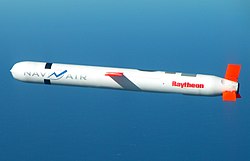 BGM-109 Tomahawk missile in flight, 2002 image. | |
| Type of | long-range cruise missile |
| Status | in service |
| Developer |  General dynamics General dynamics |
| Years of development | 1972-1980 |
| Test start | March 1980-1983 |
| Adoption | March 1983 |
| Manufacturer | General Dynamics (originally) Raytheon / McDonnell Douglas |
| Units produced | 7302 (production continues) [1] [sn. one] |
| Unit cost | Tactical Tomahawk: $ 1.87 Million (FY2017) [2] (Block IV) |
| Years of operation | 1983 - n. at. |
| Main operators |  US Navy US Navy Royal Navy Royal Navy Spanish Navy Spanish Navy |
| Base model | BGM-109A |
| Modifications | BGM-109A / ... / F RGM / UGM-109A / ... / E / H BGM-109G AGM-109C / H / I / J / K / L |
| ↓ All specifications | |

Background
After World War II, their cruise missile development programs were carried out with varying degrees of success in the Soviet Union and the United States of America . At the same time, in the USA, with the adoption of the Polaris submarine ballistic missiles and the Atlas , Titan , and Minitman mine-based intercontinental ballistic missiles, the development projects of the new generation of strategic cruise missiles were curtailed, as a result of which there was a gap in the segment of operational-tactical weapons of the fleet, in the USSR these projects continued and achieved impressive results. This, in turn, led to the fact that in 1972 , impressed by Soviet successes, the United States resumed the development of its own CR (the Soviet analogs were the Termit-M , Metel and Basalt anti- ship missiles) [5] . In connection with the achievements of scientific and technological progress in the field of electronics and aerodynamics, the projects of the new American KR were much smaller in size and weight than their predecessors of the late 1950s - early 1960s [6] .
History
In 1971, the leadership of the US Navy initiated work to study the possibility of creating a strategic missile defense with an underwater launch. In the initial phase of the work, two options for CR were considered:
- The first option involved the development of a heavy missile launcher with an underwater launch and a long flight range of up to 3,000 nautical miles (~ 5500 km) and missile deployment on board five George Washington and five Ethen Allen submarines in UGM-27 SLBM launchers Polaris " (diameter 55 inches ), withdrawn from service. Thus, SSBNs became carriers of strategic SSBN cruise missiles.
- The second option involved the development of a lighter RS for the 533 mm torpedo tubes of submarines with a flight range of up to 2500 km.
On June 2, 1972, a lighter version was chosen for torpedo tubes, and in November of the same year industry was awarded contracts for the development of SLCM ( English Submarine-Launched Cruise Missile ) - a cruise missile of submarines. Later, from the fleet officers who oversaw the project, she received her verbal name "Tomahawk."
In January 1974, the two most promising projects were selected for participation in competitive demonstration launches, and in 1975 the projects of General Dynamics and Lin-Temko-Vout were assigned the designations ZBGM-109A and ZBGM-110A , respectively (prefix " Z "in the designation is a status one, and in the notation system, the US Defense Ministry was used to designate systems that exist" on paper ", that is, at an early stage of development). While General Dynamics concentrated on hydrodynamic test launches of a rocket from a submarine to work out the sequence of rocket launch from depth to the surface of the water (at this stage one “dry” launch was made when the rocket leaves the launch shaft, pushed upward with compressed air , and eight “wet” launches with preliminary filling of the mine with water), “Lin-Temko-Vout” had carried out similar tests in advance earlier and had already begun work on the integration of the engine with the rocket body and improving the aerodynamic characteristics of their experimental prototype [7] .
In February 1976, the first attempt to launch the YBGM-110A prototype from the torpedo launcher (TA) (prefix “Y” in the designation) failed due to the TA failure. The second attempt was not successful due to the non-disclosure of the wing consoles. In March 1976, given the two flawless launches of the YBGM-109A prototype and its less risky design, the US Navy announced the BGM-109 missile as the SLCM contest winner, and work on the BGM-110 project was discontinued [8] .
At the same time, the Navy leadership decided that the SLCM should be adopted by surface ships, so the meaning of the acronym SLCM was changed to English. Sea-Launched Cruise Missile - Sea- based cruise missile (SLCM). Flight tests of the YBGM-109A , including the TERCOM terrain correction system (“ Terkom ”, the English Terrain Contour Matching , which in turn is a modified version of similar aircraft navigation systems), [9] continued for several years. The preparation of three-dimensional maps of the terrain for the hardware-software complexes of navigation equipment for missiles was carried out by the Military Cartographic Agency of the Ministry of Defense [10] . The TERCOM system provides the missile with a flight below the radar horizon, allowing it to fly at an extremely low altitude, just above the tops of trees or roofs of buildings, complicating the task of the enemy with its zigzag flight path [11] . To increase the accuracy of striking accuracy, the relief system was supplemented with a digital scene-matching area correlator , so that, according to the developers, they beat accurate to the mailing address and hit the target “through the front door”. [12]
Since 1976, the Tomahawk Aircraft Work Program (TALCM) was oversaw jointly by the Navy and Air Force, which were also included in the program for developing its own air-launched cruise missile ( English -Launched Cruise Missile ) with an aim to equip it with strategic bomber aircraft. The main competitor of General Dynamics in the air-to-surface class was Boeing with its AGM-86 ALCM , the most intense phase of testing occurred in the spring-summer and lasted until the end of 1976 (which is not typical for US missile weapons projects as a rule, intensification of launches does not increase in the first year, but as control tests approach). Joint tests with the AGM-86A took place under the US Strategic Aviation Command program. Then in 1976, the land version of the Tomahawk (GLCM) was recognized as satisfying the requirements of the Air Force [13] .
In January 1977, Presidential Administration Jimmy Carter initiated a program called the JCMP ( Joint Cruise Missile Project ), which ordered the Air Force and Navy to develop their cruise missiles on a common technology base. One of the consequences of the JCMP program was that only one type of marching propulsion system ( Williams F107 turbojet engine AGM-86 ) and terrain correction system TERCOM ( McDonnell Douglas AN / DPW-23 missile BGM-109 ) was further developed. Another consequence was the cessation of work on the base modification of the AGM-86A, which was almost ready to be put into production, and competitive flight tests for the role of the main air-based cruise missile between the extended version of the AGM-86 extended to 2,400 km range, designated as ERV ALCM . Extended Range Vehicle , later became AGM-86B ) and AGM-109 (modified YBGM-109A air-based). After the flight tests between July 1979 and February 1980, the AGM-86B was declared the winner of the competition, and the development of the air-based AGM-109 was stopped [14] .
The marine version of BGM-109 continued to develop at this time. In March 1980, the first surface flight test of a serial missile BGM-109A Tomahawk from the destroyer type USS Merrill (DD-976) ( USS Merrill (DD-976) ) took place, and in June of that year a successful launch was made serial "Tomahawk" from the submarine USS Guitarro (SSN-665) type "Stojen" . This was the world's first launch of a strategic KR from a submarine. To equip surface ships with the Tomahawk, the missile had to be mated with other military means of the ship, [13] this required an on-board weapon control system similar to that already existing on ships equipped with Harpoon missiles [15] .
Tomahawk SLCM flight tests continued for six years, control tests for three years, during which time more than 100 launches were made, as a result, in March 1983, the missile reached operational readiness and recommendations were issued for adoption.
The first modifications of these missiles, known as Tomahawk Block I , were the strategic BGM-109A TLAM-N ( Eng. Tomahawk Land-Attack Missile - Nuclear ) with a thermonuclear warhead (similar to that used on the AGM-86B and AGM-69B ) [16] and anti - ship BGM-109B TASM ( English Tomahawk Anti-Ship Missile ) with a warhead in conventional equipment. Initially, RS modifications for various types of launch medium were designated by assigning a digital suffix, for example, the surface launch rockets were designated by the indexes BGM-109A-1 and −109B-1 , and the underwater ones by the BGM-109A-2 and −109B-2 . However, in 1986, instead of a digital suffix, the letters “R” for surface ships and “U” for submarines began to be used as the first index letter (“B” - indicating the multiplicity of launch environments) to indicate launch environment.
The estimated cost of one rocket at the development and testing stage fluctuated in one direction or another from half a million dollars, depending on the volume of the order: $ 560.5 thousand (1973), $ 443 thousand (1976), $ 689 thousand (1977) [17] .
The cost of one launch of the Tomahawk KR in March 2011 was about 1.5 million US dollars [18] .
Purpose
“Tomahawk” is a functional tool for solving a wide range of combat missions and instead of a standard warhead, nuclear or conventional, a missile can serve as a carrier for cluster munitions to destroy dispersed group targets (for example, airplanes at an airfield, vehicle parking or a tent camp), or be equipped with reconnaissance the equipment and perform the functions of an unmanned reconnaissance plane for photo and video area, or promptly deliver to the remote distance of any useful naked uzku (munitions) landing on a parachute for the progressive forces in situations where delivery of cargo manned aircraft impossible or problematic (weather and climatic conditions, resistance to means of air defense of the enemy, and others.). The flight range is increased in two ways, firstly, by reducing the weight of the flight load, and secondly, by increasing the height of the missile’s flight on the marching section of the trajectory (before entering the enemy’s active anti-aircraft defense zone) [9] [19] .
Flight Profile
| The flight profile of a rocket in a vertical plane depends on its control system and the combat mission being performed, before approaching a target, a rocket equipped with a homing head with a search function for a target starts to slide ( above ), a rocket equipped with inertial navigation equipment with a programmed flight path immediately begins to dive ( below ) | ||
The missile guidance system is almost identical to the Harpoon anti-ship missile. [9] The flight profile of a missile equipped with a homing system (target acquisition and homing system) is as follows: the marching portion of the flight path involves enveloping the terrain outside the zone of effective detection by enemy radar , so the flight takes place using the built-in inertial navigation equipment (midcourse guidance unit) at low and extremely low altitudes in front of the terminal portion of the flight of the rocket climbs, it activates the dual-mode radar seeker and start searching for purpose in the dir IU passive scanning, after target detection is switched mode active radar seeker and the GOS target is captured, after which the missile comes to the target. In the absence of exact target coordinates (when shooting at moving targets), the missile is guided by approximate and in a given sector of airspace switches to flight in target search mode, at this time the GOS scans the terrain observed in the front hemisphere for the presence of targets, identifying them by overall characteristics (length, width, height, shape) from the set of parameters embedded in the software . For models that do not have a GOS (designed to shoot at stationary ground targets, ships and ships at anchor), the flight profile is practically no different, except that before approaching the target the rocket does not lift, but simply begins to dive , the guidance function is performed autopilot without a preliminary search for the target [20] .
Feasibility
The following are the advantages and disadvantages of Tomahawk sea-based cruise missiles in comparison with other means of the US nuclear missile arsenal , strategic and tactical weapons, in the context of debates on the practical feasibility of mass production and deployment of missiles (theses from the speech of the head of the strike submarine department US High Command Rear Admiral Thomas Malone ). [21] It should be borne in mind that the advantages and disadvantages in technical terms (regarding the guidance system and flight performance of the rocket) are the same for the Tomahawk, Griffin , and AIS , which have a different environment and basing method (marine, land and air, respectively).
Advantages
- Coverage of the entire globe, the possibility of delivering a nuclear missile strike for any purpose and returning to the practice of “ gunboat diplomacy ” in relation to developing countries ;
- High accuracy of the weapon and the possibility of delivering a precision- guided missile with a conventional warhead against objects of interest without creating a zone of continuous destruction, damage to the local civilian population and the threat of involvement in a major regional or world war;
- Expanding the combat capabilities of the fleet, the ability to independently solve a wide range of combat missions, up to autonomous participation in limited military conflicts without involving other types of armed forces (rocket attacks, carrier-based strikes , operations of special forces of the fleet and local collaborative formations on land);
- Complete independence of the operational level commanders in matters of selecting targets and striking at them without the need for interspecific coordination and related bureaucratic procedures, the lack of the need to contact higher headquarters and military command and control bodies for help;
- Greater strategic mobility of the involved forces and means in comparison with other basing methods (except for air, which, in turn, requires unhindered access to the airspace of the receiving side and the creation of an airfield network and ground infrastructure there ready to receive and deploy missile launch vehicles, conclusion and regular extension of relevant interstate agreements on the joint use of airspace and ground objects, as well as many other dgotovitelnyh events);
- The absence of political and legal consequences of the deployment of a group of missile-carrying ships and submarine forces in one point or another of the planet in neutral waters , which does not require coordination with local government bodies and international authorities , does not go against international legal agreements (which was especially important in the light of the protests of anti-war activists , opposition parties and movements in the countries of NATO with respect to the deployment of US strategic missiles) and, as a consequence, reduction of politi tion of tension ;
- The massing of the missile attack forces, due to the fact that the places of deployment and flight paths of missiles located on land bridgeheads, are well known to the enemy and are continuously monitored by various means of detecting and warning of a missile attack , and the sea coastal zone of the enemy’s territory is so large that so its quality monitoring, as the air corridors over the missile reaching is the European part of the country , it is extremely difficult and allows for simultaneous engagement with the set and trends;
- The possibility of increasing the grouping, if necessary, without violating legal obligations (under the treaties on the limitation of offensive arms, the US ground forces in Europe and the means of warfare available to them were quantitatively limited);
- The possibility of an immediate change of position, less vulnerability to retaliation (if missile positions in land theaters were long ago and accurately explored by a likely adversary, then basing at sea removed this issue from the agenda) and the absence of a threat to the civilian population of adjacent territories, as in the case of land missile systems deployed in NATO countries;
- A high level of infrared and blackout of rocket launch, caused by a small thermal trail and the absence of a bright flash during launch and in the initial phase of flight, to prevent its recognition from space by satellites of a missile attack warning system (unlike ballistic missiles) and other optical or thermovisual detection, which makes it more preferable as a means for delivering a covert anticipatory strike;
- The relative secrecy of the movement and placement of underwater carrier vehicles in the area of operational use, a factor of surprise for the enemy;
- Greater survivability of nuclear deterrence forces as a consequence of the above circumstances;
- A wider range of tasks performed by a naval strike grouping of ships, in contrast to land missile units ( anti-submarine measures , ensuring the safety of sea lanes and own shipping, incapacitating enemy shipping, etc.);
- Operational simplicity of the available means for launching a missile strike, which are located in sealed metal containers and do not require regular maintenance and monitoring inspections;
- Relative low cost in comparison with other types of missile weapons due to lower operating costs and expenses for paying for the activities of maintenance personnel;
- There is less likelihood of a provoked retaliatory strike by a probable adversary in the event of the detection of a single intentional (provocative) or unintentional (emergency) launch of a rocket, in contrast to the alleged reaction to his detection of the launch of an intercontinental ballistic missile of the Piskiper type or a medium-range ballistic missile of the Pershing type 2 ";
- High efficiency of the relief system when flying a rocket over a mountainous, hilly and bumpy terrain.
Weaknesses
- The need for accurate three-dimensional digital topographic maps of the terrain along the entire flight route of the rocket, which required the use of all available forces and means of species reconnaissance (during the Cold War, this task was complicated by the very active opposition of the USSR to any attempts by the intelligence agencies of the United States and NATO to take their territory and the territory of the socialist countries orientation , [22] after the disintegration of the USSR, they received virtually unlimited access to the entire post-Soviet space and to the territories of the allied countries , and access to previously secret topographic maps);
- Low efficiency of the relief system when firing at targets on a flat terrain, tundra and forest-tundra, or in a coastal zone with a gentle coast. According to a senior Pentagon official, "some regions of the USSR are flat like a pool table , TERCOM will not work there," while the bulk of the tests took place in the mountainous regions of the United States; [23]
- High fluctuations in the level of snowfall in the northern regions of the USSR, affecting the operation of the radio altimeter and, as a result, the quality of the relief system, giving rise to the seasonal nature of its application, or the need to determine the thickness of the snow cover along the flight route, which is practically impossible; [24]
- The scarcity of the Arctic regions of the USSR on landmarks and anchor points for the relief system; [25]
- Vulnerability of a radio altimeter to radar interference in general and means of setting artificial radar interference in particular; [26]
- Malfunctions of the ignition system of rocket engines at subzero temperatures at the test stage (subsequently, the problem was fixed); [eleven]
- Relatively low flight speed ( less than 1 fly) on the marching and terminal flights and, as a result, the vulnerability of the rocket on the one hand to the means of detecting and intercepting the enemy, and on the other hand, to a strong gusty wind and similar adverse weather conditions, affecting atmospheric mass turbulence ; [25]
- В отличие от межконтинентальных баллистических ракет и баллистических ракет средней дальности, в силу своей аэродинамических (скорость полёта) и массо-габаритных ( килотоннаж боевой части ) характеристик не может использоваться в качестве основного оружия первого удара для обезоруживания противника. По словам сотрудника Международного института стратегических исследований Леонарда Бертина, «ни одна держава мира с развитым ракетно-ядерным потенциалом не рискнёт сменить МБР с подлётным временем двадцать минут до самых удалённо расположенных стратегических целей в глубине территории противника на крылатые ракеты, летящие четыре часа до целей на расстоянии всего трёх тысяч километров». Но, тем не менее, ракета может использоваться в качестве вспомогательного оружия для нанесения ударов по штабам и органам управления противника, дополняя тем самым имеющийся ядерный арсенал; [27]
- Низкая вероятность преодоления эшелонированной системы противоракетной обороны противника, включающей в себя истребительную авиацию и тактические наземные средства ПВО. Совместные учения Армии и ВВС США, показали, что стандартные армейские зенитно-ракетные комплексы « Хок » усовершенствованной модели могут обнаружить в зоне радиолокационной досягаемости, сопровождать до зоны поражения и условно сбить ракету типа «Томагавк» в семи-девяти случаях из десяти. А по данным американской разведки, советские истребители МиГ-25 из числа дежурных средств перехвата, барражирующие на высоте свыше шести километров, обеспечивали эффективное поражение крылатых ракет, летящих на малой высоте; [28] По словам тогдашнего заместителя Министра обороны США Уильяма Перри , в силу высокой способности обнаружения малогабаритных целей на фоне помех от местных предметов, которой обладали советские системы противовоздушной обороны типа С-300 , вероятный противник располагал достаточно эффективным средством противодействия угрозе применения крылатых ракет со стороны США и НАТО, кроме того, по сведениям авторитетного издания в сфере авиации и ракетостроения «Aviation Week», в СССР проводились учения и мероприятия боевой учёбы лётчиков авиации ПВ О по обнаружению и поражению имитаторов крылатых ракет при помощи УРВВ ; [29]
- Протесты антивоенных активистов и сторонников ядерного разоружения в самих США, обусловленные способностью ракеты нести ядерную боевую часть [30] .
Основные недостатки ракеты были продиктованы, главным образом, независимыми от разработчиков причинами (географическими и погодно-климатическими особенностями страны-вероятного противника № 1 на тот момент, то есть СССР). Опыт применения ракет против других стран в постсоветский период мировой истории показал, что при прочих равных ракеты демонстрируют высокую эффективность боевого применения на иных театрах военных действий, не имеющих перечисленных ограничивающих факторов, против стран, не обладающих естественной защитой от ракет типа «Томагавк».
Tests
Начиная с 1976 года все пункты программы НИОКР выполнялись с опережением календарного плана. Исходная программа испытаний предусматривала 101 пуск ракет, оснащённых РЛГСН ПКР « Гарпун » и самолётной навигационной системой TERCOM с начала 1977 по конец 1979 года (из них 53 пусков для технической оценки лётных характеристик, 10 пусков ракет с ядерной боевой частью по программе , 38 пусков для оценки боевых возможностей в условиях различных вводных тактических ситуаций). [31] Опытные пуски для оценки видимости с земли силуэта пролетающей ракеты визуальным и инструментальным способом, а также оставляемого ею теплового следа (при помощи специальной инфракрасной фиксирующей аппаратуры) проводились на полигоне « Уайт-Сендз ». Кроме того, программа испытаний включала опытные пуски на полигоне авиабазы « Хилл » в штате Юта . Контрольные замеры эффективной отражающей площади массо-габаритных макетов ракет LTV и General Dynamics были сняты в установке для определения радиолокационных сечений летательных аппаратов на авиабазе « Холломан » (обе авиабазы расположены в штате Нью-Мексико ). Устойчивость бортовой электроники и других систем ракеты к воздействию электромагнитного излучения ядерного взрыва измерялось в лабораториях корпорации IRT в Сан-Диего , штат Калифорния [32] .
Несмотря на интенсивность и высокую продуктивность работ на начальном этапе (в ходе опытных пусков в 1976 году система наведения показала результаты в три раза лучше ожидаемых, полёты ракет на сверхмалых высотах превзошли требования по минимальной высоте), [33] программа испытаний затянулась по времени в сравнении с исходным планом и в итоге, со времени начала испытаний до середины 1982 года было выполнено 89 пусков. В целях экономии средств, опытные прототипы ракет вместо боевой части оснащались парашютной системой, срабатывавшей по завершении выполнения ракетой полётного задания (или по команде с пункта управления испытаниями) для обеспечения сохранности встроенной телеметрической аппаратуры и последующего изучения обстоятельств каждого опытного пуска [9] . В ходе 20 первых запусков 17 ракет были успешно подобраны [13] .
| Перечень пусков по программе лётных испытаний | ||||||
|---|---|---|---|---|---|---|
| № пуска | дата и время | № ракеты | тип ПУ | тип ракеты | note | result |
| one | 13 февраля 1976 | T4:1 | TA | планер | Бросковое испытание | успешный |
| 2 | 15 февраля 1976 | T6:1 | ТА | планер | Бросковое испытание | успешный |
| 3 | 28 марта 1976 | T7:1 | Самолёт A-6 | планер | Интеграция ДУ и СУ с ракетой. 1-е лётное испытание с маршевой ДУ | успешный |
| four | 26 апреля 1976 | T8:1 | A-6 | планер | Устойчивость при флаттере и управление | успешный |
| five | 16 мая 1976 | T8:2 | A-6 | планер | Расширение режимов полёта | успешный |
| 6 | 5 июня 1976 | T9:1 | A-6 | РПНЦ | Интеграция СУ и ДУ с ракетой. 1-й полёт с СУ с коррекцией TERCOM | успешный |
| 7 | 11 июня 1976 | T8:3 | A-6 | планер | Расширение режимов полёта | аварийный |
| eight | 16 июля 1976 | T9:2 | A-6 | РПНЦ | Отработка системы навигации, TERCOM, 1-й полёт с демонстрацией огибания рельефа | успешный |
| 9 | 30 июля 1976 | T9:3 | A-6 | РПНЦ | Отработка системы навигации, TERCOM, огибания рельефа | аварийный |
| ten | 8 августа 1976 | T8:4 | A-6 | планер | Определение индикаторной воздушной скорости; отработка низковысотного полёта | успешный |
| eleven | 27 августа 1976 | T10:1 | A-6 | РПНЦ | Наращивание лётных характеристик | успешный |
| 12 | 1 сентября 1976 | T8:5 | A-6 | планер | Отработка манёвра на конечном участке, расширение лётных режимов | успешный |
| 13A | 28 сентября 1976 | T10:2 | A-6 | РПНЦ | 1-я демонстрация возможности поражения наземной цели | успешный |
| 13B | 30 сентября 1976 | |||||
| 14 | 14 октября 1976 | T11:1 | A-6 | планер | Наращивание лётных характеристик | успешный |
| 15 | 15 ноября 1976 | T11:2 | A-6 | планер | Наращивание лётных характеристик | аварийный |
| sixteen | 7 декабря 1976 | T12:1 | A-6 | ПКР | 1-я демонстрация загоризонтного поиска и захвата надводной цели | успешный |
| 17 | 29 января 1977 | T10:3 | Aircraft | РПНЦ | 1-й лётное испытание SMAC — системы коррекции по изображению местности, для снижения КВО | успешный |
| 18 | 11 февраля 1977 | T12:2 | Aircraft | ПКР | Отработка загоризонтного поиска и захвата цели | успешный |
| nineteen | 24 февраля 1977 | T5:1 | Наземная ПУ | планер | 1-й пуск из контейнера, 1-й пуск с мобильной наземной ПУ, отработка перехода со стартовой на маршевую ДУ | успешный |
| 20 | 19 марта 1977 | T10:4 | Aircraft | РПНЦ | Свободный полёт по наземному маршруту, отработка SMAC | успешный |
| 21 | 12 апреля 1977 | T12:3 | Aircraft | ПКР | Отработка проекта загоризонтного радиолокационного наведения «Outlaw Shark» через ПЛ-посредник, расширение режимов полёта | успешный |
| XXX | 9 июня 1977 | T6:4 | ТА | ПКР | Оценка возможности полёта в противоположном направлении | успешный |
| 22 | 20 июня 1977 | T3:1 | ТА | ПКР | Отработка выхода из воды и перехода на маршевый двигатель, подготовительный к первому подводному пуску | аварийный |
| 23 | 7 января 1978 | T10:5 | Aircraft | РПНЦ | 1-е лётное испытание в рамках оценки живучести от средств ПВО, оценка системы «свой-чужой» | успешный |
| 24 | 2 февраля 1978 | T4:2 | USS Barb | РПНЦ | 1-й пуск с ПЛ, с перископной глубины | успешный |
| 25 | 2 февраля 1978 | T14:1 | USS Barb | ПКР | пуск с перископной глубины | частично успешный |
| 26 | 16 марта 1978 | T11:3 | Aircraft | РПНЦ | низковысотный пуск, полёт по заранее подготовленному полётному заданию, оценка живучести (от средств ПВО) | успешный |
| 27 | 18 апреля 1978 | T11:4 | Aircraft | РПНЦ | оценка живучести (от средств ПВО) | успешный |
| 28 | 24 апреля 1978 | T4:3 | Наземная ПУ | РПНЦ | 2-й наземный пуск; отработка мобильной ПУ, стартовой ДУ, СУ, оценка лётных данных | успешный |
| 29th | 26 мая 1978 | T10:6 | Aircraft | РПНЦ | 1-я демонстрация TAAM : оценка отделения боевых элементов кассетной БЧ, поражение взлётной полосы; коррекция от DSMAC | успешный |
| thirty | 21 июня 1978 | T11:5 | Aircraft | РПНЦ | Полёт по заранее подготовленному полётному заданию, оценка живучести (от средств ПВО), попутно проверялись боевые возможности по захвату и сопровождению крылатой ракеты с земли радиолокационными станциями наведения ЗРК Hawk и Roland , ИК ГСН ЗУР Chaparral , Stinger и Redeye [34] | успешный |
| 31 | 25 июля 1978 | T13:1 | ПЛ | ПКР | оценка траектории при загоризонтном наведении | аварийный |
| 32 | 25 июля 1978 | T18:1 | ПЛ | ПКР | Оценка траектории при загоризонтном наведении | аварийный |
| 33 | 28 июля 1978 | T11:6 | Aircraft | наземная цель | Полёт по заранее подготовленному полётному заданию, отработка огибания рельефа, оценка живучести | успешный |
| 34 | 14 сентября 1978 | T4:4 | Подвижный стенд | РПНЦ | Отработка надводного пуска с динамической платформы (т. н. «качающийся стенд»), оценка живучести | аварийный |
| 35 | 30 октября 1978 | T11:7 | Aircraft | РПНЦ | Полёт по заранее подготовленному ПЗ, отработка огибания рельефа, оценка живучести | частично успешный |
| 36 | 13 декабря 1978 | T11:8 | Aircraft | РПНЦ | Полёт по заранее подготовленному ПЗ, отработка огибания рельефа, оценка живучести | успешный |
| 37 | 29 января 1979 | T20:1 | Наземная ПУ | ПКР | Оценка системы уплотнений, пиротехнической системы, запуска ДУ и перехода на маршевый | успешный |
| 38 | 14 февраля 1979 | T18:2 | ПЛ | ПКР | Отработка подводного пуска на заданной глубине и скорости: оценка системы уплотнений, пиротехнической системы, запуска ДУ и перехода на маршевый | успешный |
| 39 | 22 февраля 1979 | T24:1 | ПЛ | ПКР | Оценка TASM на глубине, оценка системы выравнивания давления | успешный |
| 40 | 13 апреля 1979 | T20:2 | Наземная ПУ | ПКР | 1-е испытание ПКР с системой пассивного обнаружения PI/DE ; контроль качества запуска ДУ, оценка полёта с контролем качества ДУ | успешный |
| 41 | 21 апреля 1979 | T11:9 | Aircraft | РПНЦ | Проверка новой системы TERCOM/карт конечного участка. Оценка живучести | аварийный |
| 42 | 7 июня 1979 | T10:7 | Aircraft | РПНЦ | Проверка новой системы TERCOM/карт конечного участка. Оценка живучести | аварийный |
| 43 | 28 июня 1979 | T18:3 | ПЛ | ПКР | Загоризонтное наведение в реальном режиме времени, 1-й пуск с использованием СУО Mk117 , оценка живучести | успешный |
| 44 | 17 июля 1979 | AL2:1 | Aircraft | РПНЦ | 1-й пуск с вращающейся ПУ. Отработка модифицированной (Case I) навигационной системы. | успешный |
| 45 | 19 июля 1979 | T24:2 | ПЛ | ПКР | Отработка АРЛГСН в режимах поиска PL2 и пассивного обнаружения PI/DE | успешный |
| 46 | 1 августа 1979 | AL1:1 | Aircraft | РПНЦ | Отработка навигационной системы | нет данных |
| 47 | 8 августа 1979 | T17:1 | ПЛ | РПНЦ | Интеграция средств Департамента энергетики (спец. БЧ или станция помех). Демонстрация атаки наземной цели; обновление TERCOM; прорыв ПВО | аварийный |
| 48 | 9 августа 1979 | T20:3 | ПЛ | ПКР | Оценка СУО Mk117 ; отработка АРЛГСН в режимах поиска PL2 и пассивного обнаружения PI/DE, загоризонтного наведения; оценка живучести | аварийный |
| 49 | 9 сентября 1979 | T24:3 | Aircraft | 1-й пуск AGM-109 с пилона B-52 | нет данных | |
| 50 | (13) 14 сентября 1979 | T18:4 | Наземная ПУ | ПКР | 1-й вертикальный пуск; использование режима SWT АРЛГСН | успешный |
| 51 | 29 сентября 1979 | AL4:1 | Aircraft | РПНЦ | Оценка лётных характеристик | нет данных |
| 52 | 27 октября 1979 | AL2:2 | Aircraft | РПНЦ | Попадание в цель | нет данных |
| 53 | 7 ноября 1979 | T17:2 | ПЛ | РПНЦ | Проверка передатчика S-диапазона (Департамент энергетики, спец. БЧ или станция помех). Отработка атаки наземной цели; сбор данных по условиям работы боевой части; | успешный |
| 54 | 15 ноября 1979 | AL6:1 | Aircraft | РПНЦ | Пуск на большой высоте и скорости полёта носителя | нет данных |
| 55 | 6 декабря 1979 | AL1:2 | Aircraft | РПНЦ | Оценка лётных характеристик | нет данных |
| 56 | 27 декабря 1979 | AL4:2 | Aircraft | РПНЦ | Пуск на малой высоте полёта носителя, оценка лётных характеристик | нет данных |
| 57 | 24 января 1980 | AL7:1 | Aircraft | РПНЦ | Пуск на большой высоте и скорости полёта носителя, попадание в цель | нет данных |
| 58 | 8 февраля 1980 | AL5:1 | Aircraft | РПНЦ | Пуск по плану Стратегического авиационного командования, оценка лётных характеристик | нет данных |
| 59 | 13 марта 1980 | T19:1 | Наземная ПУ | ПКР | 1-й пуск c наклонной счетверённой ПУ Mk143 ABL для надводных кораблей; использование режима SWT АРЛГСН | успешный |
| 60 | 19 марта 1980 | T27:1 | USS Merrill | ПКР | 1-й пуск c надводного корабля; демонстрация взаимодействия «корабль/интегрированная система управления оружием/ПУ Mk143 ABL » | частично успешный |
| 61 | 16 мая 1980 | T16:1 | Наземная ПУ | РПНЦ | 1-й пуск по программе GLCM c мобильной ПУ TEL ; отработка специальной БЧ W84 | успешный |
| 62 | 6 июня 1980 | T20:4 | ПЛ USS Guitarro | ПКР | Отработка модифицированной СУО Mk117 Mod (6T) и загоризонтного наведения | успешный |
| 63 | 8 июля 1980 | T24:4 | ПЛ | ПКР | Максимальная глубина и скорость ПЛ; отработка процесса подготовки траектории управляемого полёта | аварийный |
| 64 | 16 августа 1980 | T15:1 | Aircraft | РПНЦ | Демонстрация характеристик DSMAC Block I и СУ Block III | аварийный |
| 65 | 26 ноября 1980 | T16:2 | Наземная ПУ | РПНЦ | 1-й пуск с прототипа вертикальной ПУ VLS (наземный) | успешный |
| 66 | 16 декабря 1980 | T27:2 | ПЛ | ПКР | Максимальная глубина и скорость ПЛ; отработка процесса подготовки полётного задания | аварийный |
| 67 | 15 января 1981 | T42:1 | ПЛ | ПКР | Демонстрация характеристик ракеты в режиме наведения ГСН PL2, 1-е реальное поражение цели | успешный |
| 68 | 21 января 1981 | T28:1 | ПЛ | ПКР | Демонстрация характеристик ракеты в режиме наведения ГСН BOL («пуск только по пеленгу» — ГСН включается сразу после пуска) | успешный |
| 69 | 23 января 1981 | T43:1 | ПЛ | ПКР | Демонстрация характеристик ракеты в режиме наведения ГСН PL4 | успешный |
| 70 | 15 февраля 1981 | T17:3 | ПЛ | РПНЦ | 1-я атака наземной цели полностью штатной ракетой с обычным снаряжением; оценка системы DSMAC Block 1 | успешный |
| 71 | 20 марта 1981 | T40:1 | ПЛ | ПКР | Демонстрация характеристик ракеты в режиме наведения ГСН PL3 | успешный |
| 72 | 28 марта 1981 | T50:1 | ПЛ | РПНЦ | 1-й подводный пуск ракеты в обычном снаряжении, по наземной цели; демонстрация выдачи коррекции системами TERCOM и DSMAC | успешный |
| 73 | 10 июля 1981 | T51:1 | ПЛ | РПНЦ | 1-е поражение реальной наземной цели; демонстрация системы планирования ракетных ударов | успешный |
| 74 | 30 июля 1981 | T50:2 | ПЛ | РПНЦ | Оценка ракеты в обычном снаряжении | успешный |
| 75 | 2 августа 1981 | T41:1 | ПЛ | ПКР | Демонстрация характеристик ракеты в режиме наведения ГСН PL2 | аварийный |
| 76 | 19 сентября 1981 | T17:4 | Aircraft | РПНЦ | 1-й полёт в ночных условиях; оценка DSMAC в ночных условиях | успешный |
| 77 | 27 октября 1981 | T52:1 | ПЛ | РПНЦ | Certification TLAM-C — ракеты в обычном снаряжении для атаки наземной цели | успешный |
| 78 | 7 ноября 1981 | T54:1 | ПЛ | РПНЦ | Certification TLAM-C | аварийный |
| 79 | 14 декабря 1981 | T53 | ПЛ | РПНЦ | Certification TLAM-C | нет данных |
| 80 | 28 января 1982 | T48 | ПЛ | ПКР | нет данных | |
| 81 | 25 февраля 1982 | T72:1 | Наземная ПУ | РПНЦ | 2-й пуск по программе GLCM с передачей полётного задания на TEL от LCC | нет данных |
| 82 | 25 марта 1982 | T73:1 | Наземная ПУ | РПНЦ | Оценка GLCM | нет данных |
| 83 | 30 марта 1982 | T56 | ПЛ | РПНЦ | Войсковые испытания TLAM-C ( OPEVAL — буквально оценка операций ) | нет данных |
| 84 | 19 мая 1982 | T74:1 | Наземная ПУ | РПНЦ | Войсковая оценка GLCM (OPEVAL) | нет данных |
| 85 | 21 мая 1982 | T55 | ПЛ | РПНЦ | Оценка TLAM-C | нет данных |
| 86 | 8 июля 1982 | T60 | ПЛ | ПКР | Оценка TASM в войсковых условиях (OPEVAL) | цель поражена |
| 87 | 18 июля 1982 | T45 | ПЛ | ПКР | Оценка TASM в войсковых условиях (OPEVAL). Реальная БЧ, потопление мишени (списанного эсминца « Агерхольм ») | цель поражена |
| 88 | 20 июля 1982 | T46 | ПЛ | ПКР | Оценка TASM в войсковых условиях (OPEVAL) | промах |
| 89 | 26 июля 1982 | T107 | ПЛ | ПКР | Войсковая оценка TASM (OPEVAL) | промах |
| октябрь 1986 | РК | РПНЦ | Проверка боевых возможностей ракеты, пуск с корабля-носителя в Мексиканском заливе по наземному заглубленному бункеру на расстоянии более 800 км, полёт на высоте до 150 метров с противорадиолокационным манёвром на подлёте к цели [35] | цель поражена | ||
| Источники информации | ||||||
| ||||||
Следует учитывать, что в перечень испытаний не были включены попытки запуска, несостоявшиеся по техническим причинам ( no-go ), как-то: несрабатывание системы зажигания и другие причины, в силу которых тот или иной пуск не состоялся. Кроме того, военные чины предпочитали не употреблять выражение «неудачный пуск» ( failure ), используя вместо него более обтекаемую формулировку «частично успешный пуск» ( partial success ), подразумевая при этом, что всё шло успешно до момента сбоя или отказа в работе той или иной подсистемы [36] .
Involved Structures
В отличие от проектов других крылатых ракет, проект «Томагавк» не имел генерального подрядчика, вместо этого он имел четыре—пять ассоциированных , с каждым из которых у ВМС был заключён индивидуальный контракт (исходно таковых подрядчиков было три, позже к ним добавились другие), [37] отвечающих за производство корпусов, элементов системы наведения, контрольно-измерительных приборов, маршевых и стартовых двигателей, а также субподрядчиков , законтрактованных ассоциированными подрядчиками для поставки комплектующих и решения других производственных задач малой важности. В производстве различных узлов и агрегатов ракет участвовали следующие коммерческие структуры:
- Системная интеграция
- Корпус и аэродинамические элементы — General Dynamics Corp. , Convair Division , промышленный район Сан-Диего , Калифорния . Подразделения: [38]
- Изготовление аэродинамических элементов из листового металла, металлообработка — Lindbergh Facility, Линдберг-Филд ;
- Механическая обработка деталей — Air Force Plant 19, Линдберг-Филд ;
- Изготовление боевых частей — Sycamore Canyon Test Facility, Мирамар ; Pomona Standard Arm Missile Production, Помона ;
- Сборка ракет, заводские испытания — Kearny Mesa Facility, Карни-Меса ;
- Guidance system
- Инерциальная навигационная аппаратура — McDonnell Douglas Astronautics Co. , Сент-Луис , Миссури ; [39]
- Система самонаведения — Texas Instruments, Inc. , Даллас , Техас ; [39]
- Встроенный электронно-вычислительный контрольно-измерительный прибор — Litton Guidance and Control Systems, Inc. , Вудленд-Хиллз , Калифорния ; Litton Systems Ltd , Торонто , Онтарио ; [39]
- Радиовысотомер — Honeywell International, Inc. , Миннеаполис , Миннесота ; Kollsman Instrument Co., Мерримак , Нью-Гэмпшир ; [39]
- Power point
- Маршевый двигатель — Williams Research Corp., Уоллед-Лейк , Мичиган (разработка), Детройт , Мичиган (производство); Огден , Юта (производство); Teledyne Industries, Inc., Teledyne CAE Division, Толидо , Огайо (производство); [40]
- Стартовый двигатель — Atlantic Research Corp., Александрия , Виргиния (разработка и производство); [41]
Production
Среднемесячные показатели производства в 1980-е годы соответствовали определению «мелкосерийное производство» и составляли по пять ракет в месяц (возможности производственных мощностей заводов «Конвэр» в Сан-Диего были ограничены количеством станков и другого оборудования и не превышали 60 ракет в месяц + 20 при задействовании на полную мощность по нормам мирного времени + 60 при подключении альтернативных поставщиков). [42] Показатели по другим ассоциированным подрядчикам не намного их опережали: «Атлантик рисёрч» обеспечивал 20 стартовых двигателей, «Уильямс рисёрч» и «Теледайн» обеспечивали 20 маршевых двигателей, «Макдоннелл-Дуглас» — 10 блоков навигационной аппаратуры для обыкновенных модификаций, «Тексас инструментс» — 15 блоков навигационной аппаратуры для противокорабельной модификации. Производство каждого из указанных элементов могло быть доведено до 120 шт. в месяц после доукомплектования предприятий рабочей силой, введения посменного рабочего дня и подключения альтернативных поставщиков в случае таковой необходимости (угрозы крупной региональной войны и тому подобных ситуаций). [43]
Modifications
«Томагавк» разрабатывалась в целом ряде модификаций, включающих в себя варианты, отличающиеся по типу боевой части :
- с ядерной боевой частью (стратегическая)
- с осколочно-фугасной боевой частью (оперативно-тактическая)
И по рабочей среде средства-носителя [3] [44]
Ракеты морского базирования SLCM ( англ. Sea-Launched Cruise Missile )
- подводного базирования
- надводного базирования
По типу плавучего плавсредства -носителя (для ракет надводного базирования)
- корабельные палубные
- на плавучей ракетной платформе
По типу транспортно-пускового контейнера [45]
- в герметичном стальном контейнере из заполненного водой торпедного аппарата («мокрый» старт из-под воды)
- в герметичном алюминиевом контейнере с защищённой бронёй выдвижной палубной пусковой установки или установки вертикального пуска
По системе управления ракетой на конечном (терминальном) участке траектории [16]
- Самонаводящиеся модификации с ОФБЧ (для поражения движущихся целей, кораблей)
- Инерциально-навигационные модификации с ЯБЧ (для поражения стационарных целей)
Ракеты сухопутного базирования GLCM ( англ. Ground-Launched Cruise Missile )
Ракеты воздушного базирования MRASM ( англ. Medium-Range Air-to-Surface Missile )
Некоторые войсковые индексы (указаны в скобках жирным шрифтом)
- Крылатая ракета подводного базирования для поражения наземных целей с ядерной боевой частью ( BGM-109A )
- Крылатая противокорабельная ракета подводного базирования ( BGM-109B )
- Крылатая ракета подводного базирования с осколочно-фугасной боевой частью ( BGM-109C )
- Крылатая ракета воздушного базирования ( AGM-109C , AGM-109I )
| 8 из 16 вариантов, проходивших испытания в 1977 году [46] [47] | ||||
|---|---|---|---|---|
| Способ базирования | Warhead | Управление ракетой в полёте | Program | Status |
| Воздушный | ЯБЧ | Инерциальная навигация | TALCM для стрельбы по наземным целям | закрыта |
| Сухопутный | ЯБЧ | Инерциальная навигация | GLCM для стрельбы по наземным целям | доработана |
| Корабельный | ОФБЧ | Самонаведение | SLCM противокорабельная | доработана |
| Подводный | ОФБЧ | Самонаведение | SLCM противокорабельная | доработана |
| Корабельный | ЯБЧ | Инерциальная навигация | SLCM для стрельбы по наземным целям | доработана |
| Подводный | ЯБЧ | Инерциальная навигация | TSLCM для стрельбы по наземным целям | доработана |
| Сухопутный | ОФБЧ | Самонаведение | GLCM противокорабельная | закрыта |
| — программы, получившие дальнейшее развитие. — программы, не получившие дальнейшего развития. | ||||
Всего в разработке находились 16 программ (8 секретных и 8 совершенно секретных ) сочетающих в себе перечисленные выше параметры в различных комбинациях (например, КРВБ-ОФБЧ-ГСН-ПКР , КРПЛ-ЯБЧ-ИНС-СЦ , КРНБ-ЯБЧ-ИНС-СЦ и др.), между которыми присутствовала высокая степень взаимозаменяемости аэродинамических элементов, элементов систем наведения, двигателей и др. при удешевлении и технологическом упрощении производства [48] . Модификации подводного базирования (SLCM) оптимизировались под размещение на борту любой американской , а надводные модификации предназначались для вооружения кораблей различного типа. Модификации ракеты сухопутного (GLCM) и воздушного (TALCM) базирования разрабатывались для ВВС, для размещения на самоходных пусковых установках колёсных тягачей седельного типа (т. к. армейское командование, как это обычно бывает в США, не проявило заинтересованности) и на внешних точках подвески подкрыльевых пилонов стратегических бомбардировщиков (в этом сегменте опытно-конструкторских работ «Томагавк» конкурировала с перспективной AGM-86A , которой в итоге и было отдано предпочтение). [9]
Флотские модификации
- RGM/UGM-109A
Исходная модификация «Томагавка» (хотя на вооружение была принята позднее противокорабельной TASM) — крылатая ракета большой дальности с ядерной боевой частью. Первый пуск серийного образца был проведён в 1980 году, но из-за длительной доводки ракета официально была принята на вооружение лишь в 1983 году [49] .
Ракета имела инерциальную систему управления, дополненную рельефометрической системой коррекции TERCOM. Она оснащалась ядерной боевой частью W-80 с мощностью энерговыделения, изменяемой от 5 до 200 килотонн. Дальность ракеты превышала 2500 км (самая дальнобойная модификация). Ракеты BGM-109A предназначались для размещения на надводных кораблях (позднее стала обозначаться как RGM) в пусковых установках ABL , и на подводных лодках (модификация UGM), для запуска через стандартный 533-мм ТА [49] .
Технически, BGM-109A рассматривалась ВМФ США как равноэффективное оружие превентивного/ответного удара, так как возможность базирования на неспециализированных носителях облегчала её развёртывание у территории противника, а обнаружение и перехват ракеты из-за малой высоты полёта представляли собой серьёзную проблему для существовавших в 1980-е средств ПВО [50] .
Все ракеты BGM-109A были списаны в рамках договора СНВ-I [сн. 3] в начале 1990-х.
- RGM/UGM-109B Tomahawk Anti-Ship Missile (TASM)
Одной из первых неядерных моделей ракеты (и первой моделью, принятой на вооружение) была дальнобойная противокорабельная ракета под обозначением RGM/UGM-109B TASM. Конструктивно TASM представляла собой «Томагавк», на котором система TERCOM, бесполезная при полётах над морем, была заменена активной радиолокационной, аналогичной ГСН ПКР «Гарпун» . Ракета предназначалась для поражения надводных целей на больших дистанциях и была оснащена 450-килограммовой полу бронебойной боевой частью.
Максимальная дальность применения TASM составляла 450 километров. В отличие от советских дальнобойных ПКР вроде П-700 Гранит , TASM пролетал всё это расстояние на сверхмалой высоте (около 5 метров над уровнем моря) и не мог быть обнаружен корабельной РЛС на большом расстоянии [51] .
Из-за дозвуковой скорости ракеты полёт на максимальное расстояние занимал около получаса. За это время быстроходный корабль мог выйти из расчётного района нахождения, поэтому, прибыв в точку предполагаемого расположения цели, TASM начинал поисковый манёвр «змейка» [52] . ГСН TASM могла распознавать размеры кораблей и выбирать наиболее крупные [53] . При приближении к цели ракета выполняла запрограммированные маневры уклонения и либо атаковала её в бреющем полёте, ударяя в борт (для крупных кораблей), либо выполняла манёвр «горка» и падала на цель из пикирования (для небольших маневренных катеров). ГСН ракеты работала на переменных частотах, и могла функционировать в пассивном режиме, наводясь на радары противника.
Ракета могла запускаться из тех же пусковых установок, что и обычный «Томагавк», как и из торпедных аппаратов подводных лодок.
Несмотря на большую дальность и малую высоту полёта, TASM была довольно примитивной ракетой, не способной осуществлять координированные схемы атаки, поэтому ВМФ США оценивал его боевую ценность не слишком высоко. Кроме того, ракета не имела системы опознавания «свой-чужой», что делало её применение в присутствии рядом с целью дружественных или нейтральных судов затруднительным. Был выдвинут ряд предложений по модернизации ракеты, в частности — по оснащению её дополнительным целеуказанием с орбитальной платформы или палубного вертолёта, но они не были реализованы. В начале 2000-х, в связи с относительным снижением международной напряжённости, ракета была снята с вооружения, и все существующие образцы были переделаны в другие модификации [53] [сн. 4] .
В 2012 году фирма «Raytheon» предложила возродить TASM в виде дешёвой модификации для существующих «Томагавков» [54] . Проект рассматривался флотом как запасное решение на случай неудачи новой дальнобойной противокорабельной ракеты LRASM; однако, главной претензией к проекту была относительно высокая ЭПР ракеты, что (при её дозвуковой скорости и отсутствии возможности прятаться за рельефом при действиях над морем) делало новую TASM лёгкой жертвой для современных систем ближней ПВО кораблей. Currently [ какое? ] проект пересмотрен в план создания модификации двойного назначения, способной поражать как наземные, так и морские цели [55] .
- RGM/UGM-109C Tomahawk Land-Attack Missile — Conventional (TLAM-C)
Первая модификация с неядерной боевой частью, предназначенная для поражения наземных целей. Разрабатывалась ВМФ США для точного поражения стратегически важных объектов в тылу противника.
Вместо ядерной боевой части ракета получила осколочно-фугасную боевую часть WDU-25/B массой 450 кг. Более тяжёлая в сравнении с ядерной боевая часть вынудила уменьшить дальность полёта ракеты до 1250 км (1600 — в модификации Block III).
Так как инерциальная система наведения обеспечивала КВО порядка 80 метров, что было недостаточно для неядерной боевой части, ракета была оснащена системой оптико-электронного распознавания целей AN/DXQ-1 DSMAC (Digital Scene Matching Area Correlation). Система позволяет ракете распознавать наземные цели, сопоставлять их с имеющимся в памяти бортового вычислителя изображением цели и выполнять наведение с КВО с точностью до 10 метров [56] .
Первая модификация ракеты — Block-II — атаковала цель только на бреющем полёте , строго по курсу. Последующая модификация — Block-IIA — имела два режима атаки: «горка» с последующим пикированием на цель сверху и Programmed Warhead Detonation — подрыв ракеты точно в момент пролёта над целью.
Модификация Block-III, принятая в 1994 году, имела более мощный двигатель и новую БЧ WDU-36/B меньшей массы, но сопоставимой мощности. Это позволило увеличить дальность стрельбы до 1600 км. TLAM-C Block-III была первой ракетой в семействе, получившей в дополнение к инерциальному наведению и системе TERCOM систему наведения GPS .
Планировавшаяся, но не осуществлённая по экономическим причинам, модификация Block-IV TMMM (Tomahawk Multi-Mode Missile) предполагала создание единого образца ракеты, способной атаковать как наземные цели, так и корабли. Предполагалась установка новой радиолокационной системы распознавания цели. Программа была закрыта в пользу программы Tactical Tomahawk.
- RGM/UGM-109D
Модификация TLAM-C с кассетной боевой частью, включающей 166 суббоеприпасов BLU-97/B CEB. Предназначалась для поражения площадных целей, вроде аэродромов, и скоплений войск противника. Из-за большой массы кассетной боевой части эта модификация ракеты имела наименьшую дальность из всех, равную 870 километрам [56] .
- BGM-109E
Предполагавшаяся противокорабельная модификация, на замену TASM. Не осуществлена, разработка прекращена в середине 1980-х. Обозначение BGM-109E позже передано иной модификации ракеты [56] .
- BGM-109F
Предполагавшаяся противоаэродромная версия BGM-109D с более тяжёлыми суббоеприпасами для эффективного выведения из строя ВПП аэродрома. Не осуществлена, разработка прекращена в середине 1980-х [56] .
- BGM-109H
Предполагавшаяся версия ракеты TLAM-C Block-IV c пенетрационной боевой частью для поражения подземных объектов и укреплений. Не осуществлена. Обозначение BGM-109H позже передано иной модификации.
- RGM/UGM-109E Tactical Tomahawk
Модификация ракеты, призванная сделать её более пригодной для тактической поддержки войск, то есть применения в непосредственной близости от линии фронта. В ходе программы были приняты меры по снижению стоимости ракеты в сравнении с предшествующими образцами за счёт использования более лёгких материалов и более дешёвого двигателя Williams F415-WR-400/402. Система спутниковой связи UHF даёт возможность перенацеливать ракету в полёте на любую из 15 заранее запрограммированных целей. Установленная на борту ТВ-камера позволяет оценивать состояние цели при приближении к ней ракеты и принимать решение о продолжении атаки или перенацеливании ракеты на другую цель.
Из-за облегчённой конструкции ракета более не пригодна для запуска из торпедных аппаратов. Тем не менее, подводные лодки, оснащённые ВПУ Mk-41, по-прежнему могут применять эту ракету.
В настоящее время ракета является основной модификацией, применяемой ВМФ США. 5 ноября 2013 года компанией «Рейтеон» ВМС США была поставлена трёхтысячная КР данной модификации [57] начиная с 2004 года [58] .
- RGM/UGM-109H Tactical Tomahawk Penetration Variant
Модификация Tactical Tomahawk, оснащённая проникающей боевой частью, предназначенной для поражения заглубленных в землю либо хорошо защищённых целей.
- RGM/UGM-109E TLAM-E (Tomahawk Block IV)
Находящаяся в настоящее время в разработке модификация Tactical Tomahawk с расширенными возможностями по тактическому применению и дополнительной способностью поражать движущиеся цели (включая надводные корабли).
Сухопутные модификации
GLCM (Ground-Launched Cruise Missile) : BGM-109G Gryphon Сухопутная модификация BGM-109A, приспособленная для запуска с подвижной пусковой установки. Разработана совместно ВМС и ВВС США для замены устаревшей ядерной крылатой ракеты MGM-13 Mace . Проект самоходной пусковой установки представлял собой сцепку седельного тягача с платформой полуприцепного типа, на которой размещено четыре ракеты. Для испытаний использовался стандартный общевойсковой грузовик , кузов которого был переделан под размещение четырёх пусковых труб (каждая из которых представляет тот же алюминиевый контейнер, что и для корабельных палубных пусковых установок), с гидравлическим приводом подъёмного устройства [19] .
Конструктивно ракета была идентична BGM-109A за единственным исключением — использованием термоядерной боевой части W-84 изменяемой мощности от 0,2 до 150 килотонн. Эффективная дальность стрельбы ракеты составляла около 2500 км. Запуск её осуществлялся со специально разработанной четырёхзарядной установки TEL, смонтированной на двухосном полуприцепе с тягачом MAN AG с колесной формулой 8 × 8.
В мирное время ракеты базировались в укреплённых подземных укрытиях GAMA (GLCM Alert and Maintenance Area). В случае возникновения военной угрозы батареи ракет должны были выдвинуться на заранее рассчитанные засекреченные боевые позиции. Каждая батарея содержала 16 ракет. Всего с 1982 по 1988 было развёрнуто 6 ракетных крыльев с 448 боевыми ракетами, из них 304 в Западной Европе. Вместе с ракетами Першинг-2 «Грифоны» рассматривались как адекватный ответ советским БРСД «Пионер» в Восточной Европе.
Согласно договору 1987 года , «Грифоны» (хотя они не являлись баллистическими ракетами) были сняты с вооружения вместе с ракетами Першинг-2.
Модификации воздушного базирования
- AGM-109 TALCM (Tomahawk Air-Launched Cruise Missile)
Версия BGM-109A, доработанная для воздушного запуска с самолёта-бомбардировщика. Использовалась во время совместных работ флота и ВВС по программе JCMP (Joint Cruise Missile Project) в 1979. Проиграла конкурс ракете «Боинг» AGM-86 ALCM [53] .
При разработке авиационной ракеты особый акцент делался не только и не столько на самой ракете, сколько на средствах-носителях, и «Боинг», как разработчик ALCM, и «Дженерал дайнемикс» как разработчик TALCM, имели вид на сопряжение ракет с бортовыми системам управления вооружением ими же произведённых самолётов, переоборудованных под оснащение крылатыми ракетами стратегического бомбардировщика B-52G/H (12 AGM-86B на внешней подвеске) и истребителя-бомбардировщика FB-111H (8—10 AGM-86B на внешней подвеске или 3 AGM-86A во внутреннем бомбоотсеке) соответственно. Выбывшая из соревнования в первом туре «Лин-Темко-Воут» также имела виды на разработку авиационной ракеты под собственный самолёт — штурмовик A-7 . Кроме того, параллельно велась программа работ по созданию специального самолёта-ракетоносца на базе уже существующих либо разработки нового ( Cruise Missile Carrier Aircraft , сокр. CMCA ), что ещё более удовлетворяло интересам крупного бизнеса, так как сулило заказы на изготовление новых самолётов. При этом «Боинг» последовательно отстаивала идею подвески ракет на подкрыльевых пилонах, в то время как их конкуренты из «Дженерал дайнемикс» продвигали идею размещения ракет на вращающейся пусковой установке (что позволяло осуществлять пуск в любом направлении без смены курса самолёта, в этом плане оператор бортового управляемого вооружения не зависел от пилота и мог действовать совершенно самостоятельно). [59] [60] Чтобы вынести вопрос с выбором средства-носителя за пределы двух конкурирующих разработчиков ракет, под размещение крылатых ракет предполагалось дооборудовать при условии достаточного финансирования находившийся тогда на стадии разработки стратегический бомбардировщик B-2 , либо использовать для этих же целей переоборудованные транспортные самолёты Lockheed C-5 , Lockheed L-1011 , Boeing 747 или McDonnell Douglas DC-10 [61] .
- AGM-109C/H/I/J/K/L MRASM (Medium-Range Air-to-Surface Missile)
Projects planned in the 1980s for missiles BGM-109 for the Air Force. The main modifications were similar to naval modifications, with the exception of suitability for launching from bombers and variations of the warheads used. The AGM-109I was intended as a multi-purpose missile with an infrared target recognition system. Subsequently, the project was divided into fleet AGM-109L and Air Force AGM-109K . Due to the lack of interest in the program on the part of the fleet, which feared excessive development costs, the joint program was closed in 1984. Not a single rocket was implemented [53] .
Performance Specifications
There are many modifications of this missile, which differ mainly in the type of warhead, maximum range and type of guidance system.
| RGM / UGM-109A TLAM-N | RGM / UGM-109B Tasm | BGM-109G Glcm | RGM / UGM-109C TLAM-C | RGM / UGM-109D TLAM-D | RGM / UGM-109E Tactical tomahawk | RGM / UGM-109H Ttpv | AGM-109H / K MRASM | AGM-109L MRASM | |||
|---|---|---|---|---|---|---|---|---|---|---|---|
| Picture | |||||||||||
| Stage of modernization | Tomahawk block i | Tomahawk Block II / IIA | Tomahawk Block III | Tomahawk Block II / IIB | Tomahawk Block III | Tomahawk block iv (formerly Block V) | |||||
| Basing | Above / Underwater | Mobile ground | Above / Underwater | Above / Underwater (with UVP ) | Above / Underwater | Aerial ( B-52 ) | Aerial ( A-6E ) | ||||
| Year of supply start | 1983 | 1986 | 1993 | 1988 | 1993 | 2004 | 2005 (plan) | development discontinued in 1984 | |||
| Range | 2500 km | 460 km (550 km [62] ) | 2500 km | 1250 km | 1,600 km (before 1850) | 870 km | 1250 km [63] | 1,600 km [63] (2,400 [64] ) | no data | 2500 km (~ 600 [65] ) 472/509 km (H / K) [sn. 5] [66] | ~ 600 km [65] (564 [66] ) |
| Length | 5.56 m 6.25 m (with starting accelerator) | 5.84 m (5.94 [66] ) | 4.88 m | ||||||||
| Wingspan | 2.62 m | ||||||||||
| Diameter | 531 mm (518 [63] ) | 518 mm | 531 mm (518 [63] ) | ||||||||
| Weight | 1180 kg 1450 kg (with CDS) | 1200 kg 1470 kg (with CDS) | 1310 kg 1590 kg (with CDS) | 1450 kg [62] | 1220 kg 1490 kg (with CDS) | ~ 1500 kg | 1200 kg | 1315 kg (H) 1193 kg (K) [66] | 1009 kg [66] | ||
| Fuel supply | ~ 365 kg | ~ 465 kg | ~ 365 kg | ~ 465 kg | ~ 205 kg | ||||||
| Flight speed | up to 880 km / h (0.5-0.75 M ) | ||||||||||
| Sustainer engine | Turbojet F107-WR-400 thrust 2.7 kN | Turbofan engine Williams F107-WR-402 thrust 3.1 kN | Turbojet Williams F107-WR-400 thrust 2.7 kN | Turbofan engine Williams F107-WR-402 thrust 3.1 kN | Turbofan engine Williams F415-WR-400/402 with a thrust of 3.1 kN | Turbojet engine J402-CA-401 thrust 3.0 kN | |||||
| Starting engine | Solid rocket engine Atlantic Research Mk 106 thrust 26.7 kN for 12 s | RDTT Mk 135 | not applied | ||||||||
| Warhead | nuclear (5-200 ct ), 110 kg [62] | semi-armor-piercing WDU-25 / B , 450 kg (from Bullpup B ) | nuclear 5-150 ct) | semi-armor-piercing WDU-25 / B , 450 kg | OFBCH WDU-36 / B , 340 kg ( BB - PBXN-107) | cassette 166 BE of the combined action of BLU-97 / B CEB (on 1,5 kg) in 24 cartridges | OFDF WDU-36 / B, 340 kg ( PBXN-107 Type 2 ) | penetrating WDU-43 / B | AGM-109H: 28 concrete mills BE BLU-106 / B BKEP 19 kg each (58 BEAM BEAM, 481 kg total [66] ) AGM-109K: high-explosive fragmentation WDU-25A / B 450 kg (425 [66] ) | OFBCH WDU-7 / B 295 kg (Penetrating WDU-18 / B Condor [65] ) | |
| March control system | inertial ( ANN ) with correction along the contour of the terrain ( TERCOM AN / DPW-23 ) | ANN | ANN + TERCOM | ANN P-1000 + TERCOM AN / DPW-23 | ANN RPU (on KLG ) + correction from TERCOM AN / DPW-23 and NAVSTAR receiver (5-channel) | ANN P-1000 + TERCOM AN / DPW-23 | ANN RPU (on KLG ) + correction from TERCOM AN / DPW-23 and NAVSTAR receiver (5-channel) | ANN (on VOG ) + Noise immunity NAVSTAR + TERCOM + two-way satellite communication ( VHF ) with carrier | BINS LN-35 (on KLG ) + TERCOM AN / DPW-23 | ||
| End guidance system | ARLGSN AN / DSQ-28 (10-20 GHz) | OESK on digital maps of the area AN / DXQ-1 ( DSMAC ) | Oesk DSMAC IIA | OESK AN / DXQ-1 ( DSMAC ) | OECK DSMAC IIA | OESK DSMAC IV | OESK DSMAC IV | OECK DSMAC II + Infrared seeker ( IIR , for AGM-109K / L) | |||
| Accuracy ( CVO ) | 80 m (35 m [62] ) | 80 m | 20-25 m (10 m [62] ) | 10-15 m (8 m [62] ) | 20-25 m (10 m [62] ) | 10-15 m | 5-10 m | ||||
Application Efficiency
Efficiency of application is achieved due to:
- low altitude;
- high accuracy in stationary objects;
- non-compliance with ongoing strategic arms treaties; [67]
- low cost of maintaining in combat condition;
- ease of deployment on non-specialized ships and submarines;
- low cost and, as a result, a large number of missiles in service
Counteraction
Since the Tomahawk flies at a subsonic speed (800 km per hour), cannot maneuver with great overloads, and cannot use false targets, the detected missile can be hit by modern air defense and missile defense systems that satisfy altitude restrictions. [68] [69] [70]
According to electronic warfare experts, the KR “Tomahawk” “ is a complex goal and there are no sufficiently effective electronic warfare means in the world that can guarantee to knock them off course or incapacitate ” [71] .
Launch
Missiles are launched from carrier vehicles through torpedo tubes of submarines of caliber 533 mm or more and from surface ships from inclined launchers of the ABL type (Mk 143) and vertical launchers Mk 41 (also some types of nuclear submarines are equipped with these vertical launchers). TEL ground-based container launch launchers were used to launch the BGM-109G modification missiles, but, in connection with the conclusion in 1987 of an agreement between the USSR and the USA on the elimination of intermediate and shorter-range missiles , they were withdrawn from service and destroyed by 1991.
Media
Panel of the control system for onboard torpedo and missile weapons of the Virginia submarine | San Jacinto missile cruiser airborne missile artillery control panel |
Initial (90 boats + 5 in the project) [72]
- Attack nuclear submarines (SSN) such as Thresher , Sturgeon , Los Angeles ;
- Nuclear-powered missile-carrying cruisers (CGN) of the type "Long Beach" , "Bainbridge" , "Trakstan" , "California" , "Virginia" ;
- Missile cruisers (CG) type "Belknap" ;
- Destroyers (DD) of the Spruence type .
Modern
- 32 Los Angeles-class submarines , 12 missiles - a total of 384 missiles;
- 4 upgraded Ohio-class submarines , up to 154 missiles (7 missiles in drum-type launchers for each of 22 mines from Trident SLBMs) - up to a total of 616 missiles;
- 3 submarines of the Sivulf type , up to 50 charges for torpedo tubes, including cruise missiles - up to 150 missiles in total;
- 14 submarines of the Virginia type , up to 12 missiles - a total of 108 missiles;
- The British submarine type "Suiftshur" displacement of 4900 tons, 5 torpedo tubes, 20 torpedoes and missiles;
- The British submarine of the Trafalgar type has a displacement of 5,200 tons, 5 torpedo tubes, 25 torpedoes and missiles;
- British strike submarine of the Astyut type (2007, the first of four of this class), displacement of 7200/7800 tons, service life ~ 30 years, 6 torpedo tubes, 48 torpedoes and missiles;
- 64 destroyer type “Arly Burke” in service, the capacity of two VPU Mk41 systems “Aegis” - 90/96 cells (depending on the series of the ship) [73] [74] . In the universal version of armament, the ship carries 8 “Tomahawks”, in the shock - 56, total from 512 to 3584 KR;
- 22 missile cruisers of the Ticonderoga type, VPU Mk41 capacity of the Aegis system - 122 cells, typical load - 26 KR Tomahawk - total 2648 KR;
- Since 2016, the launch of 2 new DDG-1000 destroyers with 80 launchers each [73] - a total of 160 KR
In total, according to the data for 2016, the US Navy can simultaneously install from 4671 to 7743 KR “Tomahawk” on more than 120 surface and underwater carriers. If there is an appropriate number of such, and due to other types of weapons. Moreover, strictly one type of missile for one carrier can be loaded into universal US PUs.
Discarded
- 31 Spruens type destroyer , 8 aircraft in two four-shot ABL launchers
- 4 battleships of the Iowa type , 32 missiles in eight four-shot launchers ABL
- 1 long beach nuclear missile cruiser , 8 missiles in two four-shot ABL launchers
- 37 Stegen submarines , 8 missiles launched through torpedo tubes
Timeline
Creation
Sources: [33] [31] [75]
- Pre-project preparation stage
- I quarter 1973 - the beginning of the conceptual study, the formulation of the tactical and technical specifications
- II quarter 1973 - choice of direction of work (cruise missile of submarines)
- Design stage
- I quarter 1974 - The Department of Defense Procurement Council of the United States Department of Defense approves the start of work on a new cruise missile for the armament
- II quarter 1974 - advanced conceptual development of the project
- June 12, 1974 - two contracts were concluded for the development of a competitive guidance and inertial navigation system for missiles ( McDonnell Douglas and E-Systems)
- I quarter 1975 - The Defense Procurement Council approves the start of work on the design of a new cruise missile DSARC 1A
- II quarter of 1975 - assessment of the Navy of competing projects (life-size models and technical projects) presented by various participating corporations ( LTV and General Dynamics - rocket, Williams Research and Teledyne - main engine, Atlantic Research and Thiokol - starting engine)
- 3rd quarter of 1975 - a contract was signed to create a guidance / inertial navigation system for a rocket ( McDonnell Douglas )
- Stage of testing and evaluation of technical parameters
- February 13, 1976 - first launch of an uncontrolled prototype
- March 1976 - a contract was signed to create a body, aerodynamic elements ( Convair ), a month ahead of the schedule
- March 28, 1976 - the first launch of a guided prototype, two months ahead of schedule
- June 1976 - a contract was signed to create a rocket engine ( Williams Research )
- June 5, 1976 - the first fully autonomous missile flight, four months ahead of schedule
- III quarter 1976 - assessment of the potential and effectiveness of system integration of products of various contractors
- February 24, 1977 - the first launch from a ground-based launcher, the Defense Procurement Council approves the decision to create, based on existing experience, a land variant of the missile to equip the ground forces of the US Air Force
- January 14, 1977 - the decision of the Ministry of Defense on the start of full-scale testing of options for submarine and ship-based missiles
- July 20, 1977 - A US citizen is arrested by an FBI employee in Miami after a lengthy operational development and collection of evidence. Karl Heiser and German citizen Karl Weishenberg on charges of trying to acquire Tomahawk missiles for $ 250,000 in the interests of the USSR for smuggling it on a pleasure motor boat across the Gulf of Mexico to a Soviet intelligence official in Cuba
- July 26, 1982 - completion of rocket tests.
Purchasing
| US Navy rocket purchases | ||||||
|---|---|---|---|---|---|---|
| Year | amount | Budget (million dollars) | Source | |||
| Rockets | R&D | Spare parts | Total | |||
| 1991 | 678 | $ 1,045.9 million | $ 12.2 million | $ 28.1 million | $ 1.0974 billion | [76] |
| 1992 | 176 | $ 411.2 million | $ 33.1 million | $ 15.9 million | $ 470.8 million | [76] |
| 1993 | 200 | $ 404.2 million | $ 3.7 million | $ 14.7 million | $ 422.6 million | [76] |
Combat use
Sneaky Uncle Clinton will do you a bang,
Blinks "tomahawk", as if through Iraq ...
In total, from the moment it was taken into service, more than 2000 missiles were used in combat operations [77] . The 2000th missile was launched in 2011 with the destroyer USS Barry (DDG-52) during Operation Odyssey Dawn in Libya [78] , and in the same year, the five hundredth test launch of this missile was carried out during the operation period [79] .
- Gulf War (1991) - for the entire duration of the operation, according to the “Consolidated Report on the Air Force in the Gulf War” (orig. - “Gulf War Air Power Survey Summary Report”), 297 missiles were fired, 282 of which successfully hit the set targets, 6 missiles failed immediately after the launch and 9 missiles did not launch for reasons of failure on board. [80] [81]
In the first 4 days of the operation, cruise missiles accounted for only 16% of air strikes, and after 2 months their share reached 55% of the total number of strikes, with 80% of all KR strikes falling on the Tomahawks. Among the significant shortcomings that have manifested are the long preparation time for the flight mission for this type of aircraft, equipped with relief and optoelectronic correction systems using digital terrain maps, even if the calculation has the necessary images. In addition, the low-informal plain terrain, which does not contain a sufficient number of landmarks, or, on the contrary, the terrain, which contributes to masking the target, forced the use of the same approach routes to the target - as a result, missile losses increased [82] . - Operation Decisive Power (1995)
- Operation Desert Strike (1996)
- Operation Desert Fox (1998) - the Kyrgyz Republic (Tomahawk and CALCM ) accounted for 72% of all air strikes, while preparation for launch was reduced to 25 hours. A total of 370 missiles were used, of which only 13 did not hit targets [82] .
- NATO war against Yugoslavia (1999). Applied more than 700 KR different basing.
- The invasion of Iraq (2003)
- Intervention in Libya (2011) [83] - Over 200 missiles were fired [78]
- War in Syria (2017) - 59 missiles [84]
- Coalition strike in Syria in April 2018 - 106 missiles
Deliveries and Export
In the period from 1998 to 2011 it was set [85] :
- To the UK
- 55 Tomahawk Block III missiles designed to engage ground targets (26 in 1998, 7 in 2000 and 22 in 2003)
- 65 Tactical Tomahawk missiles to hit ground targets (between 2007 and 2011)
- US Armed Forces
- 2135 Tactical Tomahawk missiles to destroy ground targets (440 missiles each year since 2007 [d. 6] )
In 2012, the U.S. Navy ordered a $ 338 million Tomahawk Block IV cruise missile from Raytheon 361. The contract provides for the transfer of 238 vertical launch missiles for surface ships and 123 missiles for submarines. Delivery should be completed in August 2014 [86] .
Armed
The main operators are the United States and the United Kingdom. The Netherlands (in 2005) and Spain (in 2002 and 2005) were interested in acquiring Tomahawk, but later, in 2007 and 2009, respectively, refused to acquire them.
Analogs
- 3M10
- 3M14
- Zircon (3M22)
- Missile de croisière naval
Notes
- ↑ Purchased through fiscal year 2011 inclusive.
- ↑ The indicated spelling and pronunciation of the missile name is well-established in the Russian-speaking Soviet and modern Russian military press and in spoken language, since this borrowing already existed in the Russian-language lexicon long before it began to be used in the United States with reference to the missile weapon model.
- ↑ The agreement permits only strategic bombers as carriers of atomic weapons.
- ↑ Потенциально, не существует никаких препятствий к восстановлению производства TASM в любой момент: обе её составляющие — ракеты BGM-109 и ракеты AGM-84 «Harpoon» в настоящее время имеются в производстве.
- ↑ При полёте на уровне моря со скоростью 0,6 Маха.
- ↑ За исключением 65 ракет данного типа поставленных в указанный период Великобритании.
Sources
- ↑ Weapons Procurement, Navy (англ.) . Fiscal Year 2014 Department of the Navy Budget Materials Volume 1-17. Departament of the Navy, USA (April 2013). — Бюджетные материалы 2014 финансового года, Военно-морского министерства США . Date of treatment November 21, 2013.
- ↑ United States Department Of Defense Fiscal Year 2017 Budget Request Program Acquisition Cost By Weapon System (pdf). Office Of The Under Secretary Of Defense (Comptroller) / Chief Financial Officer (January 2016).
- ↑ 1 2 Hearings before the Subcommittee on R&D, 1977 , Design Characteristics, p. 6400.
- ↑ http://rus.ruvr.ru/images/static/infographycs/syriamap.jpg
- ↑ Hearings before the Subcommittee on R&D, 1977 , Cruise Missile Background, p. 6397.
- ↑ Hearings before the Subcommittee on R&D, 1977 , Brief History, p. 6393.
- ↑ Navy Sets 1976 Cruise Missile Decision . // Aviation Week & Space Technology , August 12, 1974, v. 101, no. 6, p. 17.
- ↑ Andreas Parsch. LTV BGM-110 (англ.) . Сайт Designation-Systems.net (2002). Дата обращения 14 июня 2010. Архивировано 26 февраля 2012 года.
- ↑ 1 2 3 4 5 Hearings before the Subcommittee on R&D, 1977 , Design Characteristics, p. 6393.
- ↑ FY 1978 Supplemental Military Authorization, 1977 , Cruise Missiles Initiatives, p. 38.
- ↑ 1 2 Rosenblum. Misguided Missiles, 1985 , p. 49.
- ↑ Rosenblum. Misguided Missiles, 1985 , p. 48.
- ↑ 1 2 3 Hearings before the Subcommittee on R&D, 1977 , Status of Tomahawk Development, p. 6394.
- ↑ Andreas Parsch. Boeing AGM-86 ALCM (англ.) . Сайт Designation-Systems.net (2002). Дата обращения 15 июня 2010. Архивировано 26 февраля 2012 года.
- ↑ Hearings before the Subcommittee on R&D, 1977 , Design Characteristics, p. 6401.
- ↑ 1 2 Hearings before the Subcommittee on R&D, 1977 , Design Characteristics, p. 6399.
- ↑ Hearings before the Subcommittee on R&D, 1977 , Average Unit Flyaway Cost, p. 6409.
- ↑ США раскрыли стоимость операции в Ливии Lenta.ru
- ↑ 1 2 Hearings before the Subcommittee on R&D, 1977 , Design Characteristics, p. 6402.
- ↑ Hearings before the Subcommittee on R&D, 1977 , Design Characteristics, pp. 6393-6394.
- ↑ Hearings before the Subcommittee on R&D, 1977 , Land Attack Tomahawk: Advantages of Sea-Basing. Statement of Rear Adm. TL Malone, Director of the Attack Submarine Division, Office of the Chief of Naval Operations, pp. 6410-6411.
- ↑ Rosenblum. Misguided Missiles, 1985 , pp. 50-52.
- ↑ Rosenblum. Misguided Missiles, 1985 , pp. 50-51.
- ↑ Rosenblum. Misguided Missiles, 1985 , pp. 51-52.
- ↑ 1 2 Rosenblum. Misguided Missiles, 1985 , p. 52.
- ↑ Rosenblum. Misguided Missiles, 1985 , p. 55-56.
- ↑ Rosenblum. Misguided Missiles, 1985 .
- ↑ Rosenblum. Misguided Missiles, 1985 , p. 56.
- ↑ Rosenblum. Misguided Missiles, 1985 , p. 55.
- ↑ Rosenblum. Misguided Missiles, 1985 , p. 53.
- ↑ 1 2 Hearings before the Subcommittee on R&D, 1977 , Tomahawk Cruise Missile Full Scale Development Schedules, p. 6396.
- ↑ Hearings before the Subcommittee on R&D, 1977 , Extensive Testing Assures Tomahawk Survivability, p. 6404.
- ↑ 1 2 Hearings before the Subcommittee on R&D, 1977 , Milestones Passed since Fiscal Year 1976 Briefing, pp. 6394-6395.
- ↑ Successful Test Flight . // Defense Management Journal . — September 1978. — Vol. 14 — No. 5 — P. 46.
- ↑ Tomahawk is on target . // Popular Mechanics . — October 1986. — Vol. 163 — No. 10 — P. 66 — ISSN 0032-4558.
- ↑ Rosenblum. Misguided Missiles, 1985 , pp. 49-50.
- ↑ FY 1978 Supplemental Military Authorization, 1977 , Questions Submitted by Senator McIntyre, p. 155.
- ↑ DoD Authorization for Appropriations, 1981 , Air Vehicle, p. 4071-4072.
- ↑ 1 2 3 4 DoD Authorization for Appropriations, 1981 , Guidance, p. 4073.
- ↑ DoD Authorization for Appropriations, 1981 , Engine, pp. 4072-4073.
- ↑ DoD Authorization for Appropriations, 1981 , Booster, p. 4073.
- ↑ DoD Authorization for Appropriations, 1981 , SLCM Production, p. 4088.
- ↑ DoD Authorization for Appropriations, 1981 , Executive Summary of Tomahawk Acceleration Potential, p. 4073.
- ↑ DoD Authorization for Appropriations, 1981 , Executive Summary of Tomahawk Acceleration Potential, p. 4071.
- ↑ Hearings before the Subcommittee on R&D, 1977 , Design Characteristics, pp. 6399-6400.
- ↑ Hearings before the Subcommittee on R&D, 1977 , Tomahawk/ALCM Programs, p. 6392.
- ↑ Hearings before the Subcommittee on R&D, 1977 , Design Characteristics, p. 6398.
- ↑ Hearings before the Subcommittee on R&D, 1977 , Tomahawk/ALCM Programs, pp. 6391-6393.
- ↑ 1 2 Andreas Parsch. Raytheon (General Dynamics) AGM/BGM/RGM/UGM-109 Tomahawk (англ.) . Сайт Designation-Systems.net (2004). Дата обращения 14 июня 2010. Архивировано 26 февраля 2012 года.
- ↑ N. Friedman: «World Naval Weapons Systems, 1997/98»
- ↑ MissileThreat :: RGM/UGM-109B TASM
- ↑ http://img15.nnm.ru/3/c/d/a/5/14163a5d352927084877adb26e0_prev.jpg
- ↑ 1 2 3 4 Cruise Missiles Parts I, II
- ↑ Back to the Future — Targeting the New TASM // Information Dissemination
- ↑ Raytheon demonstrates new seeker technology for Tomahawk Block IV missile — POINT LOMA, Calif., Oct. 7, 2013 // PRNewswire
- ↑ 1 2 3 4 Raytheon AGM/BGM/RGM/UGM-109 Tomahawk // designation-systems.net
- ↑ US Navy celebrates delivery of 3,000th Tactical Tomahawk missile (англ.) . Naval Air System Command (8 November 2013). Date of treatment November 12, 2013.
- ↑ Barbara Grijalva. Raytheon celebrates military milestone (англ.) . Tucson News Now (6 November 2013). Date of treatment November 12, 2013.
- ↑ FY 1978 Supplemental Military Authorization, 1977 , Cruise Missiles Initiatives, p. 40-43.
- ↑ FY 1978 Supplemental Military Authorization, 1977 , Cruise Missile Program Comparison, pp. 57-60.
- ↑ FY 1978 Supplemental Military Authorization, 1977 , Questions Submitted by Senator McIntyre, p. 164.
- ↑ 1 2 3 4 5 6 7 Белов, Валентинов, 1996 , Совершенствование крылатой ракеты «Томагавк».
- ↑ Шевченко, 2009 , №8, с. 68.
- ↑ 1 2 3 Carlo Kopp. Tomahawk Cruise Missile Variants (англ.) . Air Power Australia (July 2005). — Technical Report APA-TR-2005-0702. Дата обращения 4 марта 2012. Архивировано 26 июня 2012 года.
- ↑ 1 2 3 4 5 6 7 Bill Gunston. An Illustrated Guide to Modern Airborne Missiles. — New York: Arco Pub., 1983. — P. 118-119. — 159 p. — (Illustrated Military Guides Series). — ISBN 0-668-05822-6 .
- ↑ Рост ядерного превосходства США (недоступная ссылка) . Keir A. Lieber, Daryl G. Press, «Foreign Affairs», США . inosmi.ru (2 мая 2006). Дата обращения 11 сентября 2007. Архивировано 25 февраля 2012 года.
- ↑ «Оса», (9К33, SA-8, SA-8A, Gecko) зенитный ракетный комплекс (недоступная ссылка) . Дата обращения 1 ноября 2008. Архивировано 3 сентября 2008 года.
- ↑ «Тор» (9К330, SA-15, Gauntlet), зенитная ракетная система
- ↑ http://www.arms-expo.ru/site.xp/049056051055124057056050.html «Панцирь-С1» (SA-20), зенитный ракетно-пушечный комплекс
- ↑ Разработчик систем РЭБ: «Американские „Томагавки“ — сложные цели»
- ↑ Hearings before the Subcommittee on R&D, 1977 , Tomahawk Launch Platforms, p. 6412.
- ↑ 1 2 Россия-2020, gzt.ru, 28.02.2008
- ↑ newalgorithm.com, «Томагавки», находящиеся на борту американского эсминца в Одесском порту, являются «слепыми», 9 июля 2007
- ↑ Hearings before the Subcommittee on R&D, 1977 , Tomahawk Program Plan, p. 6403.
- ↑ 1 2 3 Program Acquisition Costs by Weapon System. Department of Defense Budget for Fiscal Year 1993 . — January 29, 1992. — P. 57 — 124 p.
- ↑ Компания «Рейтеон» поставила ВМС США 3000-ю КР «Томагавк» Блок.4 . Сайт ЦАМТО (12 ноября 2013). Date of treatment November 12, 2013.
- ↑ Tomahawk: Serving the US and Allied Warfighte (англ.) . Of. сайт Рейтеон (2012). Date of treatment November 12, 2013.
- ↑ Сводный отчет о Военно Воздушных Силах в Войне в Персидском Заливе (англ.) . Архивировано 26 июня 2012 года.
- ↑ PBS Frontline — Weapons: Tomahawk missile (англ.) . Архивировано 26 июня 2012 года.
- ↑ 1 2 Опыт боевого применения крылатых ракет морского базирования США Армейский вестник
- ↑ ВМС США ударили по Ливии «Томагавками» Lenta.ru
- ↑ US launches missiles at Syrian base after chemical weapons attack (англ.) , NBC News . Дата обращения 7 апреля 2017.
- ↑ Tomahawk 1998-2011 Report (англ.) . Deagel.com (24 February 2012). Дата обращения 29 февраля 2012. Архивировано 26 июня 2012 года.
- ↑ ВМС США заказали "Томагавков" на 337 миллионов долларов . Лента.ру (08.06.2012). Дата обращения 9 июня 2012. Архивировано 26 июня 2012 года.
Literature
- Fiscal Year 1978 Supplemental Military Authorization . : Hearings before the Subcommittee on Research and Development of the Committee on Armed Services, United States Senate, 95th Congress, 1st Session. — Washington, DC: US Government Printing Office, 1977. — 299 p.
- Prepared Statement of Capt. Walter M. Locke, US Navy, Tomahawk Cruise Missile Project Manager . / Hearings before the Subcommittee on Research and Development of the Committee on Armed Services, United States Senate, March 31, 1977. — Washington, DC: US Government Printing Office, 1977. — 6454 p.
- Statement of Rear Adm. Walter Locke, Joint Cruise Missiles Project Office, Director . / Department of Defense Authorization for Appropriations for Fiscal Year 1982 : Hearings before the Committee on Armed Services, United States Senate, 97th Congress, 1st Session, March 11, 1981. — Washington, DC: US Government Printing Office, 1981. — 4385 p.
- Werrell, Kenneth P. The Evolution of the Cruise Missile. — Maxwell Air Force Base, Alabama: Air University Press, 1985. — 289 с.
- Rosenblum, Simon . Misguided Missiles: Canada, the Cruise and Star Wars . — Toronto: James Lorimer & Company, 1985. — 234 p. — (Canadian Issue) — ISBN 0-88862-698-3 .
- Gibson, James N. Nuclear Weapons of the United States: An Illustrated History. — Atglen, Pennsylvania: Schiffer Publishing Ltd., 1996. — 240 с. — (Schiffer Military History). — ISBN 0-7643-0063-6 .
- Белов А., Валентинов А. Совершенствование крылатой ракеты «Томахок» (рус.) // Зарубежное военное обозрение. — М. : «Красная звезда», 1996. — Вып. 596 . — № 11 . — С. 44-49 . — ISSN 0134-921X .
- Кожевников В. Ракетный комплекс «Томахок» морского базирования (рус.) // Зарубежное военное обозрение. — М. : «Красная звезда». — ISSN 0134-921X .
- Краснов А., Бессарабов Н. Применение крылатых ракет и борьба с ними истребителей ПВО (рус.) // Зарубежное военное обозрение. — М. : «Красная звезда», 1995. — № 6 . — С. 30-33 . — ISSN 0134-921X .
- Лумпуров К. Крылатые ракеты «Томахок» в ВМС США (рус.) // Зарубежное военное обозрение. — М. : «Красная звезда», 1992. — № 2 . — С. 58-60 . — ISSN 0134-921X .
- На полигонах мира: Испытания КРМБ "Томахок" в США (рус.) // Зарубежное военное обозрение. — М. : «Красная звезда», 2009. — Вып. 744 . - No. 3 . — С. на обложке . — ISSN 0134-921X .
- Персидский залив: война в воздухе (рус.) // Крылья Родины . — М. , 1992. — № 6 . — С. 18-19 . — ISSN 0130-2701 .
- Радомиров Р. Американские крылатые ракеты морского базирования (рус.) // Зарубежное военное обозрение. — М. : «Красная звезда», 1982. — № 2 . — С. 79-82 . — ISSN 0134-921X .
- Шевченко И. Крылатые ракеты морского базирования (рус.) // Зарубежное военное обозрение. — М. : «Красная Звезда», 2011. — Вып. 876 . — № 11 . — С. 83-87 . — ISSN 0134-921X .
- Шевченко И. Современное состояние и перспективы развития крылатых ракет морского базирования ВМС США (рус.) // Зарубежное военное обозрение. — М. : «Красная звезда», 2009. — Вып. 749 . — № 8 . — С. 66-73 . — ISSN 0134-921X .
Links
Русскоязычные
- Крылатая ракета «Tomahawk» BGM-109 A/С/D . ИС «Ракетная техника» БГТУ . Дата обращения 14 июня 2010. Архивировано 26 февраля 2012 года.
- Противокорабельная ракета «Tomahawk» BGM-109 B/E . ИС «Ракетная техника» БГТУ . Дата обращения 14 июня 2010. Архивировано 26 февраля 2012 года.
- Томагавк Сайт «Энциклопедия кораблей»
- Американские ракеты бьют по больному месту России (перевод). Российский стратегический паритет с США zavtra.com.ua
- Возможный исход ядерного столкновения США и РФ zavtra.com.ua
- «Крылатые ракеты: можно ли с ними бороться?», Анатолий Соколов, ВОЙНА и МИР
- Мобильные «Тополя» под прицелом «Tomahawk»
Иноязычные
- Raytheon Missile Systems Tomahawk Cruise Missile (англ.) . Оф. сайт компании Raytheon . Дата обращения 14 июня 2010. Архивировано 26 февраля 2012 года.
- Andreas Parsch. Raytheon (General Dynamics) AGM/BGM/RGM/UGM-109 Tomahawk (англ.) . Сайт Designation-Systems.net (2004). Дата обращения 14 июня 2010. Архивировано 26 февраля 2012 года.
- BGM-109 Tomahawk (англ.) . Сайт GlobalSecurity.org (27 апреля 2005). Дата обращения 14 июня 2010.
- Greg Goebel. Cruise Missiles. ALCM & SLCM (англ.) . Greg Goebel's IN THE PUBLIC DOMAIN. Дата обращения 14 июня 2010. Архивировано 26 февраля 2012 года.
- Fact File The US Navy