IRAS 17163-3907 , also Hen 3-1379, is probably a yellow hypergiant located about 13 thousand light years from the Sun in the constellation Scorpio . The star is immersed in a thick shell of ejected gas and dust and, due to its characteristic appearance, is informally called the Fried Egg Nebula ( Eng. Fried Egg Nebula ). Yellow hypergiants are in an extremely active evolutionary stage.
| IRAS 17163-3907 | |||
|---|---|---|---|
| Star | |||
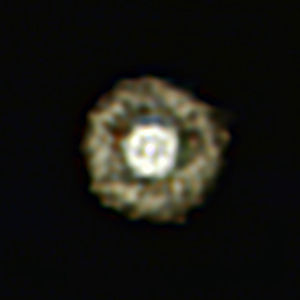 Image of a nebula around a yellow hypergiant IRAS 17163-3907, obtained at Very Large Telescope | |||
| Observational data ( The Age of J2000) | |||
| Right ascension | 17 h 19 m 49.330 s [1] | ||
| Declination | −39 ° 10 ′ 37.94 ″ [1] | ||
| Distance | 3600 - 4700 pc [2] | ||
| Visible magnitude ( V ) | 12.45 [3] | ||
| Constellation | Scorpio | ||
| Astrometry | |||
| Proper motion (μ) | RA: + 4.3 [1] Dec: -; 2,3 [1] | ||
| Absolute magnitude (V) | ~ -; 10 [4] | ||
| Specifications | |||
| Spectral class | Late B / Early A | ||
| physical characteristics | |||
| Radius | 300 - 400 [2] R ☉ | ||
| Temperature | 7500 - 10000 [2] K | ||
| Luminosity | ~ 500000 [2] L ☉ | ||
| |||
| Information in databases | |||
| SIMBAD | data | ||
Content
Opening
The star was discovered and cataloged as a star with emission lines Hen 3-1379 in 1976, [5] then in 2003 it was classified as a protoplanetary nebula after conducting an infrared sky survey at a wavelength of 2.2 microns. [6] In 1989, the star was attributed to the stars of the post- asymptotic branch of giants , assuming a luminosity of about 9600 luminosities of the Sun and a distance of about 1000 pc . [7]
Although IRAS 17163-3907 is one of the brightest sources of infrared radiation at medium wavelengths, but until 2011 there were very few observations of this object, until it was suggested that the object was at a greater distance and, therefore, brighter probably a yellow hypergiant. [four]
Description
The image of this star, according to the results of which the object was called the Fried Egg Nebula, was obtained in the middle of the infrared range on the VISIR instrument of the Very Large Telescope system in the Atacama Desert , northern Chile . Filters transmit radiation with wavelengths of 12810 nm (red in the image), 11850 nm (green) and 8590 nm (blue). [2] The star has a luminosity exceeding the sun 500 thousand times. The resulting image is one of the best shots of yellow hypergiants. Probably, the star will end its existence as a supernova flash. [four]
Shells
The star is characterized by two observable dusty shells. The inner shell has a diameter of 4800 AU. The outer shell has a diameter of 12,000 AU. [2] The source of material for shells is the substance released by a star during flares inherent in hypergiants. The period between the emissions of a substance, creating the first and second outer shells, is estimated at 435 years, the total mass of the emission is about 4 solar masses, and 1% is dust. During periods of greatest activity, the star emits about 1 mass of the Sun of matter every few hundred years. It was found that the shell is rich in silicates and oxygen. A star may have a large number of outer shells, but they were not found when observing a VISIR instrument, because the field of view of the instrument is insufficient. Estimates of the parameters of the outer shells show that they contain about 0.17 solar masses of interstellar dust and were created during a flash about 17000 years ago, as a result of which 6-7 solar masses of gas were ejected. [4] [8]
The shells of a star are similar in properties to shells around IRC + 10420 (also evolved a massive star experiencing a mass loss), [2] as well as to outer shells around bright blue variables , which suggests that IRAS 17163-3907 is at the stage stars “before the NPG”, and the ring-shaped nebula, often surrounding stars of such types, can occur due to the mass loss at the red supergiants stage. [eight]
Notes
- ↑ 1 2 3 4 N .; Zacharias; Urban SE; Zacharias, MI; Wycoff, GL; Hall, DM; Germain, ME; Holdenried, ER; Astrograph Catalog of the Second Naval Observatory CCD Online Astrograph Catalog (UCAC2 ) // CDS / ADC Collection of Electronic Catalogs: journal. - 2003. - Vol. 1289 . - .
- ↑ 1 2 3 4 5 6 7 Lagadec, E .; Zijlstra, AA; Oudmaijer, RD; Verhoelst, T .; Cox, NLJ; Szczerba, R .; Mékarnia, D .; Van Winckel, H. A double detached shell around a post-red supergiant: IRAS 17163-3907, the Fried Egg nebula (Eng.) // Astronomy & Astrophysics: journal. - 2011. - Vol. 534 . - P. L10 . - DOI : 10.1051 / 0004-6361 / 201117521 . - . - arXiv : 1109.5947 .
- ↑ N .; Siódmiak; Meixner, M .; Ueta, T .; Sugerman, BEK; Van De Steene, GC; Szczerba, R. Hubble Space Telescope Snapshot Survey of Post-AGB Objects (eng.) // The Astrophysical Journal: journal. - 2008. - Vol. 677 . - P. 382 . - DOI : 10.1086 / 529115 . - . - arXiv : 0801.4612 .
- ↑ 1 2 3 4 SHJ; Wallström; Muller, S .; Lagadec, E .; Black, JH; Oudmaijer, RD; Justtanont, K .; Van Winckel, H .; Zijlstra, AA Investigating the nature of the Fried Egg nebula. CO mm-line and optical spectroscopy of IRAS 17163-3907 (eng.) // Astronomy & Astrophysics: journal. - 2015. - Vol. 574 . - P. A139 . - DOI : 10.1051 / 0004-6361 / 201321516 . - . - arXiv : 1501.03362v1 .
- ↑ KG; Henize. Observations of southern emission-line stars (English) // Astrophysical Journal Supplement Series. - 1976. - Vol. 30 - P. 491 . - DOI : 10.1086 / 190369 . - .
- ↑ RM; Cutri; Skrutskie, MF; Van Dyk, S .; Beichman, CA; Carpenter, JM; Chester, T .; Cambresy, L .; Evans, T .; Fowler, J .; Gizis, J .; Howard, E .; Huchra, J .; Jarrett, T .; Kopan, EL; Kirkpatrick, JD; Light, RM; Marsh, KA; McCallon, H .; Schneider, S .; Stiening, R .; Sykes, M .; Weinberg, M .; Wheaton, WA; Wheelock, S .; Zacarias, N.VizieR Online Data Catalog: 2MASS All-Sky Catalog Of Point Sources (Cutri + 2003) (Eng.) // VizieR On-line Data Catalog: II / 246. Originally published in: 2003yCat.2246 .... 0C: journal. - 2003. - Vol. 2246 . - .
- ↑ T .; Le Bertre; Heydari-Malayeri, M .; Epchtein, N .; Gouiffes, C .; Perrier, C. Optical and infrared suspected proto-planetary objects (Eng.) // Astronomy and Astrophysics: journal. - 1989. - Vol. 225 . - P. 417 . - .
- ↑ 1 2 Hutsemékers, D .; Cox, NLJ; Vamvatira-Nakou, C. A massive dust ring dust ring nebula around the yellow hypergiant Hen 3-1379 (Eng.) // Astronomy & Astrophysics: journal. - 2013. - Vol. 552 . - P. L6 . - DOI : 10.1051 / 0004-6361 / 201321380 . - . - arXiv : 1303.4292 .