Ferdinand Berto ( fr. Ferdinand Berthoud ; March 18, 1727 - June 20, 1807 ) - French inventor and watchmaker . In 1753 in Paris he received the title of Watchmaker. The watchmaker of the king and the Navy, left behind a vast work, in particular in the field of marine chronometry.
| Ferdinand Berto | |
|---|---|
| Date of Birth | |
| Place of Birth | |
| Date of death | |
| Place of death | |
| A country | |
| Occupation | , , , |
| Awards and prizes | Member of the Royal Society of London ( February 16, 1764 ) |
Biography
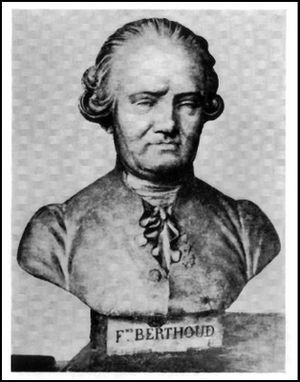
Ferdinand Berto was born on March 18, 1727 in the Swiss valley of Val de Travers, in the canton of Neuchâtel , into a noble family of watchmakers.
His father, Jean Bert, was a master carpenter and architect, as well as a participator of Quavert, a noble bourgeois Neuchâtel, and a judge of Val de Travers (from 1717 to 1732). Judith Bertu's mother (1682-1765) was a native of Kuve.
Ferdinand had four brothers: Abraham (1708-?); Jean-Henri (1710–1790), Judge Val de Traverse, Court Secretary in Verrier, a lawyer in Cressier and an expert watchmaker; Jean-Jacques (1711–1784), draftsman; Pierre (1717-?), A peasant and a watchmaker. In 1741, Pierre married Margaret Borel-Jacquet, with whom he had two sons: Pierre-Louis (1754–1813) and Henri (? - 1783). Their career will be closely linked with the career of Uncle Ferdinand Burt.
Ferdinand had two sisters: Jeanne-Marie (1711-1804) and Susanna-Marie (1729 -?).
In 1741, at the age of fourteen years old, Ferdinand Bertu begins to study watchmaker from his brother Jean-Henri in Kuva and at the same time receives good scientific training. On April 13, 1745, Ferdinand Berto completed his studies and received a certificate of an artisan-watchmaker.
In 1745, at the age of 18, Ferdinand Berto arrived in Paris to improve his skills in watchmaking. He works as an assistant to the Parisian watchmakers. Literary sources sometimes mention information about how he worked in the workshop of Julien Le Roy, where he demonstrated amazing success. Together with him worked the son of his mentor Pierre Leroy (1717-1785), who would later become his main rival.
December 4, 1753 by special order of the monarch and the decision of the Royal Council, contrary to the corporate charter, Ferdinand Bert at the age of 26 officially receives the title of Watchmaster.
Since 1755, Ferdinand Bert is trusted to compile several articles on watch making for the Methodological Encyclopedia published from 1751 to 1772 under the guidance of the philosopher and writer Diderot and the mathematician and philosopher d'Alembert .
In 1759, Ferdinand Bertu publishes his first work entitled “The Art of Using and Adjusting Pendulums and Clocks. For those who have no knowledge in watchmaking ”( L'Art de conduire et de régler les pendules et les montres, à l'usage de ceux qui n'ont aucune connaissance d'horlogerie ) [1] . Others will follow this publication (see Chapter “Works”).
In 1763, Ferdinand Bert on behalf of the king went to London to see the John H. Garrison marine chronometer H4. He is accompanied by Charles Etienne Camus, a mathematician and member of the Royal Society of London, and Joseph Jérôme Lefrançois de Lalande, an astronomer. The trip disappointed Ferdinand Bertha, as Harrison showed him only the H1, H2 and H3 chronometers (having received £ 500 as a reward) and categorically refused to show the notorious H4 chronometer, the most perfect of all.
But if the trip to London did not allow Ferdinand Bert to see the famous H4 Harrison chronometer, then it opened the doors of the London scientific community to him. In view of the significance of his works in the field of watch making, on February 16, 1764, he was elected a "foreign member" of the Royal Society of London .
In 1764, by order of the king and commissioned by the French Academy of Sciences, two members of the academy - Duhamel du Monceau and Abbot Chappe d'Otroche were to experience Ferdinand Bert's sea clock number 3 at sea. The latter himself brought the clock to Brest and was present at the tests conducted on the frigate “ L'Hirondelle ”.
In 1765, Ferdinand Bertu takes a second trip to London to meet with Harrison through the mediation of the Saxon Minister Bruhl . However, Harrison again refused to show him his work, realizing that Bert is able to use his discoveries for the needs of the French fleet. Finally, the English watchmaker Thomas Mudge (1715-1795) - a member of the Commission of Longitude and the inventor of the English lever anchor - agreed to describe the principle of the H4 chronometer to Ferdinand Bert (Harrison demanded a reward of £ 4,000 for such a description, which was truly an astronomical sum) [4] .
On May 7, 1766, Ferdinand Bert sent to Duke Praslin, Minister of the Marine Fleet, Count Choiseul (1712-1785) a memo in which he describes his project to create a marine clock 6 and 8. He asks for the content of 3000 pounds as a reward for his work on the previous sea watches and payment of forthcoming expenses, which, in his opinion, are necessary for the creation of new marine watches using English technology. This memo shows the desire of Ferdinand Bert to get the content and title of the Watchmaker of the King and the Navy, as well as his desire to work on improving the sea clock and determining the longitude at sea. On July 24, 1766, the king approved a memorandum and agreed to finance the project on the creation of a marine watch [5] [6] .
Wishing to make sure that the new watches were perfect, on November 3, 1768, the Duke of Praslin commissioned the navigators, Count de Fleuriou and the priest Pingre, to try out marine chronometers 6 and 8 while traveling on the corvette “ L'Isis ” from Rochefort to Saint-Domingo . The journey lasted ten months, and the chronometer tests were excellent. In 1773, Count de Fleurier published the results of his observations in the paper “Journey by order of the king to test marine chronometers” ( Voyage fait par ordre du roi, pour éprouver les horloges marines ) [7] .
In 1769, Ferdinand Bertu invited his nephew Louis Bertu (1754–1813), a young talented watchmaker, who was to continue his studies in Paris from Kuva (Switzerland). Louis helped him in his work on the marine chronometers, which were intended for the French and Spanish fleets.
On April 1, 1770, as a result of successful tests of marine chronometers 6 and 8, Ferdinand Berto received the position of the Watchmaker of the King and the Navy with an annual salary of 3000 pounds, as well as an order from the King to create 20 marine chronometers.
The work is progressing well, and soon Ferdinand Bert’s chronometers take their place on ships leaving for testing and geographic research at sea.
In 1771, the Chevalier de Borda (1733-1799) under the command of the Marquis Verdun de La Cruin (1741-1805) sailed on the Flora frigate on the Canary Islands and the Antilles to conduct a series of tests of marine chronometers. In 1774 and 1775, these trials continued during expeditions to the Canary Islands and to the coast of Africa under the command of Count Chastenay de Puiségur (corvette " L'Espiègle ") and Chevalier de Bord (" Boussole ").
On August 1, 1785, Ferdinand Bert transmits five chronometers to Count de Laperouse, captain of the Astrolabe frigate, who sets off on an expedition around the world to continue the discovery of James Cook (1728–1779) in the Pacific Ocean. The marine chronometers of this expedition were lost in 1788 during the collapse of the Astrolabe in the open sea near the Santa Cruz Islands (Solomon Islands).
In 1791, Ferdinand Berthe transferred four more marine chronometers of the Chevalier expedition to Joseph de Bruny d'Antrcasto (1737-1793), which was sent by order of King Louis XVI at the head of two frigates ( La Recherche and L'Espérance ) to search for the Laperouse expedition.
In 1795, Ferdinand Bertu was elected a first-class resident member of the Mechanical Arts Division of the Institute of France . During the revolution, Bertu, settling in the Louvre and having state content, continued to work on his watch and monitor the safety of marine chronometers. However, his main concern was the publication of the most significant of his works - “History of determining time by means of clocks” ( Histoire de la mesure du temps par les horloges ) (1802).
On July 17, 1804, Ferdinand Bertu, as a member of the Institute, received from Napoleon the title of Cavalier of the Legion of Honor.
Ferdinand Berto died on June 20, 1807, at the age of 80, leaving no children behind. He was buried in Graulh , in the valley of Montmorency ( Val d'Oise department ), where he was erected a monument.
Work
In 1752, at the age of 25, that is, seven years after his arrival in Paris, Ferdinand Berto proposed his own mathematical pendulum for discussion by the Royal Academy of Sciences , which proved its high skill in watch making. Academicians Charles Étienne Camus and Pierre Bouguer compiled a commendable account of his work.
Ferdinand Berto repeatedly handed over sealed bags to the Royal Academy of Sciences. For example, on November 20, 1754, he presented the project “Machines for measuring time at sea”. This project has never been published. As it turned out, it was the first project of the marine chronometer. The sealed package with the project was opened by the president of the academy only in 1976.
On December 13, 1760, Ferdinand Bertou presented to the Royal Academy of Sciences a “Report on the principles of construction of the Marine Chronometer” (“Mémoire sur les principes de construction d'une Horloge de Marine”). This report described the famous chronometer 1, the creation of which will be completed in early 1761. February 28, 1761 Bertu introduced the supplement. In April 1763, the first chronometer was exhibited at the Royal Academy of Sciences.
In 1754, the Academy of Sciences approved the clock and the mathematical pendulum of Ferdinand Bert.
Ferdinand Berto sought not only to research, but also to publish the results of their research. This double work allowed him to quickly get into the scientific circles of his era. He was entrusted with writing several articles for the Methodological Encyclopedia , published from 1751 to 1772 under the leadership of Diderot (1713–1784) and d’Alembert (1717–1783).
In 1759 Bert published a popularization work, which was a great success: “The art of using and adjusting pendulums and clocks. For those who have no knowledge in watchmaking ”( L'Art de conduire et de régler les pendules et les montres. A l'usage de ceux qui nont aucune connaissance d'horlogerie ). It was followed by a volume work, published in 1763, “An Essay on Watchmaking, in which this art is viewed from the point of view of benefits to citizens, astronomy and navigation” ( L'Essai sur l'horlogerie; dans lequel on traite de cet Art relativement à l 'usage civil, à l'Astronomie et à la Navigation ). This popular science work was also a great success, was translated into several languages and withstood several reprints in the XVIII and XIX centuries.
The year 1763 was a turning point in Bert’s career, from which the progress of maritime navigation depended on. The Paris Academy of Sciences was not only a witness, but also a reliable support in his work. He opened two sealed packages, which were sent to the Academy in 1760 and 1761, and described the marine chronometer 1. On August 29 of the following year, Ferdinand Bert presented another report on the “creation of a marine chronometer”.
His projects are carefully studied and set the rhythm of his activities. On May 7, 1766, he again proposes the creation of two marine chronometers, the so-called chronometers 6 and 8, which are now stored in the Paris Museum of Arts and Crafts. After successful tests of these chronometers, Ferdinand Bertou receives the “Patent of the watchmaker of the King and the Navy, which is entrusted with the inspection of the production of marine watches” (“Brevet d'horloger Méchanicien du Roi et de la Horneges marines”) (1 April 1770).
In 1773, Ferdinand Bertou publishes “A treatise on sea watches, containing the theory, construction and operation of these watches and ways to test them, in order to achieve with their help the refinement of nautical charts and the definition of longitude at sea” ( Traité des horloges marines contenant la théorie, la construction , la carte-d'œuvre de ces machines et la manière de les éprouver, pour parvenir par leur moyen, à la rectification des cartes marines et à la détermination des longitudes en mer ). This treatise for the first time describes everything needed to create marine chronometers. Thus, Bert legitimizes his work on the study of longitude at sea in relation to his rivals: Harrison and Pierre Leroy (1717-1785).
Two years later, in 1775, Ferdinand Bertou publishes a new work: “Longitude by measuring time, or a method for determining longitude at sea using sea watches, as well as tables needed by a pilot to simplify observations associated with longitude and latitude” ( Les longitudes I love you and I love you, I love you and I love you and I love you ? This book was reprinted in 1785.
In 1787, Bertou published the book “On the Measurement of Time, or Addition to the Treatise on a Marine Watch and to an Essay on Watchmaking, containing principles for creating, constructing and testing small hours for determining longitude and applying the same principles for producing pocket or astronomical watches” De la Mesure du Temps ou supplément au traité des horloges marines et de l'Essai sur l'orlogerie, contenant les principé d'exécution, de construction et de l'épreuves des petites hormones é longées de l'application montres de poche, ainsi que plusieurs construction d'horloges astronomiques ). This book will be translated into German in 1798.
In 1792, Ferdinand Bertou publishes "A treatise on watches for determining longitude, containing the design, description and all details of the manufacture of these mechanisms, as well as their dimensions and methods for testing them ..." ( Traité des montres à Longitudes contenant la construction, la description & tous les détails de main-d'œuvre de ces Machines; leurs dimensions, la manière de les éprouver, etc ), in which it proposes to use compensation balance with a spiral spring to achieve better isochronism.
Four years later, in 1796, Bertou publishes the “Continuation of the Treatise on watches for determining longitude, containing: 1. the design of a portable vertical clock; 2. description and testing of small horizontal clocks, smaller and more suitable for use during long voyages ”( Suite du Traité des montres à longitudes, contenant: 1 ° la construction des montres verticales portatives, 2 ° la description et les épreuves des petites horloges horizontales plus simples et portatives pour servir dans les plus longues traversée ).
In 1802, Ferdinand Bertou publishes one of his most significant works - The History of the Definition of Time with a Clock ( Histoire de la mesure du temps par les horloges ). This work confirms his exceptional knowledge and skill in watchmaking.
In 1807, shortly before his death, Bertou published his latest work: “Supplement to the treatise on clocks for determining longitude with an appendix containing indications of basic research and work done by Ferdinand Bert from 1752 to 1807 with various parts of the mechanisms for determining time” ( Supplément au Traité des montres â Longitudes avec appendice contenant la notice de indication of the principals recherches of the travaux parite Fer par Fer in th Fer Fer th th th . This book will be reprinted twice: in 1816 and in 1838.
A passionate experimenter, a talented and courageous designer, inventor and distributor of knowledge, Ferdinand Bertu not only participated in the improvement of watchmaking, but also promoted the use of accurate clocks in science, contributing to the development of progress. He was the only watchmaker who published all the results of his research, describing them in the most methodical and detailed way. Gifted with the talents of an engineer and a scientist, endowed with an amazing performance, Ferdinand Bertu performed the largest number of experiments among all the watchmakers of his time.
Ferdinand Berto was exceptionally fruitful and left behind many inventions in the field of marine chronometers, pocket and wall clocks, specialized and measuring instruments. He published dozens of works, including about 4,000 printed pages and 120 engravings.
Titles, privileges and other symbols of recognition, which marked his long career, which lasted from the reign of Louis XV to the era of the First Empire, as well as the attention that our contemporaries give him, reflect the importance of this master in the development of measurement accuracy.
- Exhibitions
The exhibition “Ferdinand Bertou, the King’s Watchmaker” was held in 1984 at the International Museum of Watchmaking in La Chaux-de-Fonds , and then in Paris, at the National Maritime Museum (from January 17 to March 17, 1985).
Ferdinand Bert products are constantly exhibited in various museums around the world, in particular, in the French Conservatory of Arts and Crafts, in the Swiss International Museum of Watchmaking and in the British Museum.
Notes
- ↑ 1 2 BNF ID : 2011 open data platform .
- ↑ 1 2 Committee of historical and scientific works - 1834.
- ↑ Encyclopædia Britannica
- ↑ Paris, National Archives, Marine G 98, Fol. eleven.
- ↑ Paris, National Archives, Marine B 3 571, Fol. 273-274.
- ↑ Paris, National Archives, Marine G 97, Fol. 10-13.
- ↑ Paris, National Archives, Marine G 97, Fol. 11-13.