Totoaba [2] ( lat. Totoaba macdonaldi ) is a species of marine ray-finned fish , the only one of the genus Totoaba and the largest representative of the family of croaker . It lives in the waters of the USA and Mexico , in the Gulf of California . By-catch when fishing for totoabs is one of the reasons for the reduction in the number of California guinea pigs . Included in various "red" books and lists of threatened species [3] [4] [5] .
| Totoaba |
|
| Scientific classification |
|---|
| No rank : | Bilateral symmetrical |
| Gender: | Totoaba Villamar, 1980 |
|
| International scientific name |
|---|
Totoaba macdonaldi ( Gilbert , 1890 ) |
| Synonyms |
|---|
- Cynoscion macdonaldi
Gilbert, 1890 [1]
|
| Security status |
|---|
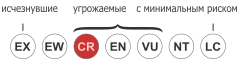
Endangered SpeciesIUCN 3.1 Critically Endangered : 22003 |
|
Totoaba can grow up to a weight of 100 kg and a length of 2 m. These fish live up to 15 years, and reach puberty no earlier than 6-7. The basis of nutrition is other fish and small crustaceans.
Since the 1920s, fishing has been practiced, reaching significant sizes in the mid-1940s, but declining by the 1970s. Then there were catch bans in connection with the environmental efforts of governments. Since 1975, it has not been conducted. Fish have recently been bred on fish farms.
In China, Totoba swimming bladder is considered a delicacy, and is also used as a therapeutic agent of traditional (unscientific) medicine. The meat is used to make soups. Due to high bubble prices, illegal fishing of this fish takes place.