Montanoceratops [2] ( Latin Montanoceratops ) is a genus of herbivorous dinosaurs from the family Leptoceratopsidae , known for a number of fossils from Upper Cretaceous sediments ( Maastrichtian tier ) of North America [3] .
| † montaceratops | |||||||||||||||||||||||||||||||||||||||||||||||
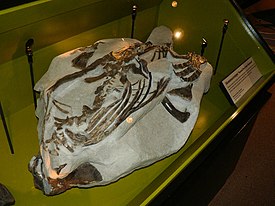 Instance at the Canadian Museum of Nature | |||||||||||||||||||||||||||||||||||||||||||||||
| Scientific classification | |||||||||||||||||||||||||||||||||||||||||||||||
|---|---|---|---|---|---|---|---|---|---|---|---|---|---|---|---|---|---|---|---|---|---|---|---|---|---|---|---|---|---|---|---|---|---|---|---|---|---|---|---|---|---|---|---|---|---|---|---|
| |||||||||||||||||||||||||||||||||||||||||||||||
| International scientific name | |||||||||||||||||||||||||||||||||||||||||||||||
Montanoceratops Sternberg , 1951 | |||||||||||||||||||||||||||||||||||||||||||||||
| Single species | |||||||||||||||||||||||||||||||||||||||||||||||
† Montanoceratops cerorhynchus
| |||||||||||||||||||||||||||||||||||||||||||||||
| Geochronology 70—68 Ma
◄ Nowadays◄ Cretaceous-Paleogene extinction◄ Triassic extinction◄ Perm mass extinction◄ Devonian extinction◄ Ordovician-Silurian extinction◄ Cambrian explosion | |||||||||||||||||||||||||||||||||||||||||||||||
Content
Study History
The first fossils of Montanoceratops were discovered in 1916 by Barnum Brown and during the excavation of on the reservation territory of the Blackfoot Indians . After reconstruction in 1935, in 1942, they named the find Leptoceratops cerorhynchus , reckoning the fossil to the genus Leptoceratops discovered in 1914 by Brown. Description scientists have published in the [4] . During the preparation, the researchers made a mistake and placed a part of the zygomatic bone on the nose, taking it as a horn, the specific name of cerorhynchus - “with a horn on the nose” - relates to their error [5] .
In 1951, Charles Sternberg discovered three almost complete skeletons of leptoceratops, and, based on the differences in structure, established that L. cerorhynus is not leptoceratops, and isolated it into a separate genus, Montanoceratops . The name consisted of three bases: 'Montana', referring to the name of the place where the remains were found (in the state of Montana ); 'κερας', which means "horn"; 'ωψ', which means "muzzle" [6] .
In 1986, David Weizhempel found some material, described in 1998 as an instance of montanoceratops [7] . Three years later, Peter Mackowitzky described part of the skull of Montanoceratops, discovered by Brown as early as 1910 [8] , and in 2010 a description of a number of specimens of this genus of dinosaurs updated by the same scientist [9] was published.
Description
The anatomy and appearance of montanoceratops is judged by a number of incomplete skeletons and elements of the skull [9] .
The body length of montanoceratops, according to , was 2.5 m and weight 170 kg [10] .
The caudal vertebrae have extremely high spinous processes [11] , possibly supporting a low sail [10] . The spinal ones carry similar outgrowths of much smaller sizes, but the diapophysis and parapophyses — the formations on the body of the vertebra — on the sixth, seventh and eighth vertebrae are very strong and heavy [11] . The ribs are strongly curved, wide, especially those that are attached to the fourth spinal vertebra [11] .
The fingers of a rather short front paws are long, topped with claws, but not hooves, unlike the hind limbs [12] . The femoral neck is thick and the head is massive. The bones of the leg are atypically large [11] .
The pelvis is flattened, but long; the ischium is elongated, with a curvature acquired due to cohesion with the pubic bone . The shape of the surface of the Ilium is similar to a bow, about the middle of the curved shaft is a depression, which included the head of the thigh [13] .
Skull
The skull of the montanoceratops is very large, high and wide due to the length of the processes of the zygomatic bones , but at the same time it is short, with a rather poorly developed bone collar formed by the bones of the crown and the back of the head . The surface of the skull is relief, many cones and knots, but no horns [12] .
Nostrils are round, not very large and set high. The orbits are shaded by overhanging, ossified eyelids. The infraorbital and supraorbital windows are hypertrophied, the preorbital ones are more modest in size [14] .
Among the distinctive features of the structure of the skull of montanoceratops, researchers note large nasal bone with a formation that in later ceratops was responsible for supporting the horn [15] .
The lower jaw is long and low. It is distinguished by an atypically straight lower edge, which lacks a chin that is typical of other members of the family; the front of the lower jaw is higher than the back. The narrow coronary process is directed vertically [16] .
The teeth of the mandible are narrow, high and strongly curved, with a double facet of wear [17] . They have small notches [18] .
Systematics
According to popular belief montanotseratops belongs to Leptoceratopsidae family where a nursing taxon kind Ischioceratops [19] or Koreaceratops [20] , and takes in conjunction with one of these two genera place sister group to clade consisting of Udanoceratops , Leptoceratops , Zhuchengceratops , Unescoceratops and Gryphoceratops [19] .
Until 2001, the genus was considered a representative of the protoceratopsid family, where most of the primitive horned dinosaurs were placed [9] . Such a viewpoint is still encountered [12] .
The cladogram on the work of He and colleagues in 2015 [19] :
| Leptoceratopsidae |
| ||||||||||||||||||||||||||||||||||||||||||||||||||||||
Paleobiology and paleoecology
All ceratops, among which montanoceratops, were herbivorous . They fed on leaves and shoots, cutting them off with a sharp beak, then pushing them into the mouth with the tongue [12] .
According to the first study of the remains of this genus of dinosaurs, on the caudal vertebrae of the type specimen were traces of ankylosis [11] . Montanoceratops had dental problems, in particular, the teeth notches erased [18] .
The remains of montanoceratops were found in sediments of the formations of the St. Mary-River and Horseshoe Canyon formations, their age is about 70 Ma [21] . The younger remains of the ceratops (about 68 million years old) from identified in 2011 also as montanoceratops [22] .
In the habitats of montanoceratops marsupial and placental mammals were common. The rivers were inhabited by fish, frogs, turtles, crocodiles and Humpsosaurs [21] .
The dominant position in the region was occupied by predatory tyrannosaurus daspletosaurus and albertosaurus , while small predators, in particular troodontids and dromaeosaurids , fed on smaller game. Large and small herbivorous dinosaurs from the groups of ankylosaurids , marginocephals , ornitopods and omnivorous representatives of the mani-raptors served them as food [21] .
Notes
- ↑ † Montanoceratops cerorhynchus (English) information on the Fossilworks website. (Checked November 26, 2017) .
- ↑ Dixon D. Dinosaurs. Visual Encyclopedia / Per. N. Mironova. - M .: Eskmo, 2013. - p. 232. - 256 p. - ISBN 978-5-699-50460-2 .
- ↑ Brown, Schlaikijer, 1942 , Introduction.
- ↑ Brown, Schlaikijer, 1942 , Introduction.
- ↑ Holtz, 2007 , p. 50.
- ↑ Sternberg, 1951 , p. 226.
- ↑ Chinnery, Weishampel, 1998 , Introduction.
- ↑ Makovicky, 2001 , Introduction.
- ↑ 1 2 3 Makovicky, 2010 , p. 68
- ↑ 1 2 Paul, 2016 , p. 280.
- ↑ 1 2 3 4 5 Brown, Schlaikijer, 1942 , Description, p. eight.
- ↑ 1 2 3 4 Paul, 2016 , p. 276.
- ↑ He et al., 2015 , Diagnosis.
- ↑ Hailu, Dodson, 2004 , p. 483.
- ↑ Brown, Schlaikijer, 1942 , Introduction, p. one.
- ↑ Ryan et al., 2011 .
- ↑ Chinnery et al., 1997 , Description and Comparison.
- ↑ 1 2 Morschhauser, Lamanna, 2013 , p. 253.
- ↑ 1 2 3 He et al., 2015 , Phylogenetic Analysis.
- ↑ Han et al., 2015 , Phylogenetic Analysis.
- ↑ 1 2 3 Hailu, Dodson, 2004 , p. 577-578.
- ↑ Ryan et al., 2011 , Figure 3.
Literature
- Brown B., Schlaikjer EM The skeleton of Leptoceratops with the description of a new species (English) // American Museum Novitates: Journal. - New York: American Museum of Natural History, 1942. - No. 1169 . - P. 1-15 .
- Sternberg C. Complete Redwoods Leoptoceratops Grace Brown from the Upper Edmonton Member on the Red Deer River, Alberta (Eng.) // National Museum of Canada Bulletin: Journal. - National Museum of Canada, 1951. - Vol. 123 . - P. 225-255 .
- Holtz T. Dinosaurs for All Ages / Rey LV - First Printing edition. - Random House Books for Young Readers, 2007. - P. 50 (PDF). - 432 p. - ISBN 978-0375824197 .
- Chinnery BJ, Weishampel DB Montanoceratops cerorhynchus (Dinosauria: Ceratopsia) and relationships among basal neoceratopsians (Eng.) // Journal of Vertebrate Paleontology : Journal. - The Society of Vertebrate Paleontology, 1998. - September 15 ( vol. 18 , no. 3 ). P. 569-585 . - DOI : 10.1080 / 02724634.1998.10011085 .
- Makovicky PJ A Montanoceratops cerorhynchus (Dinosauria: Ceratopsia) braincase from the Horseshoe Canyon Formation of Alberta (Eng.) // Tanke DH, Carpenter K., Skrepnick MW (eds.) Mezozoic Vertebrae Life: collection of articles. - Bloomington: Indiana University Press, 2001. - 18 June. - P. 243-262 . - ISBN 9780253339072 .
- Makovicky PJ A redescription of Montanoceratops cerorhynchus holotype with a review of the referred material (eng.) // Ryan MJ, Chinnery-Allgeier BJ, Eberth DA (eds.) New York Times for the Royal Tyrrell Museum Ceratopsian Symposium: a collection of articles. - Bloomington: Indiana University Press, 2010. - p . 68-82 . - ISBN 9780253353580 .
- Hailu Y., Dodson P. Basal Ceratopsia // The Dinosauria . - 2nd ed. - University of California Press, 2004. - p. 478-493. - 861 p. - ISBN 9780520941434 .
- Paul GS Protoceratopsids // The Princeton field guide to dinosaurs . - 2nd ed. - Princeton University Press, 2016. - p. 276, 280-281. - 360 p. - (Princeton Field Guides). - ISBN 9781400883141 .
- He Y., Makovicky PJ, Wang K., Chen S., Sullivan C., Han F. ONE: Journal / AA Farke, M. Raymond (eds.). - PLoS, 2015. - 23 December ( vol. 10 , iss. 12 ). - P. e0144148 . - DOI : 10.1371 / journal.pone.0144148 . - PMID 4689537 .
- Ryan MJ, Evans DC, Currie PJ, Brown CM, Brinkman D. New leptoceratopsids from the Upper Cretaceous of Alberta, Canada (Eng.) // Cretaceous Research: Journal. - Elsevier , 2011. - 1 December ( vol. 35 ). - P. 69-80 . - DOI : 10.1016 / j.cretres.2011.11.018 .
- Chinnery BJ, Lipka TR, Kirkland JI, Parrish JM, Brett-Surman MK Neoceratopsian teeth from the North America (English) // Lucas SG, Kirkland JI, Estep JW (eds.) Lower and Middle Cretaceous Terrestrial Ecosystems: a collection of articles. - New Mexico Museum of Natural History and Science Bulletin, 1997. - Vol. 14 - P. 297-302 .
- Morschhauser EM, Lamanna MC A Reevaluation of the Granger and Gregory 1923 and the hygiene bones of Protoceratops andrewsi (Ornithischia: Ceratopsia) and a review of the hyoid elements in ornithischian dinosaurs (eng.) // Annals of Carnegie Museum: Journal. - Pittsburgh: Carnegie Museum, 2013. - 5 January ( vol. 81 ). - P. 247-255 . - DOI : 10.2992 / 007.081.0404 .
- Han F., Forster CA, Clark JM, Xu X. A New Taxon of the Understanding of Ceratopsia (Eng.) // PLoS ONE: Journal / M. Shawkey (ed.). - PLoS, 2015. - 9 December ( vol. 10 , iss. 12 ). - P. e0143369 . - DOI : 10.1371 / journal.pone.0143369 . - PMID 26649770 .
Links
- Montanoceratops cerorhynchus Neopr . prehistoric-wildlife.com .