Narkomedusa ( Latin Narcomedusae ) - a detachment of marine streaking from the class hydroid ( Hydrozoa ). All representatives in the life cycle have no polyp stage [1] . Distributed mainly in the open sea at great depths, but some representatives can be found near the coast, as well as in seas with low salinity [3] [4] . The detachment has about 40 species [1] .
| People's Commissariat | |||||||||||||||||
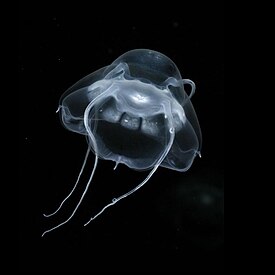 Bathykorus bouilloni (Aeginidae) | |||||||||||||||||
| Scientific classification | |||||||||||||||||
|---|---|---|---|---|---|---|---|---|---|---|---|---|---|---|---|---|---|
| |||||||||||||||||
| International Scientific Name | |||||||||||||||||
Narcomedusae Haeckel , 1879 [1] | |||||||||||||||||
| Families [1] [2] | |||||||||||||||||
| |||||||||||||||||
Content
Jellyfish
Typical adult drug abusers have a lenticular form and a relatively well-developed mesoglue [3] [5] . A characteristic appearance is given to them by a rim of primary tentacles , displaced some distance from the edge of the umbrella to its outer surface [3] [5] . The number of these tentacles is relatively small (no more than 16) [4] . On the lapis (blades formed by the dissected edge of the umbrella) are mace- shaped sensory organs with statocystas , and in some representatives also miniature secondary tentacles [6] .
Another characteristic feature of narcoticus is a modification of the structure of the digestive system. Their very short, wide manubirium (oral proboscis) is spread over the inner surface of the umbrella, its lumen is combined with an extensive cavity of the stomach [3] [6] . Most representatives of the edge of the stomach form outgrowths to the edge of the umbrella - gastric pockets ( eng. Manubrial pouches ). Radial intestinal channels are absent [6] . Sometimes the gastric pockets are connected by a peripheral channel passing along the edge of the umbrella [3] [6] . The sex glands are associated with the stomach or the stomach pockets [3] .
Life cycle
In most cases, the larvae lead a free lifestyle in plankton. In contrast to the majority of those who shoot, in which the axis of symmetry of the larva corresponds to the axis of symmetry of the adult organism, during the development of the narco-jedus a 90 ° rotation takes place: the tentacles develop larvae on the side [1] . For some species, early development of larvae in the cavity of the maternal individual has been described [7] .
Parasitic forms
Some representatives of the Cunina ( Cuninidae ) and Pegantha ( Solmarisidae ) genera lead a parasitic lifestyle at certain stages of the life cycle [8] . Among their hosts, scyphoid and hydroid jellyfish ( Anthomedusae , Leptomedusae , Trachymedusae and other Narcomedusae ) are described [9] . During infection, the larva settles on the surface of the host's proboscis and undergoes a metamorphosis, during which it forms a long proboscis and a pair of tentacles [7] . To get food, such a parasitic larva immerses the proboscis in the host's digestive system. At the opposite end of the body, a stolon is subsequently formed, on which subsidiary jellyfish or second-generation parasitic larvae are formed by budding, which are parasitized in the cavity of the host's stomach [7] . The first generation larvae are also able to separate from the host and turn into jellyfish [7] .
In addition to jellyfish, polychaete worms, fish and copepods are described as hosts for narcoticus [8] [9] .
Taxonomy
Aeginidae
The family has less than ten species, united by six genera [10] . Gastric pockets are located in the interradius between the axes, along which the primary tentacles are located [1] . This orientation of the gastric pockets, together with molecular biology data, indicates that Aeginidae is a paraphyletic taxon in relation to the family Tetraplatiidae [1] .
Csiromedusidae
The only species, Csiromedusa medeopolis , was described in 2010 in the waters of Tasmania [11] [12] . They have two corolla tentacles and unusual outgrowths on the top of the umbrella ( eng. Sky-scraper-like structures ), which were interpreted as the sex glands [12] .
Cuninidae
About 20 species, combined in 4 genera [1] [13] . Gastric pockets are located perradially - on the same axis as the tentacles (the number of tentacles and pockets are equal) [1] .
Solmarisidae
About 10 species in 2 genera ( Pegantha and Solmaris ) [1] [14] . The stomach does not form pockets [1] .
Tetraplatiidae
Currently, two species of Tetraplatiidae are known : Tetraplatia volitans and Tetraplatia chuni [1] [15] . Miniature pelagic organisms 1–10 mm long, with a highly modified structure [16] . Unlike other narcotuses, they are devoid of tentacles and an umbrella; they have a worm-like body subdivided by a transverse furrow into the oral and aboral parts [16] . In the transverse groove four lobes are located radially symmetrically, which Tetraplatia use for swimming [16] .
Notes
- ↑ 1 2 3 4 5 6 7 8 9 10 11 12 Daly, M., Brugler, MR, Cartwright, P., Collins, AG, Dawson, MN, Fautin, DG, France, SC, McFadden, CS, Opresko, DM , Rodrigues, E., Romanos, SL, Stakes, JL (2007). The phylum Cnidaria: A review of phylogenetic patterns and diversity 300 years after Linnaeus, 127–182. In: Zhang, Z.-Q., Shear, WA (eds.) (2007). Linnaeus Tercentenary: Progress in Invertebrate Taxonomy. Zootaxa 1668 : 1–766. Text (English) (Verified March 15, 2011)
- ↑ Detachment Narcomedusae (English) in the World Register of Marine Species . (eng.) (checked March 15, 2011)
- ↑ 1 2 3 4 5 6 Information on drug addicts on the website of the Geneva Museum of Natural History (English) (Tested on March 15, 2011)
- ↑ 1 2 Naumov D.V. Hydroids and hydro-mussels. M. —L .: Academy of Sciences of the USSR, 1960 - 626 p.
- ↑ 1 2 Ruppert E.E., Fox R.S., Barnes R.D. Protists and lower multicellular // Invertebrate Zoology. Functional and evolutionary aspects = Invertebrate Zoology: A Functional Evolutionary Approach / Per. from English T. A. Ganf, N. V. Lentsman, E. V. Sabaneyeva; by ed. A. A. Dobrovolsky and A. I. Granovich. - 7th edition. - M .: Academy, 2008. - T. 1. - p. 312-313. - 496 s. - 3000 copies - ISBN 978-5-7695-3493-5 .
- ↑ 1 2 3 4 Russell, FS (1981). Narcomedusae. Fiches d'identification du zooplancton 166 : 1–5. Text (English) (Verified March 15, 2011)
- ↑ 1 2 3 4 Ivanova-Kazas O. M. Comparative Embryology of Invertebrates. The simplest and lower multicellular. - M .: Science, 1975. - 217 p. - p. 164-167.
- ↑ 1 2 Bouillon, J., Boero, F. (2000). Synopsis of the World and the Hydromedusae of the World, with a list of the worldwide species. Thalassia Salentina 24 : 47–296. Text (English) (Verified March 16, 2011)
- ↑ 1 2 Ohtsuka, S., Koike, K., Lindsay, D., Nishikawa, D., Miyake, H., Kawahara, M., Mulyadi, Mujiono, N., Hiromi, J., Komatsu, H. ( 2009). Symbionts of marine medusae and ctenophores. Plankton Benthos Research 4 (1): 1–13. Text (English) (Verified March 16, 2011)
- ↑ Family Aeginidae (English) in the World Register of Marine Species . (eng.) (checked March 15, 2011)
- Family Csiromedusidae (English) in the World Register of Marine Species . (eng.) (checked March 15, 2011)
- ↑ 1 2 Gershwin, LA, Zeidler, W. (2010). Csiromedusa medeopolis : a remarkable Tasmanian medusa (Cnidaria: Hydrozoa: Narcomedusae) composed of a new family, genus and species. Zootaxa 2439 : 24–34. Abstract (English) (Verified March 15, 2011)
- Family Cuninidae (English) in the World Register of Marine Species . (eng.) (checked March 15, 2011)
- ↑ Family Solmarisidae (English) in the World Register of Marine Species . (eng.) (checked March 15, 2011)
- ↑ Family Tetraplatiidae (English) in the World Register of Marine Species . (eng.) (checked March 15, 2011)
- 2 1 2 3 Collins, AG, Bentlage, B., Matsumoto, GI, Haddock, SHD, Osborn, KJ, Schierwater, B. (2006). Solution to the phylogenetic enigma of Tetraplatia , a worm-shaped cnidarian. Biological Letters 2 : 120–124. Text Archive dated January 11, 2011 on Wayback Machine (English) (Retrieved March 15, 2011)
Links
- Information about drug addicts on the site ville-ge.ch (English) (Checked March 15, 2011)
- Photo of Tetraplatia volitans on ville-ge.ch (Eng.) (Tested on March 15, 2011)
- Photo of Csiromedusa medeopolis on blogspot.com (English) (Tested on March 15, 2011)