Apollo 9 ( English Apollo 9 ) - a manned spacecraft that completed the first test flight in full configuration (command and lunar modules), during the preparation of expeditions to the moon .
| Apollo 9 | |
|---|---|
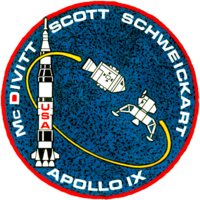 | |
| General information | |
| Organization | |
| Ship flight data | |
| Ship name | Apollo 9 |
| Launch vehicle | Saturn-5 AS-504 |
| Launch pad |  Cape Canaveral , Complex 39-A Cape Canaveral , Complex 39-A |
| Launch | March 3, 1969 16:00:00 UTC |
| Ship landing | March 13, 1969 17:58:54 UTC |
| Landing place | Atlantic Ocean , |
| Flight duration | 10 days 01 hour 00 minutes 54 seconds |
| Number of turns | 151 |
| Apogee | 229 km |
| Perigee | 203 km |
| Mood | 32.57 ° |
| Circulation period | 88.64 min |
| Weight | 26801 kg |
| NSSDC ID | 1969-018A |
| SCN | 03769 |
| Crew flight data | |
| Crew members | 3 |
| Call sign | Hamdrop (Sweetie) / Spider (Spider) |
| Crew photo | |
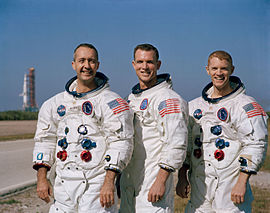 from left to right: James McDivitt, David Scott, Russell Schweikart | |
| Associated Expeditions | |
Content
- 1 crew
- 2 General information
- 3 Mission Tasks
- 4 Prelaunch and start
- 5 Rebuilding compartments
- 6 The first three days of flight
- 7 Fourth day of flight
- 8 Fifth day of flight
- 9 Sixth-tenth day of flight
- 10 Landing
- 11 Some results of the flight
- 12 Source
- 13 See also
- 14 References
Crew
- Commander - James McDivitt
- Command Module Pilot - David Scott
- Lunar Module Pilot - Russell Schweikart
General information
- The ship included a command module (sample 104) and a lunar module (sample LM-3).
- Starting from this Apollo flight, astronauts assigned the command module and the lunar module the names that served as the call signs. For the command module, the astronauts chose the call sign "Gamdrop" ( en: Gumdrop , which can be translated as "Sweetie" or "Marmalade"), for the lunar module - "Spider" (" Spider ").
- The mass of the ship is 36.5 tons.
- To launch, the Saturn-5 rocket was used (sample SA-504).
- The purpose of the flight is a comprehensive test of the ship in a geocentric orbit.
Flight Tasks
The maximum possible simulation of operating modes and flight conditions provided for by the standard program for flying to the moon. Rebuilding the compartments of the ship. Undocking of the lunar and main modules. Autonomous flight of the lunar module. Separation of the take-off stage of the lunar module from the landing stage and docking of the take-off stage with the command module. Conducting an experiment on moving through outer space from the lunar module to the main one after docking in order to simulate the emergency return of astronauts from the lunar module in the event of a failed docking, as well as testing the lunar spacesuits in vacuum .
The flight program was completed almost completely (due to Schwykart's malaise, they refused the experiment on the transition). During the flight, a number of operations involving high risk were carried out, in particular, the first independent flight of a manned spacecraft incapable of landing on Earth.
Prelaunch and start
Initially, the launch of the ship was scheduled for February 28, 1969, but due to the illness of the astronauts was postponed to March 3. The decision on the postponement was made on February 26, when all three astronauts of the main crew took on a serious character previously observed colds. The main cause of the crew’s astronaut’s disease is the general weakening of the body due to a very intense pre-flight training program (up to 18 hours a day). By February 28, astronauts felt better and resumed training. The delay in launching led to additional costs in the amount of 500 thousand dollars .
When the decision was made to postpone, the Saturn-5 rocket with the ship was in a state of 16-hour readiness. After the resumption, the preparation went fine, and at the estimated time on March 3, 1969 at 16:00 GMT the Apollo 9 ship started. The ship, according to ground-based means of trajectory measurements, was put into a geocentric orbit close to the calculated one, but the on-board computer indicated incorrect data. Incorrect calculations of the on-board computer indicated its possible malfunction, which would hinder the implementation of many of the intended flight tasks. Later it turned out that the computer was working, but incorrect error correction data was entered into it. After entering new data on amendments, the computer began to provide the required accuracy of calculations.
Rebuilding Compartments
After the last stage of the launch vehicle with the ship entered geocentric orbit, the crew checked the on-board systems for about two hours, simulated the transition to the flight path to the moon and prepared for a maneuver to rebuild the compartments.
At 2 hours and 30 minutes of flight time, the command module separated from the last stage of the launch vehicle, moved 15 meters from it and turned 180 degrees (this did not work out right away). For about 15 minutes, the main unit made a group flight with a stage, astronauts photographed the lunar module installed on the stage.
At 3 hours 02 minutes 08 seconds of flight time, Scott ensured the docking of the command module with the lunar on the first attempt. Laz tunnels were filled with oxygen . Scott opened the hatch and made sure that the grips of the docking unit were triggered correctly, and then connected the electrical circuits of the main and lunar modules.
At 4 hours 18 minutes 05 seconds of flight time, the pyro-bolts connecting the lunar module and the last stage of the launch vehicle were blown up, and the spring pusher triggered the separation of the ship from the stage.
The crew, using the auxiliary engines of the ship, took the ship to a safe distance from the stage, which, after turning on the engines, entered the heliocentric orbit upon command from the Earth.
The first three days of the flight
At the sixth hour of the flight, the main engine of the main unit was turned on for five seconds. With this inclusion, the stability of the docking unit to vibration and acceleration was checked. After the maneuver, the astronauts put the ship into " drift " and switched the on-board systems to the power saving mode. At the tenth hour of the flight, the rest period began.
On the second day of the flight, several more starts of the main engine of the main unit were made to test the stability of the docking unit and check the manual engine thrust vector control system.
At the fortieth hour of the flight, Schweikart was supposed to begin dismantling the docking station and go to the lunar module, where McDivitt was to join him. These operations were started much later, due to the fact that Schweikart felt unwell. McDivitt asked to provide him with the opportunity to negotiate with the medical director of the flight on a “closed” channel (as a rule, negotiations with astronauts during flights under the Apollo program were conducted through an open communication line, immediately became available to the press and could be transmitted in real time at any time time scale to a commercial radio network). McDivitt reported on the attack of vomiting at Schweikart and the delay caused by this, and also asked to revise the schedule of operations. Scott, instead of Schweikart, dismantled the docking station and provided oxygen to the crew compartment in the take-off stage of the lunar module.
Schweikart felt better and after about an hour was late he began the transition to the lunar module. In ground training, the transition took about 10 minutes, in real conditions, Schweikart took 90 minutes, possibly because he did not fully recover from the attack.
After about an hour, McDivitt joined Schweikart, who was in the crew compartment of the lunar module. The astronauts turned on the on-board power supplies, checked the module equipment and gave the command to deploy the chassis of the lunar module.
At 46 hours 29 minutes of flight time, the first television show began aboard, which lasted about seven minutes. Astronauts showed the crew compartment of the lunar module and each other. Image quality was satisfactory. Due to malfunctions at the ground receiving station, McDivitt's speech during the session was received with distortion. Schweikart was silent for the entire session.
At the fiftieth hour of the flight, the engine of the lunar module landing stage engine was scheduled to be switched on, and astronauts throttled the engine thrust manually. After turning off the engine, the astronauts de-energized the onboard systems of the lunar module and returned to the crew compartment of the main module.
At 54 hours 25 minutes of flight time, the command module engine was turned on, which worked for about forty-three seconds and put the ship into orbit with a perigee height of 229 kilometers and an apogee height of 239 kilometers - an orbit close to the calculated initial one for the autonomous flight of the lunar module, scheduled for the fifth day.
Fourth day of flight
On the fourth day of the flight, Schweikart was scheduled to go into outer space . The day before, when Schweikart had two bouts of vomiting, McDivitt decided to abandon the exit experiment and confine himself to depressurization of the lunar module crew compartment and opening the hatch, and Schweikart during this period had to use an autonomous life support system designed to access the surface of the moon. This decision was agreed with the flight leaders. However, after a period of sleep, by the beginning of the fourth day of flight, Schwykart became better, and McDivitt requested permission for Schwykart to go out into outer space for one day into the area in front of the hatch, but without subsequent passage through the ship’s hull to the crew compartment of the command module and vice versa initial program. Scott had to carry out operations to depressurize the crew compartment of the command module, opening the hatch and others in accordance with the initial program.
At the seventieth hour of the flight, Schwykart and McDivitt moved to the lunar module. Schweikart put on a backpack autonomous life-support system and switched the spacesuit to powered by this system.
At the seventy-third hour of flight, the crew compartments of the lunar and command modules were depressurized, at 73 hours 03 minutes of flight time, astronauts opened the hatches of both compartments. Two minutes later, Schweikart put a frame with a protective visor on his helmet, attached a halyard, and after another two minutes he began to get out of the moon module hatch (with his feet forward) and at 73 hours 08 minutes of flight time he was already standing on the landing in front of the hatch, his legs fixed in latches. Scott through the open hatch of the crew module crew module photographed Schweikart during the exit. Schweikart, in turn, photographed the ship and Scott, leaning out of the hatch. Schweikart refused television shooting in outer space, as provided for by the initial program, because he did not have time for preparatory operations with a television camera.
As Schwykart reported that he was doing well, McDivitt asked flight managers for permission to extend Schweikart's time in outer space to about two hours. The flight managers did not give such permission, citing the fact that the extension will force to shorten the rest period, and it is especially necessary for astronauts before the most important experiment planned for the fifth day of flight - an autonomous flight of the lunar module.
Schweikart tested the handrails, holding on to which, according to the original program, he had to move to the crew compartment of the command module. Schweikart reported that the handrails allow you to control the position of the body in zero gravity . At 73 hours 46 minutes of flight time, Schwykart, on the orders of McDivitt, began returning to the lunar module.
The Schweikart exit lasted 47 minutes (counting from opening to closing the hatch). The radio system in the satchel provided a reliable connection between Schweikart and the Earth (the ship’s radio system was used for relaying). The tests of the spacesuit and the knapsack system were successful, although it should be noted that Schweikart did not perform operations requiring high energy costs.
Upon completion of spacewalk, both crew compartments were filled with oxygen . McDivitt and Schweikart conducted a television session from the lunar module lasting about thirteen minutes. Astronauts showed the control panel, the equipment of the lunar module, the process of eating. In addition, through the portholes of the lunar module, astronauts showed the Earth, the command module (while in the porthole of the command module his pilot - Scott was visible), the landing gear of the lunar module. Image quality was significantly better than in the first session.
After the session, Schweikart and McDivitt de-energized the onboard systems of the lunar module and returned to the command module.
According to telemetry, it turned out that the astronauts apparently forgot to de-energize the two systems in the lunar module. Flight leaders ordered one of the astronauts to return to the lunar module and check this. Astronauts initially refused, stating that it would take at least 30 minutes, which would shorten an already short rest before a responsible experiment on the fifth day of the flight. The flight leaders insisted, and Schweikart made the transition to the lunar module and back to check the systems. The entire operation took 11 minutes.
Fifth day of flight
At the eighty-ninth hour of the flight, Schwykart and McDivitt moved to the lunar module, and Scott, who remained in the command module, installed the receiving cone and the docking pin. When undocking, some difficulties were observed. As it turned out, Scott did not sharply throw the toggle switch to the "separation" position. The separation occurred at the fifty-ninth turn, at the ninety-third hour of flight. The command module moved about fifteen meters from the lunar module, after which McDivitt began to slowly rotate the lunar module in different axes, so that Scott could visually inspect the module in different planes. Later, for the same purpose, Scott turned the command module. Scott and Schweikart took photographs. Astronauts saw each other through the windows.
At 93 hours 02 minutes of flight time, Scott, using the engines of the orientation system, transferred the command module to a slightly different orbit, using which he retreated 5.2 km from the lunar module. McDivitt oriented the lunar module so that the command module was constantly in sight, and Schweikart using the on - board radar determined the distance to the command module and relative radial speed. Schweikart also set up the gyro-stabilized platform of the main guidance system and introduced updated data into the emergency guidance system that was to be tested.
At 93 hours 47 minutes of flight time, the lunar module landing stage engine was turned on. The thrust of the engine was throttled by astronauts in the range from 10 to 40 percent of the full. The lunar module went into orbit with an apogee height of 253 kilometers. When, turning in this orbit, the lunar module moved away from the command module to a maximum distance of 89 kilometers (astronauts reported that the command module was still being visually observed at this distance), radar tests were conducted to ensure that the lunar and command module meet in orbit.
At 95 hours 39 minutes of flight time, McDivitt turned on the lunar module landing stage engine for the second time. As a result, the lunar module passed into orbit close to the circular one and lying about 20 kilometers above the orbit of the command module.
At 96 hours 16 minutes of flight time, after the separation of the take-off stage of the lunar module from the landing, the engines of the orientation system on the take-off stage were switched on, which transferred the take-off stage into orbit with a perigee altitude of about 220 kilometers.
At 96 hours and 58 minutes of flight time, the main engine of the take-off stage of the lunar module was turned on so that it would go into an orbit below the orbit of the command module.
At 97 hours 57 minutes of flight time, the first maneuver was carried out at the final stage of approaching the take-off stage of the lunar module and the command module. At the final stage of the approach, McDivitt turned on a flashing light source on the take-off stage.
At 98 hours 33 minutes of flight time, speeds were equalized and the take-off stage of the lunar module was switched to group flight mode at a distance of about 30 meters from the command module. McDivitt turned the step so that Scott could inspect the main engine. Then McDivitt began mooring operations. Sunlight falling on the porthole of the lunar module prevented him from observing at the mooring site. Scott offered to dock and dock, but McDivitt decided to do it on his own, but asked Scott to adjust his maneuvers. The docking was completed at 98 hours 59 minutes of flight time.
After the docking was completed, the flight leaders invited the astronauts to relax, but they decided to first make the transition to the crew compartment of the command module. During the dismantling of the docking unit and the transition, the specified orientation of the ship was provided by the orientation engines of the take-off stage of the lunar module, and not the auxiliary engines of the command module, since Scott had overused the fuel supply for auxiliary engines.
Before leaving the take-off stage, astronauts brought its on-board systems to such a state that it was possible to turn on the take-off engine using a remote command transmitted from the command module. In addition, astronauts transferred accumulated debris and some items that were no longer needed from the crew compartment of the command module to the take-off stage.
The astronauts separated the command module from the take-off stage and with the help of auxiliary engines took it to a safe distance (about one kilometer) from the stage before turning on its main engine. The engine was turned on at 101 hours and 52 minutes of flight time, worked for 342 seconds and put the stage into orbit with an apogee height of about 7,000 kilometers. The stage has existed in this orbit for about 19 years.
Upon completion of the experiments listed, it was announced that astronauts completed 97 percent of the tasks planned for the flight.
Sixth to tenth day of flight
During the last five days of the flight, astronauts continued to test on-board systems, took photographs, made observations of landmarks, and also conducted communication experiments that were scheduled for the initial period of the flight, but were not carried out due to lack of time.
Photographing was carried out mainly with the aim of studying the possibility of exploring natural resources from orbit. Astronauts selectively filmed certain areas of the United States (in the states of California , New Mexico , Texas ), as well as territories of other countries ( Costa Rica , Brazil , Columbia ).
Astronauts also used on-board optical instruments to observe celestial bodies. With the help of a sextant, Scott observed Jupiter and its four satellites ( Io , Europa , Ganymede and Callisto ). Using a telescope, astronauts observed one of the artificial Earth satellites “Pegasus”, which was located at a distance of about 1600 kilometers from the ship, as well as the takeoff stage of the lunar module orbiting with high apogee.
At 121 hours and 59 minutes of flight time, it was supposed to turn on the main engine of the command module to reduce the perigee of the orbit so that auxiliary engines could provide an exit from the orbit in case of a malfunction of the main one. At the estimated time, the main engine was not turned on, as auxiliary engines did not work, which were supposed to inform the ship about acceleration to ensure fuel intake from the tanks of the main engine. Later it turned out that the astronauts did not adhere to the correct sequence of operations. The attempt was repeated at the next turn and was successful, and at 169 hours 38 minutes of flight time, another switching on of the main engine of the command module was carried out to further reduce the height of the perigee.
Landing
Due to adverse weather conditions in the estimated landing area, it was decided to land the ship not at the 151st, but at the 152nd turn in another area of the Atlantic Ocean . The helicopter carrier Guadalcanal managed to move to a new landing area.
At 240 hours 31 minutes of flight time, the main engine of the command module was turned on to ensure the descent of the ship from orbit. The crew compartment of the command module separated from the engine compartment and entered the atmosphere over Texas . Astronauts did not wear spacesuits for the landing period.
At 241 hours 00 minutes 43 seconds of flight time, the crew compartment splashed 4.8 km from the helicopter carrier Guadalcanal. The descent of the crew compartment by parachute was shown on color television using cameras mounted on a helicopter carrier. Afloat, the compartment was immediately installed in the calculated position (bottom down). Light divers were delivered to the compartment within a few minutes, the astronauts opened the hatch and went into the inflatable boat. The crew was lifted aboard the helicopter 45 minutes later and delivered to the helicopter carrier 49 minutes after the splashdown. Astronauts were delivered from a helicopter carrier to Houston , where they reported on the flight for 12 days.
Some Flight Results
According to the flight managers, it exceeded the most optimistic expectations, although it was more complex than all previous manned flights of the American space program.
Successful flight tests of the lunar module were conducted, the third consecutively successful tests of the command module, successful tests of the docking unit, the correctness of the chosen approach, landing and docking methods was demonstrated. The ability to control the command module by the forces of one astronaut is demonstrated, and successful flight tests of an autonomous life support system and a spacesuit designed to exit a person to the surface of the moon have been carried out.
In addition to some technical problems that were not considered significant, astronauts considered the flight before the flight to be a very serious drawback, which delayed the start for three days, as well as Schweikart's malaise in flight, which made it necessary to conduct an experiment on going out into space under a reduced program. The cause of Schweikart's malaise has not been precisely established. The possibility of a viral infection was ruled out. There is an assumption that this ailment was vestibular in nature.
Source
Apollo program. Part II Review on materials of the open foreign press. / Comp .: D. Yu. Goldovsky. - GONTI-1 (Head Department of Scientific and Technical Information TsNIIMash ), July 1971. - 650 copies. Ex. No. 0016.
See also
- Apollo spacecraft series