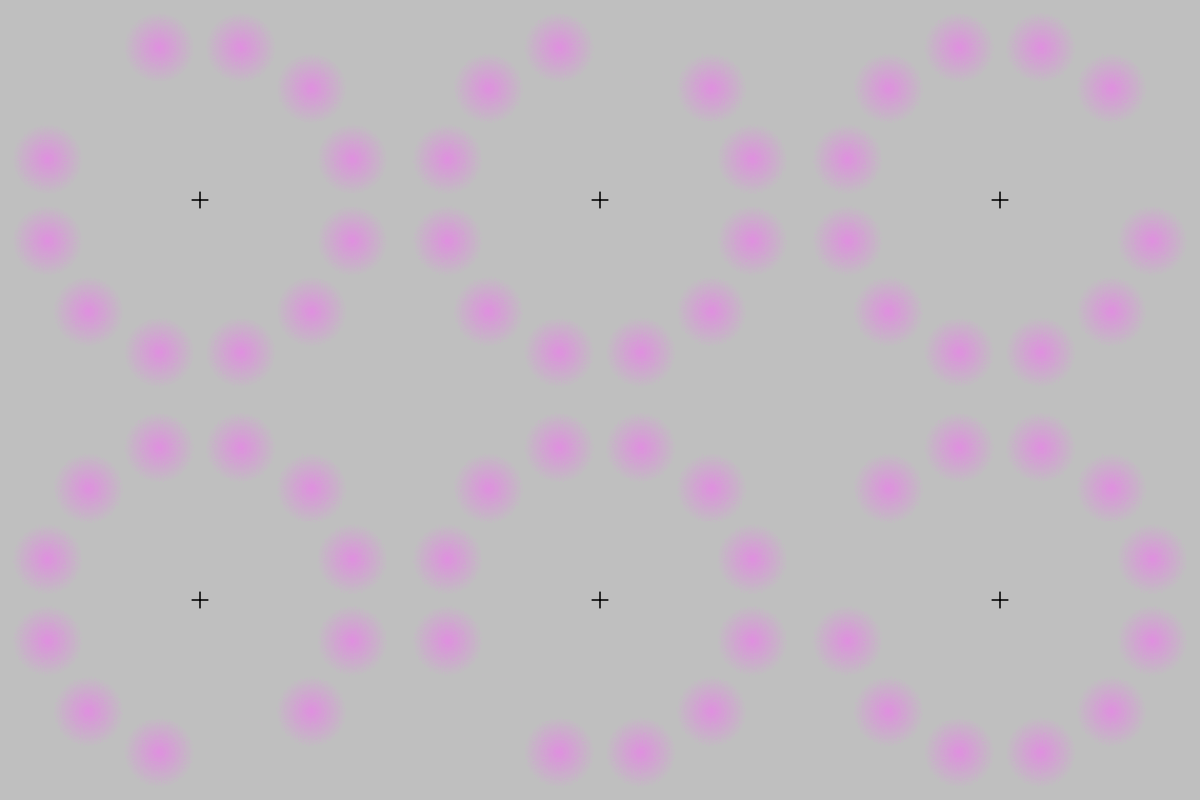
The Troxler effect or the Troxler phenomenon is a physiological phenomenon in the field of visual perception. First described by a Swiss physician , philosopher and politician Ignaz Troxler in 1804 [1] .
Effect Description
The manifestation of the phenomenon is to stop the perception of the visual stimulus, which occupies a strictly constant position in relation to the retina.
Biological Importance

A feature of the structure of the eye of vertebrate animals lies in the location of the branches of the central artery and retinal vein in front of its receptors. This structure of the eye leads to the fact that capillaries obscure the retina receptors , which in the absence of a compensatory mechanism would lead to a violation of the integrity of perception.
The peculiarity of optical compensation lies in the “cutting out” by the brain of fixed sections of the image on the retina. Since in the normal state the eyes of the animal are fixed on the object only for a short time (the human eyes are fixed on the visually expressed object for 0.2-0.6 s [2] after which the eye moves in a jerky manner ( saccade ), the only motionless object with respect to Only the structural elements of the eye itself remain in the retina.Thus, by removing fixed objects in the field of view for a long time, it becomes possible to mask defects in the eye itself (including defects of the lens and vitreous body , corneal scratches, etc.).
Limitations
The occurrence of the Troxler effect is partly limited by the angular dimensions and position of the object with respect to the optical axis of the eye.
Since there is no capillary layer in the area of the macula of the retina, there is no need for compensation. The consequence of this is the manifestation of the phenomenon only in the field of peripheral vision. The second limitation for compensation is the size of the image on the retina. Due to the fact that the diameter of the capillaries is small, the cessation of the perception of obviously large stationary objects does not occur.
Observation
- The test subject secures 2-3 pieces of dark paper with a diameter of 2-3 mm on one side of the nose
- The subject fixes his head with his hands, dropping his elbows on the table and maintaining complete immobility.
- The subject fixes his gaze on one of the pieces of paper on his nose and does not blink until the visual perception ceases.
Notes
- ↑ Described in the work of Über das Verschwinden gegebener Gegenstände innerhalb unseres Gesichtskreises
- ↑ Human physiology. Volume 1. Edited by R. Schmidt and G. Teus.-M .: Mir, 1996. ISBN 5-03-002544-8 p. 237