Gravity loss is an increase in the characteristic speed required to perform an orbital maneuver due to the operation of a jet engine against gravity. In other words, this is the cost of holding a rocket in a gravitational field .
During the entire time of the maneuver, the rocket is affected by gravitational acceleration , which partially compensates for its own acceleration acquired by a working rocket. Moreover, the less engine thrust, the more time it will have to work to complete the maneuver, the greater losses will have time to accumulate during this time.
For example, if the rocket’s thrust is slightly more than its weight, during takeoff it will rise very slowly, and almost all fuel will be spent on maintaining in space. You can reduce gravitational losses by increasing engine power, but it will become heavier and more expensive. The search for a compromise is one of the problems of rocket science.
Losses also depend on the inclination of the rocket. When launched from the ground, most of these losses occur at the beginning of the flight, when the trajectory is closer to the vertical and the vertical component of the thrust is maximum.
The amount of loss is calculated by the formula [1] :
- ,
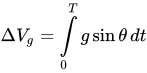
Where - local acceleration of gravity [comm. 1] , - the angle of the thrust vector over the horizon.


When the spacecraft is put into low Earth orbit, it is necessary to achieve the first space velocity equal to 7.8 km / s (for an orbit 200 km high). However, due to various losses (gravitational, aerodynamic , control losses [comm. 2] ), a higher characteristic speed of 9-10 km / s is required from the rocket [2] . At the same time, in practice, a significant share of all losses falls precisely on the gravitational ones: for example, for the Saturn-5 LV during launches under the Apollo program, they accounted for 88% [3] of all losses in the active section of the trajectory.
Unlike rockets, airplanes practically do not experience gravitational losses due to lift. This is one of the reasons why orbital aircraft in the future may turn out to be a more economical way of putting into orbit [4] .
See also
- Orbital maneuver characteristic speed
- Tsiolkovsky's formula
Notes
- ↑ Valid for thrust ratio greater than 1 . In general, it should be where - engine contribution to acceleration.
- ↑ If the direction of the thrust does not coincide with the direction of movement, part of the thrust is not for acceleration, but for a change in direction.
Sources
- ↑ Sikharulidze, 2013 , p. 104.
- ↑ Lobanovsky Yu. I. Forecast of the characteristic velocity of launching into low Earth orbit . - 2008 .-- S. 17 .
- ↑ Shuneiko I.I. Manned flights to the moon, design and characteristics of Saturn V Apollo. - M .: VINITI, 1973.- S. 24.
- ↑ Sable S. Do not make a mistake in choosing // Technique - Youth. - 2000. - July. - S. 24 . - ISSN 0320-331X .
Literature
- Levantovsky V. I. Mechanics of space flight in an elementary exposition. - 3rd ed. - M .: Science, 1980.
- Sikharulidze Yu. G. Ballistics and guidance of aircraft. - 2nd ed. (email). - M .: BINOM, 2013 .-- ISBN 978-5-9963-2283-1 .