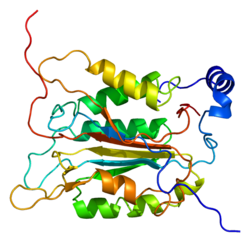
Caspase 1 ( Eng. Caspase-1 , abbr. CASP1 ), also an interleukin-1 converting enzyme (abbreviation ICE from Eng. Interleukin-1 converting enzyme ) is a proteolytic enzyme , is the first identified enzyme of a large family of cysteine proteases ( hydrolase class), is an evolutionarily conserved enzyme that by proteolysis cleaves other proteins, such as precursors of inflammatory cytokines - interleukine 1β and interleukin 18 , as well as an inducer Pyroptosis followed by proteolysis gasdermina D to form an active x mature peptides [1] [2] [3] .
| Caspase 1 | |||||||||||||
|---|---|---|---|---|---|---|---|---|---|---|---|---|---|
 | |||||||||||||
| Identifiers | |||||||||||||
| , ICE, IL1BC, P45, caspase 1 | |||||||||||||
| External IDs | |||||||||||||
| |||||||||||||
| Orthologists | |||||||||||||
| Kinds | Person | Mouse | |||||||||||
| Entrez | |||||||||||||
| Ensembl | |||||||||||||
| Uniprot | |||||||||||||
| RefSeq (mRNA) | |||||||||||||
| RefSeq (protein) | |||||||||||||
| Locus (UCSC) | |||||||||||||
| PubMed Search | |||||||||||||
| Wikidata | |||||||||||||
| View / Edit (Man) | View / Edit (Mouse) | ||||||||||||

Caspase 1 plays a central role in cellular immunity as an initiator of the inflammatory response. After activation through the formation of an inflammation complex, it initiates a pro-inflammatory response through cleavage and, thus, activation of two inflammatory cytokines, interleukin 1β (IL-1β) and interleukin 18 (IL-18), as well as pyroptosis, the programmed lytic pathway of cell death, by cleavage Hasdermin D. molecules. Two caspase-1 activated cytokines are excreted from the cell to further induce an inflammatory response in neighboring cells [4] .
The enzyme is encoded by the gene - CASP1 , which is localized on the long arm (q-arm) of the 11th chromosome [5] . The enzyme consists of a sequence of 404 amino acid residues and has a molecular weight of 45 159 Da [6] .
Caspase Expressing Cells 1
Caspase 1, due to evolutionary conservatism, persists in many eukaryotes of the animal kingdom . Due to its role in the inflammatory immune response, it is highly expressed in tissues and organs involved in immune defense, such as the liver , kidney , spleen, and blood ( neutrophils ) [7] [8] . After infection, the inflammatory response increases the expression of CASP1 using a positive feedback mechanism that enhances the response [8] .
Structure
Caspase 1 is formed as a zymogen (procaspase 1), which can then be split into subunits of 20 kDa (p20) and 10 kDa (p10), which later become part of the active enzyme. Active caspase 1 contains two heterodimers p20 and p10. Caspase includes a catalytic domain with an active site that encompasses both the p20 and p10 subunits [9] , as well as the non-catalytic activation domain of caspase and recruitment ( CARD ). It interacts with other proteins containing CARD domains, such as the apoptosis-associated Speck-like protein containing CARD ( ASC ) and the Nod-like receptor (NLR) NLRC4 , through CARD-CARD domain interactions, causing inflammatory reactions of many diseases [ 3] [10] .
Functions
Proteolytic cleavage
Activated caspase 1 proteolytically cleaves pro-IL-1β and pro-IL-18 into their active forms, IL-1β and IL-18. Active cytokines lead to an inflammatory response that occurs next. Caspase 1 also cleaves Hasdermin D into its active form, which leads to pyroptosis [10] .
Inflammatory response
After maturation, cytokines initiate subsequent signaling events to induce a pro-inflammatory response, as well as activate the expression of antiviral genes. The speed, specificity and types of response depend on the received signal, as well as on the protein of the sensor that received it. Signals that can accept firemasomes include viral double-stranded RNA , urea , free radicals, and other cell-threat signals, even by-products of other immune response pathways [11] .
Mature cytokines themselves do not contain the necessary sorting sequences for entering the ER-Golgi secretory pathway and, therefore, are not excreted from the cell by conventional methods. However, it is theoretically assumed that the release of these pro-inflammatory cytokines is independent of cell breakdown by pyroptosis and is actually an active process. There is evidence for and against this hypothesis. The fact that cytokines are secreted for many types of cells, despite the fact that they show absolutely no signs of pyroptosis, supports this hypothesis [12] [13] . However, some experiments show that non-functional Hasdermin D mutants still have normal cleavage of cytokines, but do not have the ability to secrete them, this indicates that pyroptosis may indeed be necessary for secretion in some way [14] .
Pyroptosis
After an inflammatory response, activated caspase-1 can induce pyroptosis, the lytic form of cell death, depending on the signal received, as well as on the specific domain of the inflammasome protein that received it. Although pyroptosis may or may not be required for a complete inflammatory response, an inflammatory response is completely necessary before pyroptosis occurs. In order to cause pyroptosis, caspase-1 cleaves Hasdermin D, which either directly or through some signaling cascade leads to pyroptosis [12] . The exact mechanism of pyroptosis is unknown [12] .
Other features
It has also been shown that caspase-1 causes necrosis and can also function at various stages of development. Studies of a similar protein in mice indicate a role in the pathogenesis of Huntington's disease . Alternative gene splicing leads to five transcription variants encoding various isoforms [15] . Recent studies have shown the involvement of caspase-1 in the promotion of death of CD4 T cells from HIV infection , two significant events that contribute to HIV progression and lead to AIDS [16] [17] .
Regulation
Activation
Caspase-1, usually in its physiologically inactive form of zymogen, is activated when it is assembled into a filamentous inflammatory complex ( inflammasoma ) by autoproteolysis into the subunits p10 and p20 [18] [19] . The inflammasome is a ring complex consisting of trimers specific for protein-protein signals, such as NLR cells, and AIM-1 receptors (absent in melanoma), adapter proteins such as ASC , and caspases, in this case caspases 1. In some cases, when signaling proteins contain their own CARD domains, for example, in NLRP1 and NLRC4 , the CARD-CARD interaction is direct, that is, there is no adapter protein in the complex. There are various sensory and adapter proteins, various combinations of which give answers to inflammatory reactions to certain signals. This allows the cell to have a different concentration of inflammas depending on the severity of the received signal [12] [20] .
Inhibition
Only the CARD domain containing proteins (COP), as the name implies, are proteins that contain only non-catalytic CARD domains. Due to the importance of CARD-CARD interactions in the formation of inflammation, many COPs are known caspase activation inhibitors. For caspase-1, the genes responsible for the specific interaction of the complexes COP-ICEBERG, COP1 (ICE / pseudo-ICE) and INCA (Inhibitory CARD) are all found near the locus and are believed to have arisen from events of gene duplication and subsequent deletions of catalytic domains. Although they all interact with the inflammasome through the interaction of CARD-CARD, however, they differ in how they perform their inhibitory functions, as well as in their inhibition efficiency [19] [21] [22] .
For example, ICEBERG initiates the formation of caspase 1 filaments and, thus, is incorporated into filaments, but does not have the ability to inhibit the activation of inflammatory diseases. Instead, it is believed that it inhibits the activation of caspase-1, preventing its interaction with other important proteins containing the CARD domain [19] [21] [22] .
INCA, on the other hand, directly blocks the assembly of the inflammasome through the association (enlargement) of caspase CARD-domain oligomers, and thereby blocks the further polymerization of the inflammasome filaments [10] [21] [22] [23] .
Similarly, POP proteins act by regulating the activation of caspase-1 by inhibiting the activation of the inflammatory process by acting on the mechanism of binding and blocking of PYD interactions, which also play a role in the formation of inflammatory diseases, although the exact mechanisms have not yet been established [22] [24 ] ] .
See also
- Caspases
- Pyroptosis
- Inflammasoma
Notes
- ↑ Thornberry NA, Bull HG, Calaycay JR, Chapman KT, Howard AD, Kostura MJ, Miller DK, Molineaux SM, Weidner JR, Aunins J. A novel heterodimeric cysteine protease is required for interleukin-1 beta processing in monocytes // Nature: journal. - 1992 .-- April ( vol. 356 , no. 6372 ). - P. 768-774 . - DOI : 10.1038 / 356768a0 . - PMID 1574116 .
- ↑ Cerretti DP, Kozlosky CJ, Mosley B., Nelson N., Van Ness K., Greenstreet TA, March CJ, Kronheim SR, Druck T., Cannizzaro LA Molecular cloning of the interleukin-1 beta converting enzyme (English) / / Science: journal. - 1992 .-- April ( vol. 256 , no. 5053 ). - P. 97-100 . - DOI : 10.1126 / science.1373520 . - PMID 1373520 .
- ↑ 1 2 Mariathasan S., Newton K., Monack DM, Vucic D., French DM, Lee WP, Roose-Girma M., Erickson S., Dixit VM Differential activation of the inflammasome by caspase-1 adapters ASC and Ipaf ( English) // Nature: journal. - 2004 .-- July ( vol. 430 , no. 6996 ). - P. 213-218 . - DOI : 10.1038 / nature02664 . - PMID 15190255 .
- ↑ Jorgensen I., Miao EA Pyroptotic cell death defends against intracellular pathogens (Eng.) // Immunological Reviews: journal. - 2015 .-- May ( vol. 265 , no. 1 ). - P. 130-142 . - DOI : 10.1111 / imr.12287 . - PMID 25879289 .
- ↑ HUGO Gene Nomenclature Commitee, HGNC: 1499 . Date of appeal September 22, 2017.
- ↑ UniProt, P29466 (English) .
- ↑ Bakele M., Joos M., Burdi S., Allgaier N., Pöschel S., Fehrenbacher B., Schaller M., Marcos V., Kümmerle-Deschner J., Rieber N., Borregaard N., Yazdi A. , Hector A., Hartl D. Localization and functionality of the inflammasome in neutrophils (Eng.) // The Journal of Biological Chemistry : journal. - 2014 .-- February ( vol. 289 , no. 8 ). - P. 5320-5329 . - DOI : 10.1074 / jbc.M113.505636 . - PMID 24398679 .
- ↑ 1 2 Kumaresan V., Ravichandran G., Nizam F., Dhayanithi NB, Arasu MV, Al-Dhabi NA, Harikrishnan R., Arockiaraj J. Multifunctional murrel caspase 1, 2, 3, 8 and 9: Conservation, uniqueness and their pathogen-induced expression pattern (Eng.) // Fish & Shellfish Immunology: journal. - 2016 .-- February ( vol. 49 ). - P. 493-504 . - DOI : 10.1016 / j.fsi.2016.01.008 . - PMID 26777895 .
- ↑ Wilson KP, Black JA, Thomson JA, Kim EE, Griffith JP, Navia MA, Murcko MA, Chambers SP, Aldape RA, Raybuck SA Structure and mechanism of interleukin-1 beta converting enzyme (Eng.) // Nature: journal. - 1994 .-- July ( vol. 370 , no. 6487 ). - P. 270-275 . - DOI : 10.1038 / 370270a0 . - PMID 8035875 .
- ↑ 1 2 3 Lu A., Li Y., Schmidt FI, Yin Q., Chen S., FuTM, Tong AB, Ploegh HL, Mao Y., Wu H. Molecular basis of caspase-1 polymerization and its inhibition by a new capping mechanism (Eng.) // Nature Structural & Molecular Biology : journal. - 2016 .-- May ( vol. 23 , no. 5 ). - P. 416-425 . - DOI : 10.1038 / nsmb.3199 . - PMID 27043298 .
- ↑ Vezzani A., Maroso M., Balosso S., Sanchez MA, Bartfai T. IL-1 receptor / Toll-like receptor signaling in infection, inflammation, stress and neurodegeneration couples hyperexcitability and seizures (English) // Brain, Behavior , and Immunity : journal. - 2011 .-- October ( vol. 25 , no. 7 ). - P. 1281-1289 . - DOI : 10.1016 / j.bbi.2011.03.03.018 . - PMID 21473909 .
- ↑ 1 2 3 4 Vince JE, Silke J. The intersection of cell death and inflammasome activation (Eng.) // Cellular and Molecular Life Sciences: CMLS: journal. - 2016. - Vol. 73 , no. 11-12 . - P. 2349-2367 . - DOI : 10.1007 / s00018-016-2205-2 . - PMID 27066895 .
- ↑ Ainscough JS, Gerberick GF, Kimber I., Dearman RJ Interleukin-1β Processing Is Dependent on a Calcium-mediated Interaction with Calmodulin // The Journal of Biological Chemistry : journal. - 2015 .-- December ( vol. 290 , no. 52 ). - P. 31151-31161 . - DOI : 10.1074 / jbc.M115.680694 . - PMID 26559977 .
- ↑ He WT, Wan H., Hu L., Chen P., Wang X., Huang Z., Yang ZH, Zhong CQ, Han J. Gasdermin D is an executor of pyroptosis and required for interleukin-1β secretion ) // Cell Research : journal. - 2015 .-- December ( vol. 25 , no. 12 ). - P. 1285-1298 . - DOI : 10.1038 / cr.2015.139 . - PMID 26611636 .
- ↑ Entrez Gene: CASP1 caspase 1, apoptosis-related cysteine peptidase (interleukin 1, beta, convertase) .
- ↑ Doitsh G., Galloway NL, Geng X., Yang Z., Monroe KM, Zepeda O., Hunt PW, Hatano H., Sowinski S., Muñoz-Arias I., Greene WC Cell death by pyroptosis drives CD4 T- cell depletion in HIV-1 infection // Nature: journal. - 2014 .-- January ( vol. 505 , no. 7484 ). - P. 509-514 . - DOI : 10.1038 / nature12940 . - PMID 24356306 .
- ↑ Monroe KM, Yang Z., Johnson JR, Geng X., Doitsh G., Krogan NJ, Greene WC IFI16 DNA sensor is required for death of lymphoid CD4 T cells abortively infected with HIV (Eng.) // Science: journal. - 2014 .-- January ( vol. 343 , no. 6169 ). - P. 428-432 . - DOI : 10.1126 / science.1243640 . - PMID 24356113 .
- ↑ Elliott JM, Rouge L., Wiesmann C., Scheer JM Crystal structure of procaspase-1 zymogen domain reveals insight into inflammatory caspase autoactivation (Eng.) // The Journal of Biological Chemistry : journal. - 2009 .-- March ( vol. 284 , no. 10 ). - P. 6546-6553 . - DOI : 10.1074 / jbc.M806121200 . - PMID 19117953 .
- ↑ 1 2 3 Humke EW, Shriver SK, Starovasnik MA, Fairbrother WJ, Dixit VM ICEBERG: a novel inhibitor of interleukin-1beta generation (Eng.) // Cell : journal. - Cell Press , 2000. - Vol. 103 , no. 1 . - P. 99-111 . - DOI : 10.1016 / S0092-8674 (00) 00108-2 . - PMID 11051551 .
- ↑ Samarani S., Allam O., Sagala P., Aldabah Z., Jenabian MA, Mehraj V., Tremblay C., Routy JP, Amre D., Ahmad A. Imbalanced production of IL-18 and its antagonist in human diseases , and its implications for HIV-1 infection (Eng.) // Cytokine : journal. - Elsevier , 2016 .-- June ( vol. Cytokines in inflammation, aging, cancer and obesity ). - P. 38-51 . - DOI : 10.1016 / j.cyto.2016.01.006 . - PMID 26898120 .
- ↑ 1 2 3 Druilhe A., Srinivasula SM, Razmara M., Ahmad M., Alnemri ES Regulation of IL-1beta generation by Pseudo-ICE and ICEBERG, two dominant negative caspase recruitment domain proteins (Eng.) // Cell Death and Differentiation : journal. - 2001 .-- June ( vol. 8 , no. 6 ). - P. 649-657 . - DOI : 10.1038 / sj.cdd.4400881 . - PMID 11536016 .
- ↑ 1 2 3 4 Le HT, Harton JA Pyrin- and CARD-only Proteins as Regulators of NLR Functions (English) // Frontiers in Immunology: journal. - 2013 .-- 1 January ( vol. 4 ). - P. 275 . - DOI : 10.3389 / fimmu.2013.00275 . - PMID 24062743 .
- ↑ Lamkanfi M., Denecker G., Kalai M., D'hondt K., Meeus A., Declercq W., Saelens X., Vandenabeele P. INCA, a novel human caspase recruitment domain protein that inhibits interleukin-1beta generation ( English) // The Journal of Biological Chemistry : journal. - 2004 .-- December ( vol. 279 , no. 50 ). - P. 51729-51738 . - DOI : 10.1074 / jbc.M407891200 . - PMID 15383541 .
- ↑ Dorfleutner A., Talbott SJ, Bryan NB, Funya KN, Rellick SL, Reed JC, Shi X., Rojanasakul Y., Flynn DC, Stehlik C. A Shope Fibroma virus PYRIN-only protein modulates the host immune response ) // Virus Genes: journal. - 2007 .-- December ( vol. 35 , no. 3 ). - P. 685–694 . - DOI : 10.1007 / s11262-007-0141-9 . - PMID 17676277 .