H2-histamine receptor (abbreviated H2 ), also H2-receptor - an integral membrane protein , one of the 4 histamine receptors , belongs to the group of rhodopsin-like receptors associated with the G-protein . Activated by histamine binding, positively bound to adenylate cyclase via Gs. It is a potent stimulator of cAMP generation, which leads to the activation of protein kinase A [1] . The gene encoding the receptor, HRH2 , is located on the long arm (q-arm) of the 5th chromosome .
| H2-histamine receptor | |||||||||||||
|---|---|---|---|---|---|---|---|---|---|---|---|---|---|
| Identifiers | |||||||||||||
| , H2R, histamine receptor H2, HH2R | |||||||||||||
| External IDs | |||||||||||||
| |||||||||||||
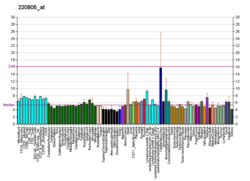
| RNA expression profile | |||||||||||||
 | |||||||||||||
| Orthologists | |||||||||||||
| Kinds | Person | Mouse | |||||||||||
| Entrez | |||||||||||||
| Ensembl | |||||||||||||
| Uniprot | |||||||||||||
| RefSeq (mRNA) | |||||||||||||
| RefSeq (protein) | |||||||||||||
| Locus (UCSC) | |||||||||||||
| PubMed Search | |||||||||||||
| Wikidata | |||||||||||||
| View / Edit (Man) | View / Edit (Mouse) | ||||||||||||
A protein consists of a sequence of 359 amino acids and has a molecular weight of 40,098 [2] .
Content
- 1 Functions
- 2 Localization of receptors
- 3 Physiological reactions
- 4 notes
Functions
Histamine is an ubiquitous messenger molecule released from mast cells , enterochromaffin-like cells and neurons [1] . Its various actions are mediated by the histamine receptors H1 , H2, H3 and H4. H2-histamine receptors stimulate the secretion of gastric juice. It also regulates gastrointestinal motility and intestinal secretion and is believed to be involved in the regulation of cell growth and differentiation [3] .
Receptor Localization
Histamine H2 receptors are expressed in the following tissues:
Peripheral tissue [1] [4]
- Gastric parietal cells (oxyntic cells)
- Vascular smooth muscle
- Neutrophils
- Mast cells
- Heart
- Uterus
Tissues of the central nervous system [4]
- Caudate nucleus - putamen (shell)
- Cortex (outer layers)
- Hippocampal formation
- Cerebellar dentate nucleus
Physiological Reactions
Activation of the H2 receptor leads to the following physiological reactions:
- Stimulation of the secretion of gastric juice (the goal of antihistamines (acting on H2 receptors) in peptic ulcer disease and gastroesophageal reflux disease )
- Smooth muscle relaxation (Experimental H2-histamine receptor agonist used to treat bronchial asthma and COPD )
- Inhibition of antibody synthesis, T-cell proliferation and cytokine production
- Vasodilation - the activity of protein kinase A causes phosphorylation of myosin light chain kinase (MLCK), reducing its activity, as a result of which myosin MLC is dephosphorylated to MLCP and thus inhibits contraction. Smooth muscle relaxation leads to vasodilation [5] .
- Inhibition of neutrophil activation and chemotaxis [4] .
Notes
- ↑ 1 2 3 Hill SJ, Ganellin CR, Timmerman H., Schwartz JC, Shankley NP, Young JM, Schunack W., Levi R., Haas HL International Union of Pharmacology. Xiii. Classification of histamine receptors (English) // Pharmacological Reviews : journal. - 1997 .-- September ( vol. 49 , no. 3 ). - P. 253—278 . - PMID 9311023 .
- ↑ UniProt, P25021 .
- ↑ Entrez Gene: HRH2 histamine receptor H2 .
- ↑ 1 2 3 Maguire JJ, Davenport AP. H 2 receptor . IUPHAR / BPS Guide to PHARMACOLOGY . International Union of Basic and Clinical Pharmacology (November 29, 2016). Date of treatment March 20, 2017.
- ↑ Walter F., PhD. Boron Medical Physiology: A Cellular And Molecular Approaoch. - Elsevier / Saunders, 2005 .-- ISBN 1-4160-2328-3 . Page 479