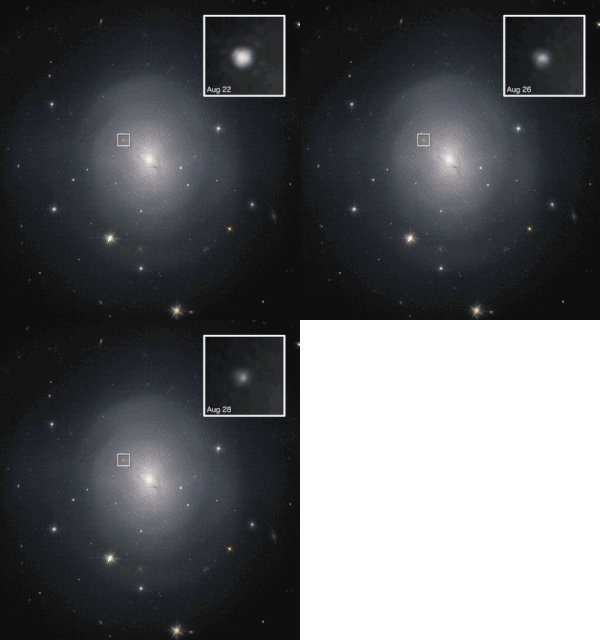
GW170817 is the first recorded gravitational-wave burst that occurred as a result of the fusion of two neutron stars . It was registered on August 17, 2017 at 12: 41: 04.4 UTC [1] by all three laser-interferometric gravitational-wave detectors of the LIGO - Virgo detection network. The discovery of this event was officially announced on October 16, 2017 in a joint press release of the LIGO Scientific Collaboration and Virgo Collaboration collaborations [2] [3] ; at the same time, a joint article of collaborations was published in Physical Review Letters [4] .
Content
- 1 History
- 1.1 Signal Detection
- 1.2 Search in the electromagnetic range
- 1.3 Subsequent Observations
- 2 Astronomical origin
- 3 Scientific results
- 4 See also
- 5 notes
History
With the commissioning of the Virgo Observatory, located near the Italian city of Pisa, on August 1, 2017, the number of gravitational detectors reached three, and it became possible to establish the coordinates of the gravitational signal more accurately. On August 14, for the first time in history, all three detectors recorded a gravitational signal from the merging of black holes, which received the designation GW170814 , whose source was determined much more accurately than those that were previously. The next signal, later called GW170817, was jointly detected by all three gravitational detectors on August 17 [5] .
Signal Detection
The signal had a duration of about 100 seconds (from the moment when it reached a frequency of 24 Hz until its end). It was associated with the independently observed short gamma-ray burst GRB 170817A , which occurred 1.74 ± 0.05 s after the maximum gravitational-wave burst (the gamma-ray burst was observed by the Fermi and INTEGRAL space observatories), as well as with the observed optical and x-ray afterglow . The source of the electromagnetic signal was in the galaxy NGC 4993 (the constellation Hydra ). Observation of the GW170817 signal by three detectors at once made it possible to determine the direction to its source; localization of the source is determined inside the region on the celestial sphere in a solid angle of 28 square degrees (with a confidence probability of 90%). The source of the gamma-ray burst is located inside this region [4] .
Search in the electromagnetic range
Based on the data on the delay between the moments of the signal arrival at Fermi and INTEGRAL, it was possible to significantly improve the localization of the gamma-ray source. It turned out that the time and region of the gamma-ray burst coincide with the direction to the source of gravitational waves obtained by the LIGO / Virgo collaboration. Further search and analysis of information from other detectors made it possible to localize the region of incoming gravitational waves and then, having received this information, telescopes across the Earth tuned in to search for fusion traces in different ranges of electromagnetic waves [5] [6] .
Based on the data of the gravitational-wave burst, LIGO / Virgo determined not only the merger of two neutron stars, which should lead to a signal in the optical range, but also the approximate distance to the system itself. Using this and estimates of the coordinates of the source, astronomers began to search for its optical manifestations with the onset of darkness in the area of the Earth where the observatories were located. Telescopes in Chile became the first, where 10 hours after the merger, the region of the burst localization became visible, but 6 teams independently opened the optical component [5] .
Subsequent Observations
Late radiation was found in other ranges. So, after 12.8 hours, the Gemini Observatory detected a near-infrared response. In the ultraviolet range, the signal was detected by the Swift and Hubble space telescopes. Also, Pan-STARRS , Magellan and Subaru telescopes were connected to the observations. As a result, an almost continuous monitoring of the source was carried out over several weeks [5] .
The X-ray component was detected only on the 9th day of observations with the Chandra telescope. Also, for quite some time, astronomers could not detect the response in the radio range . Researchers attribute the delay to the orientation of the directed release of the substance: the release was directed in the opposite direction and the effects associated with the expanding shell appeared much later. Attempts were made to detect neutrinos associated with the fusion of neutron stars, but they were unsuccessful [5] .
Astronomical Origin
From signal analysis, information about the source parameters is obtained. The total mass of the system is from 2.7 to 3.3 solar masses ( M ☉ ), more than 0.025 M ☉ during the merger turned into the energy of gravitational waves. The distance to the source is 40 +8
−14 megaparsec (130 million light-years ). As a result of the merger, either a black hole or a neutron star was formed [6] [7] .
Scientific Results
Thanks to the almost simultaneous observation of the gravitational wave and electromagnetic signal, direct restrictions on the deviation of the speed of gravitational waves from the speed of light were first established. If such a deviation exists, it lies in the range from −3 × 10 −15 to + 0.7 × 10 −15 , that is, it is compatible with zero within the error [8] . The restrictions on violation of Lorentz invariance were also clarified and the equivalence principle was verified using the Shapiro effect [8] . The fusion model of neutron stars as a source of short gamma-ray bursts was confirmed [8] .
As a result of the fusion of neutron stars, the atoms of heavy elements - gold, uranium, platinum and others - were thrown into space. Astronomers believe that such events are the main source of these elements in the Universe [6] . On Earth, radiation from a source in various ranges was recorded for several days, and the obtained data coincided with theoretical predictions for such a merger [6] .
More precise restrictions were obtained on the maximum possible mass of a non-rotating neutron star [9] .
See also
- Gravitational Wave Astronomy
- Discovery of gravitational waves
Notes
- ↑ The moment the signal ends.
- ↑ Krieger, Lisa M .. A Bright Light Seen Across The Universe, Proving Einstein Right - Violent collisions source of our gold, silver , The Mercury News (October 16, 2017). Date of appeal October 16, 2017.
- ↑ Vyacheslav Avdeev, Pavel Kotlyar . The whole world heard neutron stars: Scientists first caught the gravity waves from the confluence of neutron stars , Gazeta.ru (October 16, 2017). Date of appeal October 16, 2017.
- ↑ 1 2 Abbott B. P. (LIGO Scientific Collaboration and Virgo Collaboration) et al. GW170817: Observation of Gravitational Waves from a Binary Neutron Star Inspiral (Eng.) // Physical Review Letters : journal. - 2017 .-- 16 October ( vol. 119 , no. 16 ). - DOI : 10.1103 / PhysRevLett.119.161101 .
- ↑ 1 2 3 4 5 Vyacheslav Avdeev, Pavel Kotlyar . The neutron stars heard the whole world , Gazeta.Ru (October 16, 2017). Date of appeal October 16, 2017.
- ↑ 1 2 3 4 Edition PM . Discovery of the year: astrophysicists first observed a collision of neutron stars (Rus.) , Popmech.ru . Date of appeal October 16, 2017.
- ↑ Vasily Makarov . Clash of neutron stars: a mysterious catastrophe (Russian) , Popmech.ru (November 13, 2017). Date of treatment November 13, 2017.
- ↑ 1 2 3 Abbott BP et al. (LIGO Scientific Collaboration, Virgo Collaboration, Fermi Gamma-ray Burst Monitor, and INTEGRAL). Gravitational Waves and Gamma-Rays from a Binary Neutron Star Merger: GW170817 and GRB 170817A // The Astrophysical Journal. - 2017 .-- Vol. 848. - P. L13. - DOI : 10.3847 / 2041-8213 / aa920c .
- ↑ Dmitry Trunin. Astrophysicists have specified the ultimate mass of neutron stars . nplus1.ru (January 17, 2019). Date of appeal March 25, 2019.