Schwarzlose system submachine gun [1] - a prototype of the German experimental submachine gun developed by the designer of small arms Andreas Wilhelm Schwarzlose , famous for its Schwarzlose machine gun ( German: Maschinengewehr Patent Schwarzlose M.07 / 12 ). The internal mechanism of the submachine gun was based on the Maxim machine gun - MG 08 , but reduced and adapted to the 9 × 19 mm Parabellum cartridge . The weapon was created during the First World War and may have been tested by the German army . The unique power mechanism makes it one of the most unusual experimental weapons of the first half of the 20th century [2] [3] [4] .
| Schwarzlose submachine gun | |
|---|---|
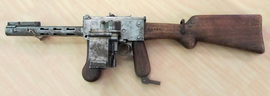 Complete submachine gun | |
| Type of | submachine gun |
| A country |  German Empire German Empire |
| Service History | |
| Wars and conflicts | World War I |
| Production history | |
| Constructor | Andreas V. Schwarzlose |
| Designed by | 1910s |
| Specifications | |
| Cartridge | 9 × 19 mm Parabellum |
| Caliber mm | 9 |
| Work principles | short recoil |
| Type of ammunition | bunker-receiver equipped with a cartridge for 80 rounds (with 10 rows of 8 rounds) |
| Aim | open |
Not much is known about the submachine gun, and details have surfaced relatively recently. His model was finally determined only in 2016, after a conference at the Tula State Museum of Arms , one of the oldest museums in Russia [1] . For a long time, even the real name of the weapon was completely unknown, because of which it basically had the nickname " Maxim submachine gun ", as well as " SMG 08/18 ", after the appearance of the computer game Battlefield 1 .
History
Details about the origin of weapons are extremely scarce. It is believed that it was created in the German Empire during the First World War [2] [3] . In 1915, the Spandau County Small Arms Testing Commission formed requirements for the design of submachine guns for the German imperial army . It required a light, fully automatic short-range weapon, which was supposed to be simple, reliable and capable of being easily transported by one person, preferably "combining the convenience of a pistol and the firepower of a machine gun." It was also requested that the new weapon use a standard German pistol cartridge, 9 × 19 mm Parabellum . By 1916, Andreas Wilhelm Schwarzlose from Berlin and Hugo Schmeisser from Suhl , presented their prototype weapons, which were carefully evaluated and tested. Ultimately, in 1918, the Commission selected a model developed by Schmeisser from the company Theodor Bergmann Called Maschinenpistole (MP) 18, I [5] .
Initially, the existence of this “experimental submachine gun” was confirmed only by a black and white photograph of a specimen from the collection of the Russian Army in St. Petersburg [2] , and the principle of its operation was not clear. As it became clear later, the copy captured in the photo was incomplete - it lacks a front wooden handle and a box of the store’s loading hopper with a cartridge-feeding mechanism [3] . In May 2014, weapons expert Maxim Popenker published photos of a second, already complete sample from the city of Tula , which is stored in a meeting of the department of small arms and cannon weapons at the Institute of High-Precision Systems named after V.P. Gryazev, Tula State University (TulSU). Experts agreed that the submachine gun is based on the German version of Maxim's machine gun - MG 08/18 (light modernized version of MG 08/15 air-cooled ), because it has a typical Maxim automation with a movable barrel and lever locking, as well as a characteristic for MG layout [4] [3] .
The identification of the submachine gun of the Schwarzlose system was made in 2016 according to patent No. 332625 of February 4, 1921, issued by the Imperial Patent Office Germany ( German: Reichspatentamt ) Wilhelm Schwarzlose of Charlottenburg [6] . A patent granted to Andreas Wilhelm Schwarzlose was also discovered in 1902 in the UK on the design of the cartridge-feeding mechanism [7] . The design presented in the patent, after some refinement, was embodied in this submachine gun [1] . German patent No. 167815 of September 14, 1904, shows that the final version of the cartridge feeding mechanism used in the Schwarzlose submachine gun was actually invented by Hermann Lehmann under the direction of the concern Friedrich Krupp AG [8] . There are several changes from the design of A. Schwarzlose in 1902, for example, the simplification of a multi-channel charger, but the main part of the concept has remained unchanged.
It is not known how many total units of the Schwarzlose submachine gun were made, but there is evidence of the existence of at least two copies, both are on the territory of Russia , but how they got there is not known for certain, maybe they could be captured as a trophy during the Romanian campaign , approximately in the years 1916-1918 [9] . It is worth noting that during the Spanish Civil War , Poland sold a lot of excess Austrian weapons to the Second Spanish Republic [10] . One of these parties, delivered November 7, 1936, contained 167 pieces of some submachine guns, described as “Austrian sub-machine-guns, old, 08/18” ( Russian Austrian submachine guns, old, 08/18 ) [ 11] . It is difficult to determine whether this was some kind of transcription error from the Polish government or a link to a small batch of Schwarzlose submachine gun based on the Maxim machine gun, model MG 08/18 [12] .
| External Images | |
|---|---|
| Photos of a sample from Tula, 2014 | |
| Left side of the weapon | |
| Empty magazine tray | |
| Cartridge lifting mechanism | |
| Shop door with closed door | |
| Open receiver cover | |
| Right side of the receiver | |
| Front clip | |
| Back clip | |
|
Design
The Schwarzlose system submachine gun is an automatic weapon based on the principle of recoil of the barrel during its short course . The barrel bore is locked by a crank mechanism similar to the Maxim system machine gun. The locking mechanism includes a crank , a connecting rod and a bolt consisting of two halves, which is a slider of the crank mechanism. The barrel and the crank mechanism are connected using a frame consisting of two frames (left and right), like a Maxim machine gun. When the barrel channel is locked, the crank and connecting rod form an obtuse angle with the top pointing downward, and the hinge connecting the crank and connecting rod rests on the fixed comb of the automation box, which ensures strong locking of the barrel channel [1] .
1 - trunk; 2 - shutter ( a - shutter hinge); 3 - connecting rod ( b - middle hinge); 4 - crank ( in - crank joint); 5 - fixed box of automation ( g - comb).
When fired, the powder gases acting on the bottom of the sleeve, and through it onto the bolt, tend to push the bolt back, folding the levers of the crank mechanism - but folding the levers is possible only down, which is prevented by the comb of the automation box. Therefore, all moving parts (crank mechanism, frame and barrel) begin a joint rollback, compressing the reciprocating spring. After about 4 mm of rollback, the middle hinge jumps onto the unlocking profile of the ridge of the automation box, which will lead to the hinge lifting up - the hinge passes the “dead center” position (the crank and connecting rod will be located on one straight line), so that the shutter is pressed even closer to the breech cut the trunk. At this point, the bullet will already leave the bore, and with a further rollback of the moving parts, the middle hinge will be higher than the two extreme ones, that is, the obtuse angle between the crank and the connecting rod will “break” upward; unlocking and accelerated retreat of the shutter will occur. The rollback of the moving parts is limited by the impact of the connecting rod on the fixed crest of the automation box, while the reciprocating spring will be in the state of greatest preload. The coil spring is twisted cylindrical, mounted in a wooden butt of a submachine gun and connected to moving parts by means of a pusher, like a machine gun LMG 14 “Parabellum” [1] .
The automatic engine and the locking mechanism of the Schwarzlose submachine gun seem completely redundant for this class of weapons, because when using relatively low - power pistol cartridges ( 9 × 19 mm Parabellum ), the simplest free shutter is more than enough. Apparently, the choice of such a complicated scheme for submachine guns was due to the use of a highly original cartridge-feeding mechanism, the details of which are driven by a rolling barrel [1] .
The Schwarzlose submachine feed mechanism of the submachine gun is extremely original in design and bears some resemblance to the Nambu Type 11 Japanese submachine gun feed mechanism. The supply of cartridges is carried out from a cartridge having 10 vertical guides ("columns") for 8 rounds each; in the guides of the cartridge are grooves of cartridge cases. The cartridge cartridge is inserted into a large hopper with a lid. Cartridges are moved from the column up to the delivery line by two combs (external and internal) having a lever drive from moving parts, and the drive lever is connected to the right frame bed. When the receiver rolls back, the lever pivots; the outer comb goes down and simultaneously moves to the left; the teeth of the outer comb capture the cartridges in the column. When the barrel group rolls, the outer comb moves to the right, and the inner comb keeps the cartridges from shifting down, which at the end of the run moves to the left and grabs the raised cartridges with its teeth. The inner comb moves to the right and releases the cartridges at the end of the rollback, simultaneously with the movement of the outer comb to the left [1] .
The movement of the cartridge is a kind of lever-copy mechanism, which is also activated from the receiver group. When the barrel group rolls back, the lever turns back, the axis of the lever is simultaneously rolled around according to the copier, as a result of which the dog located at the bottom of the lever turns back (compressing its spring) and moves to the left, idling and grabbing the cartridge by the next cut (the cut is made at the top of the column for cartridges). But if the column in which the dog jumps into the neck has not been used up yet, then the bottom of the cartridge case located opposite the neck will not allow the dog to hook into the neck (the bottom of the sleeve keeps the dog pressed all the time). When the barrel group rolls over, the lever with the dog moves in the opposite direction, moving the cartridge if the next column with cartridges has been used up (the bottom of the sleeve will not hold the dog in the squeezed position, and the dog’s hook will be able to capture the cutout wall in the cartridge). From backward movement the cassette is held by a fixed latch, which also engages with the walls of the cutouts in the cassette and is connected to the spark gap button at the rear of the receiver. To discharge the submachine gun, open the receiver cover and, pressing the spark gap button, pull out the released cartridge to the left. For loading, you need to open the lid, insert the cartridge cartridge into the receiver guide and send the cartridge to the right until it stops. The cassette has a T-shaped guide protrusion, and the corresponding guide groove [1] is made in the receiver casing.
The solution of the cartridge-feeding mechanism of the Schwarzlose submachine gun amazes with its originality and excessive complexity. The only advantage of the design is the unusually low “dead weight” of cartridge cartridges with their more than significant capacity (80 rounds). The weight of an empty cartridge is 180 grams: thus the "specific gravity" of the cartridge is 2.25 grams per cartridge. For comparison, the mass of an empty drum magazine of a Suomi M / 31 submachine gun with a capacity of 70 rounds is about 1 kg (about 14.2 grams per cartridge), and the mass of an empty four-row box magazine of the same Suomi M / 31 with a capacity of 50 rounds is 400 grams (8 grams per cartridge). Thus, in this design the “specific gravity” of the cartridge is very small and comparable with the “specific gravity” of cartridge cartridges (for example, the mass of one link of a domestic cartridge cartridge for Kalashnikov machine guns is about 6 grams). The payment for this only positive quality was a serious complication of the design of the weapon and an increase in its dimensions. The location of the bulky receiver with 80 rounds on the left side of the weapon makes it extremely difficult to hold it when firing, increases the transverse dimension and significantly worsens the balance in the transverse direction [1] .
Direct message; the next cartridge is fed by the combs of the cartridge-feeding mechanism directly into the stationary hook-extractors of the shutter. In this case, the next cartridge pushes up the fired sleeve up from the bolt hooks; the sleeve enters the sleeve catcher located in the front of the cover and is held there by a spring latch. In the run-off, the sleeve is removed into the sleeve window forward by the next shot sleeve. Striking mechanism of the striker type: the striker is driven by a protrusion at the front end of the crank - when the levers are fully extended (locking occurs), the protrusion of the crank presses on the rear end of the striker, the striker advances, the striker goes beyond the shutter mirror and punctures the capsule - a shot occurs.
The trigger is extremely simple and consists of a single spring-loaded part - the trigger. The sear is made on the top of the trigger and captures the crank on which the ledge of the combat platoon is made. The fuse against an accidental shot is also very simple and has the form of a latch that locks the reload handle. To set the weapon on the fuse, it is necessary to turn the reload handle back to the stop and, while holding it turned, raise the fuse latch up, and then release the handle. When the handle is released, the hook on its lower side engages with the reciprocal catch of the fuse, which will block the crank rotation and make it impossible to fire a shot. To remove the weapon from the fuse, you must again turn the reload handle back to the stop, turn the fuse latch down and release the handle - while turning the handle and crank will be unlocked.
The pin at the bottom of the pistol grip is designed for mounting a submachine gun on any installation. In 1921, Wilhelm Schwarzlose took a patent for a very original installation system of his own model, where an ordinary small infantry shovel is used as a stability support for weapons. On the shovel handle immediately behind the blade, a clamp is mounted that has a socket for the pistol grip kingpin. When shooting, for example, lying down or from a trench, the shooter could put a shovel with a clamp attached to it on the ground and insert the bolt of a submachine gun into the socket of the clamp. It was assumed that the shovel lying on the ground will play the role of a light bipod, which will help increase the stability of the weapon during firing and facilitate the retention of a rather bulky and heavy submachine gun of this system [1] .
Weaknesses
The Schwarzlose submachine gun is exceptionally original in its design. The cartridge-feeding mechanism of the sample is of particular interest from the point of view of the extremely small "dead weight" of cartridge cartridges, but is excessively complex in design and function, contains a significant number of moving parts and is unreliable in operation. It is also worth noting that for infantry weapons such a cartridge-feeding mechanism with cartridges with a capacity of 80 rounds seems to be sufficiently redundant.
Оригинальное оформление и избыточная сложность патроно-подающего механизма предопределили и сложность конструкции оружия в целом. Также к существенным недостаткам пистолета-пулемёта можно отнести его громоздкость, значительную массу и крайнее неудобство удержания оружия при стрельбе. Для устранения этих недостатков автор оригинальным образом приспособил в качестве опоры для оружия малую пехотную лопату, что заслуживает определенного внимания и в настоящее время. Очевидно, что пистолет-пулемёт Шварцлозе не имел ни малейшего шанса поступить на вооружение вследствие ничем не оправданной сложности конструкции, особенно по сравнению с его «ровесником» — MP-18/I [1] .
Отражение в культуре и искусстве
В компьютерных играх
Пистолет-пулемёт Шварцлозе фигурирует в компьютерной игре Battlefield 1 в сеттинге Первой мировой войны . Он стал доступен в сентябре 2017 года для класса «Штурмовик» с выходом дополнения «Во имя Царя» ( англ. In the Name of the Tsar ), посвящённого Российской империи [13] . На момент разработки игры информация об оружии практически не существовало. Из-за ограниченной информации, игровое изображение частично основано на предположениях со стороны компании DICE : оружие названо в игре как «ПП „Максим“ 08/18» ( англ. SMG 08/18 ), основанное на статье Forgotten Weapons 2014 года. При выпуске у него была скорострельность 450 выстрелов в мин, но позже она была увеличена до 770. Чтобы уравновесить большую мощность пистолета-пулемёта с 80 патронами, оружие перегревается после отстрела 30 патронов подряд.
Notes
- ↑ 1 2 3 4 5 6 7 8 9 10 11 Корнеев, 2016 , с. 159—164.
- ↑ 1 2 3 4 De Vries, 2001 , p. 9.
- ↑ 1 2 3 4 McCollum, Ian. Experimental German 08/18 Maxim SMG . Submachine Guns (англ.) . Forgotten Weapons (9 May 2014) . Дата обращения 11 сентября 2017. Архивировано 11 сентября 2017 года.
- ↑ 1 2 Попенкер, Максим. Давненько у нас не было настоящей, эксклюзивной оружейной экзотики . Живой Журнал . LiveJournal (7 мая 2014). Дата обращения 12 сентября 2017. Архивировано 12 сентября 2017 года.
- ↑ Iannamico, Frank. The MP 18, I: The First German Maschinepistole : [ eng. ] : [ arch. July 12, 2019 ] // Small Arms Review : Journal. - Henderson , NV : Chipotle Publishing, LLC , 2016 .-- Vol. 20, no. 6 (July).
- ↑ 1 2 Dokument DE000000332625A . Seiten: 5 (German) . DEPATISnet.dpma.de . Deutsches Patent- und Markenamt (4. Februar 1921) . Date of treatment July 10, 2019.
- ↑ 1 2 Dokument GB000190200080A . Seiten: 7 (German) . DEPATISnet.dpma.de . Deutsches Patent- und Markenamt (31. Januar 1903) . Date of treatment July 10, 2019.
- ↑ 1 2 Dokument DE000000167815A . Seiten: 9 (German) . DEPATISnet.dpma.de . Deutsches Patent- und Markenamt (14. September 1904) . Date of treatment July 10, 2019.
- ↑ Nathan S. Mystery German WW1 Sub Machine Gun . TheFirearmBlog.com . AllOutdoor.com (August 4, 2015). Date of treatment September 11, 2017. Archived September 11, 2017.
- ↑ McCollum, Ian. Weapons of the Spanish Civil War . Forgotten Weapons (October 4, 2016). Date accessed July 8, 2018. Archived July 8, 2018.
- ↑ Howson, Gerald. 32. Conclusions: Appendix ɪɪ: A. Polish arms shipments to Spain, September 9, 1936 - September 25, 1937 // Arms for Spain : The Untold Story of the Spanish Civil War: [ eng. ] . - 1st US ed. - New York : St. Martin's Press , 1999. - P. 263. - 354 p. - ISBN 0-312-24177-1 . - ISBN 978-0-312-24177-3 .
- ↑ Heinz, Leonard R. Small Arms of the Spanish Civil War : [ eng. ] : [ arch. July 8, 2018 ] // Forgotten Weapons : electric ed. - US , 2016 .-- August 26. - P. 11. - 45 p.
- ↑ Dalund, Joya. Battlefield 1 Update “In the Name of the Tsar” - update notes . Battlefield.com Electronic Arts (September 11, 2017). Date of treatment September 11, 2017. Archived September 11, 2017.
Literature
- Korneev, S. P. Some design features of a submachine gun of the Schwarzlose system / S. P. Korneev, A. N. Fufaev, N. P. Korneeva // World of weapons: history, collections : Materials of the International scientific and practical conference 21-22 October 2016: [ Russian ] . - Tula : Federal State Budgetary Institution of Culture "Tula State Museum of Arms" , 2016. - S. 159-164. - 519 p. : ill. + 29 cm. - 100 copies. - ISBN 978-5-9631-0551-1 .
- De Vries, Guus. Vollmer and Erma Submachine Guns // The MP38, 40, 40/1 and 41 Submachine Gun: [ eng. ] / Guus de Vries, Bas J. Martens. - 1st ed. - Arnhem , Netherlands : Special Interest Publicaties BV , 2001. - Vol. 2. - P. 9. - 152 p. : ill. - (The Propaganda Photo Series). - ISBN 90-805583-2-X . - ISBN 978-90-805583-2-8 .
Links
- Photos of a sample stored in the Museum of weapons IVTS them. V.P. Gryazev of Tula State University // Maxim Popenker - LiveJournal (Russian)
- Unidentified World War I submachine gun // Guns.ru (Russian)
- Experimental German 08/18 Maxim SMG // Forgotten Weapons (eng.)