“Humiliated and Offended” is a novel by the Russian writer Fyodor Mikhailovich Dostoevsky .
| Humiliated and offended | |
|---|---|
| Humiliated and offended | |
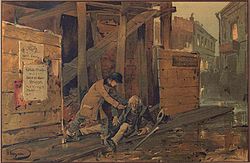 Illustration N.N. Karazin (1893) | |
| Genre | Novel |
| Author | Dostoevsky, Fedor Mikhailovich |
| Original language | Russian |
| Date of writing | 1861 |
| Date of first publication | 1861 [1] |
Content
History of creation and publication
This is the first major work written by a writer after returning from a link. The novel was first published in 1861 in the journal Vremya [1] under the title “Humiliated and Offended. From the notes of the “failed writer” ”with dedication to brother M. M. Dostoevsky. This magazine began to be edited by the author himself and his brother Michael . To fill out the magazine, Fyodor Dostoevsky was forced to create a great novel that could be printed in several issues with a sequel. A significant part of the novel was written by the author in parts directly to the deadline for the new issue of the journal.
The idea of the work dates back to 1857 . After moving to St. Petersburg in 1860, Dostoevsky immediately set about implementing his plan. In July 1861, the final part of the work was published. In the same year, the novel was released as a separate publication in St. Petersburg. During his life, the writer was reprinted two more times, in 1865 and 1879 [2] .
In several places, the author, on behalf of Ivan Petrovich, talks about the fate of his first novel, Poor People , which was published in Petersburg Collection in 1846 and was a great success. In particular, Belinsky highly praised him (B.'s critic in the novel) [3] .
Criticism
The novel was received by critics with restraint. Perhaps this was due to wariness for the writer, who had just returned from a long-standing exile. Only the democratic journal Sovremennik, pointing out the serious shortcomings of the novel, generally met him positively [3] .
Story
The novel was written on behalf of the young writer Vanya, many of whose life details are autobiographical. The duration of the novel is somewhat blurry. The days of the beginning of Dostoevsky’s literary career date back to the 1840s, and in the novel itself, in a slightly veiled form, many characters of the then literary life are mentioned, for example, Vissarion Belinsky under the transparent pseudonym “critic B.”. Some features of the events described make us see in the work not just a reflection of the life of the 1840s. The historical background of the events of the novel itself is often arbitrary. Although no more than one and a half years take place during the duration of the novel, the work mentions realities closer to the era of publication of the novel, for example, the publication of the Encyclopedia by Andrei Kraevsky .
Vanya was brought up in the family of a poor landowner Ikhmenev, along with his daughter Natasha. Ikhmenev’s richer neighbor on the estate, Prince Valkovsky, evaluating Ikhmenev’s economy, appoints him as his manager, and later asks him to lead the education of his son Alyosha for some time. However, soon after the arrival of Alyosha to Ikhmenev’s house, rumors arise that Ikhmenev wants to marry Alyosha with his daughter, encouraging their relationship in every way, and also does not quite honestly manage the prince’s estate, appropriating some amounts for himself. The prince begins the process against Ikhmenev. The matter is complicated by the fact that Alyosha and Natasha Ikhmeneva decided to conclude an alliance against the will of their parents. Vanya loves Natasha, and undertakes to promote her in everything.
Another branch of the novel is connected with a 13-year-old teenage girl, Elena or Nelli (Dostoevsky borrowed her image from the main character of Dickens ’s novel “The Shop of Antiquities”), which Vanya rescues from the hands of a cruel guardian. He sheltered her. The story of her mother is connected in some places with Prince Valkovsky.
A number of chronological shifts are observed in the novel. The action lasts only about a year and a half, but the historical facts mentioned at the beginning of the novel (when Belinsky was still alive, although this name is not in the novel) and at its end (pre-reform years) are separated by more than twelve years [3] .
Topography of the novel
As it later became characteristic of Dostoevsky, the novel takes place in St. Petersburg , and when describing many places of action and movement of heroes around the city, the writer seeks topographical accuracy. So, the book mentions Voznesensky Prospekt , where the storyteller meets with the old man Jeremiah Smith, Bolshaya Morskaya Street , where the restaurant is located, in which the storyteller has a significant conversation with Prince Valkovsky, and so on.
Characters
- Ivan Petrovich; a narrative is being conducted on his behalf
- Nikolai Sergeevich Ikhmenev, landowner
- Anna Andreevna Ikhmeneva (before the marriage of Shumilov), wife of Ikhmenev
- Natasha, daughter of Ikhmenev
- Prince Peter Alexandrovich Valkovsky
- Prince Alexei Petrovich Valkovsky, son of Peter Valkovsky (Alyosha)
- Jeremiah Smith, an old man, the first acquaintance.
- Nelly (Elena), Smith's granddaughter
- Filipp Filippych Masloboev, old friend of Ivan Petrovich
- Alexandra Semenovna, farm manager in the house at Masloboeva
- Katerina Fedorovna, future wife of Prince Alexei Valkovsky
- Anna Trifonovna Bubnova, guardian of Nelly
Style Features
The novel bears both traces of the influence of the “ natural school ” with its keen attention to the life of the city bottom, and the literature of West European realism of the mid-19th century, especially Charles Dickens and Eugene Sue , with their tendency to confused “mysterious” plots, with a long, unknown public , the mystery of the identity of certain characters associated with crimes and wickedness. At the same time, an exacerbated psychologism in the description of the characters is already noticeable in the novel. Character characters, often not receiving any motivation, are not just social types, but images of carriers of one kind or another of “ideas” or “main thoughts”.
There are also many parallels with the Dickens' “Antiquities Shop”, except for the name of the main character. Both girls live in poverty together with their grandfathers, both of them have disagreeable fathers, their lives end tragically.
Adaptations of the work
In 1915, a two-part adaptation of the novel, directed by Joseph Soifer, was performed by the troupe of the Solovtsov theater artists.
In 1958, a mini-series directed by Vittorio Cottavafi was released in Italy
In 1962, the Belgian television film directed by Senne Rufara
In 1971, the Yugoslav television film Blagoy Andreev was released [4] .
In 1976, a television version of the Maly Theater production was staged by Yevgeny Velikhov . In 1991, the feature film "Humiliated and Offended" was shot by director Andrei Eshpay .
In 2005, based on the play, the Moscow State Musical Theater, led by Gennady Chikhachev, staged a musical to the music of Alexander Zhurbin .
On February 4, 2005, the Perm Academic Theater-Theater staged the musical Vladimirskaya Ploshchad, based on the novel.
Notes
- ↑ 1 2 F.M. Dostoevsky. Humiliated and offended // "Time". - 1861. - T. I , No. 1 . - S. 5–92 . (First part),
F.M.Dostoevsky. Humiliated and offended // "Time". - 1861. - T. I , No. 2 . - S. 419—474 . (the second part of),
F.M.Dostoevsky. Humiliated and offended // "Time". - 1861. - T. II , No. 3 . - S. 235-324 . (the third part),
F.M.Dostoevsky. Humiliated and offended // "Time". - 1861. - T. II , No. 4 . - S. 615-633 . (chapters I and II of the fourth part),
F.M.Dostoevsky. Humiliated and offended // "Time". - 1861. - T. III , No. 5 . - S. 269-314 . (chapters III — VII of the fourth part),
F.M.Dostoevsky. Humiliated and offended // "Time". - 1861. - T. III , No. 6 . - S. 535-582 . (chapters VIII — XII of the fourth part) and
F.M.Dostoevsky. Humiliated and offended // "Time". - 1861. - T. IV , No. 7 . - S. 287-314 . (epilogue). - ↑ Nina Budanova. Comments on the humiliated and offended novel
- ↑ 1 2 3 "Humiliated and Offended." Perm, 1976. Notes
- ↑ Movie page on IMDB