Recycling of petrodollars [3] ( eng. Petrodollar recycling ) is the foreign expenditure or investment of proceeds from the export of petroleum products [4] . As a rule, the term is used in relation to large oil exporters - members of OPEC , Russia and Norway - who are not able to effectively distribute the resources received within the country. Global financial flows linking oil producers and consumers are estimated at hundreds of billions of US dollars per year, and part of the transactions are made in many other currencies, pegged to the dollar or not. The flows largely depend on the decisions of governments that can invest petrodollars abroad or provide other partners with assistance of a different kind. The consequences of the decisions are affecting both global finance and oil policy . The phenomenon is especially noticeable in those periods when oil prices reach historical peaks [5] . Moreover, the first influx of petrodollars (1974-1981) led to greater financial difficulties than the second (2005-2014).
Content
Capital Flows
Background
During the two indicated periods, oil exporters gained a large amount of funds [1] [2] [6] . The term " petrodollars " arose in 1973. Authorship is attributed to two commentators at once: American economist of Egyptian origin Ibrahim Oveiss and former US Secretary of Commerce Peter J. Peterson [7] [8] [9] . Some exporters formed surpluses of petrodollars - the positive difference in US dollars between the profit from the sale of oil and the domestic demand for investment resources [10] . Investing excess funds in their own economy would be ineffective due to the small population or insufficient industrialization . On the other hand, excess revenues could be invested in the economies of other countries, or aimed at the purchase of consumer goods, building materials, and weapons. In addition, the removal of petrodollars from the global economy would slow down global economic growth, ultimately damaging exporters. Their own long-term growth depended in many respects on the opportunities to profitably invest profits from the sale of oil [11] .
The first influx (1974-1981)
Recycling petrodollars helped mitigate the short-term effects of the 1973 crisis , but oil importers suffered from high prices, accumulating long-term debt. According to the IMF , the external debt of 100 oil-importing developing countries grew by 150% in 1973-1977. The situation was exacerbated by the global transition to a floating exchange rate regime . In 1974, IMF managing director Johan Witteven said: “The world monetary system has entered a difficult period for itself since the 1930s” [12] [13] . The fund launched a new lending program (1974-1976) called the Oil Facility . As part of the program, oil-producing countries and some other lenders helped states whose trade balance was severely affected by rising prices. Among the recipients were dozens of developing and some developed countries, for example, Italy and the United Kingdom [14] .
From 1974 to 1981, the total current account surplus of OPEC countries reached $ 450 billion (excluding the decades of inflation that followed). 90% of the surplus was in the Gulf countries and Libya . The Iranian government was also content with an oil surplus, but the 1978 revolution , the war with Iraq, and international sanctions greatly weakened the Persian economy. [10]
Significant volumes of Arab petrodollars were invested in securities of the US Treasury and financial markets of other developed countries. Investment flows were controlled by government organizations, now called sovereign funds [15] [16] . Billions of dollars were invested in commercial banks in the United States and Europe. All this contributed to the growth of the Eurodollar market, freer from regulation than the American money markets. The recession in the global economy has made private equity investments less attractive, with banks and wealthy governments lending mostly to developing countries. Large flows of funds were directed to Latin America, including Brazil and Argentina [10] , and other large emerging economies, for example. in Turkish . The 1973 oil crisis created a serious dollar deficit in these countries, but they still needed money to import oil and engineering products. In early 1977, the cabinet of the Turkish Prime Minister ceased to be heated, and therefore the opposition leader Suleiman Demirel uttered the famous words “Turkey lacks 70 cents” [17] [18] . According to political journalist William Grader, bank loans formed from deposits of oil-producing states saved developing countries from bankruptcy [19] . In the following decades, many of the debtors realized the impossibility of repayment. Their governments declared the neocolonial nature of their obligations, seeing the only way out of debt relief [20] .
Second Influx (2005–2014)
Responding to the second influx of petrodollars, financial market participants relied on the experience of the first cycle. Developing countries avoided major imbalances, the world economy was not so much dependent on petroleum products. World inflation and interest rates were held back much more effectively. Oil exporters sought to invest in many markets, refusing to mediate international banks and the IMF [22] [23] [24] .
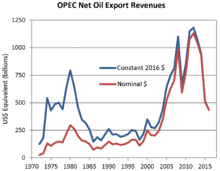
Due to the increase in prices in 2003-2008, the revenue of OPEC members reached a record $ 1 trillion per year (2008 and 2011-2014) [2] . A tangible surplus was received by Russia and Norway, which are not members of OPEC [6] . In 2014-2015, sovereign funds held a total of $ 7 trillion. [25] Iran, Iraq, Libya, Nigeria and Venezuela, which were in a state of political crisis, were unable to take advantage of the favorable circumstances of the market. Some economists attribute this state of affairs to the resource curse phenomenon [26] [27] . Most exporters were able to prepare for a price collapse caused by the overproduction of oil [28] .
International Assistance
Oil exporters send part of the proceeds to help partner countries. In journalism and even refereed publications [29] [30] , clichés of “ check diplomacy ” and “ oil Islam ” clung to such relations. The pioneer in this direction was the Kuwait Fund for Arab Economic Development (1961), since 1974 other Arab states began to provide international assistance. Partners were supported, inter alia, through the channels of the International Monetary Fund and the OPEC Fund for International Development [10] [31] [32] . There were indirect channels. Tens of millions of foreign workers who worked in the Middle East sent part of their earnings home to less prosperous countries [33] . At the same time, working conditions in the Gulf countries were very severe [34] . Some governments in oil-exporting countries provided financial support to armed groups operating in unfriendly states [35] [36] [37] [38] .
High oil prices in 1974-1981 allowed the Soviet government to support the crisis economies of the Eastern Bloc . It is believed that the overproduction of oil in the 1980s contributed to the collapse of the block in 1989 [39] . During the second influx of petrodollars, the OPEC member state of Venezuela sent money to the Cuban government and carried out preferential oil supplies under the Petrocaribe program [40] . The fall in oil prices in 2014-2017 provoked a crisis in Venezuela itself [41] .
Examples
US Treasury Securities . In 1960–2015, OPEC member governments concentrated about $ 300 billion in US Treasury bonds [42]
German automobile factory Daimler . The largest shareholder of the enterprise since 1974 is Kuwait [43] [44]
Itaipu Dam on the border of Brazil and Paraguay . Built in the 1970s on loans from banks whose depositors were oil exporters [45]
Faisal Mosque in Islamabad (1976-1986) donated to Pakistan by Saudi King Faisal [46]
In the context of food shortages (1970–80s), the Soviet Union imported western grain [47]
Since 1981, Saudi Arabia has purchased dozens of American F-15 fighter jets [48]
Harrods Department Store in London . Since 1985, owned by Arab owners [49] [50]
Chelsea Football Club since 2003 belongs to Roman Abramovich , owner of Sibneft [51] [52] [53]
A 2004 bilateral agreement between Venezuela and Cuba provides for the exchange of medical services for preferential oil supplies [54]
Since 2005, Dubai- based Emirates has acquired millions of liters of top-quality French wine [55]
The Turkish Telecommunications Corporation in 2005 came under the control of Saudi Oger . The IMF acted as broker [56]
In 2008, the Abu Dhabi Investment Council acquired 90% of the Chrysler Building in New York [57] [58]
Iran supplies arms to Lebanon and Syria , supporting Hezbollah’s organization. In 2009, the Israeli fleet intercepted 300 tons of weapons [59] [60]
“ Card Players ” Cezanne in 2011 became the property of the Qatari royal family. The record amount of the transaction exceeded $ 250 million. [61]
The construction boom of 2003-2014 in the UAE was provided mainly by foreign labor [34]
Toyota cars in Kuwait . Japanese manufacturer dominates the Kuwait market [62]
See also
- Dutch disease
Notes
- ↑ 1 2 OPEC Revenues Fact Sheet . US Energy Information Administration (January 10, 2006). Archived January 7, 2008.
- ↑ 1 2 3 OPEC Revenues Fact Sheet . US Energy Information Administration (May 15, 2017). Date of treatment May 28, 2017.
- ↑ Otherwise - "processing of petrodollars" , "recycling of petrodollars . "
- ↑ This article refers to petrodollars classified as English. oil windfalls , that is, "unexpectedly received" petrodolars. See (Smolyar, 2006) for more details.
- ↑ Nsouli, Saleh M. Petrodollar Recycling and Global Imbalances . International Monetary Fund (March 23, 2006). Date of treatment January 14, 2017.
- ↑ 1 2 Petrodollar Profusion (April 28, 2012). Date of treatment February 7, 2016.
- ↑ Personality: Ibrahim M. Oweiss (December 26, 1983), p. 8. Date of treatment January 11, 2017. “In March 1973 ... Two weeks after Dr. Oweiss had used the word - at an international monetary seminar held at Columbia University's Arden House in Harriman, New York - it was picked up by a prestigious economics commentator in The New York Times . ” According to the Oweiss and NYT websites, it appears that these events actually occurred in March 1974.
- ↑ Rowen, Hobart . Peterson Urges Cooperation (July 9, 1973), S. A1. Circulation date February 5, 2016. "He thinks the US should give more study to ways in which the excess funds - he calls them petro dollars - can be soaked up."
- ↑ Popik, Barry Petrodollar Neopr (February 1, 2012). - “Georgetown University economics professor Ibrahim Oweiss has written about petrodollars and is credited with the word's coinage by Wikipedia, but there is insufficient documentary evidence that he used the term first in 1973. Former commerce secretary Peter G. Peterson was credited with using 'petrodollar 'in a July 1973 Washington Post article. ". Date of treatment January 11, 2017.
- ↑ 1 2 3 4 Oweiss, Ibrahim M. Economics of Petrodollars // The Economic Dimensions of Middle Eastern History. - Darwin Press, 1990. - P. 179-199.
- ↑ Petrodollar Problem . International Monetary Fund. Date of treatment January 31, 2016.
- ↑ English "The international monetary system is facing its most difficult period since the 1930s."
- ↑ Recycling Petrodollars . International Monetary Fund. Date of treatment January 31, 2016.
- ↑ Neu, Carl Richard International Balance of Payments Financing and the Budget Process 27–29. US Congressional Budget Office (August 1977). Date of treatment February 5, 2016.
- ↑ Spiro, David E. The Hidden Hand of American Hegemony: Petrodollar Recycling and International Markets . - Ithaca: Cornell University Press , 1999. - P. 74–75. - ISBN 0-8014-2884-X .
- ↑ Wong, Andrea . The Untold Story Behind Saudi Arabia's 41-Year US Debt Secret , Bloomberg News (May 30, 2016). Date of appeal May 31, 2016.
- ↑ English "Turkey is in need of 70 cents."
- ↑ Özel, Işık. State – Business Alliances and Economic Development: Turkey, Mexico and North Africa . - Routledge , 2014 .-- P. 34. - ISBN 978-1-317-81782-6 .
- ↑ Greider, William. Secrets of the Temple . - Simon & Schuster , 1987. - P. 340. - ISBN 978-0-671-47989-3 .
- ↑ Carrasco, Enrique. Foreign Debt: Forgiveness and Repudiation // The E-Book on International Finance & Development / Enrique Carrasco, Charles McClellan, Jane Ro. - University of Iowa , April 2007. Archived June 6, 2011 to Wayback Machine
- ↑ Federal Reserve Economic Data graph . Federal Reserve Bank of St. Louis . Date of treatment August 25, 2016.
- ↑ Lubin, David Petrodollars, emerging markets and vulnerability . Citigroup (March 19, 2007). Date of treatment January 31, 2016.
- ↑ Recycling the Petrodollars (November 10, 2005). Date of treatment February 14, 2016.
- ↑ Oxford Analytica. World Economy Less Vulnerable To Petrodollars Neopr (August 11, 2008). Date of treatment January 13, 2017.
- ↑ Bianchi, Stefania . Sovereign Wealth Funds May Sell $ 404 Billion of Equities , Bloomberg News (February 22, 2016). Date of treatment February 22, 2016.
- ↑ The Resource Curse . Natural Resource Governance Institute (March 2015). Date of treatment January 22, 2017.
- ↑ Aguilera, Roberto F. The Price of Oil / Roberto F. Aguilera, Marian Radetzki. - Cambridge University Press, 2015. - P. 87–89. - ISBN 978-1-31643242-6 .
- ↑ Blas, Javier . Oil-Rich Nations Are Selling Off Their Petrodollar Assets at Record Pace , Bloomberg News (April 13, 2015). Date of treatment February 14, 2016.
- ↑ https://scholar.google.com/scholar?q=%22checkbook+diplomacy%22
- ↑ https://scholar.google.com/scholar?q= chosenpetro- islam »
- ↑ Timeline . Kuwait Fund. Date of treatment January 22, 2017.
- ↑ Hubbard, Ben . Cables Released by WikiLeaks Reveal Saudis' Checkbook Diplomacy (June 21, 2015). Date of treatment February 16, 2016.
- ↑ Mukherjee, Andy . Oil's Plunge Spills Over , Bloomberg News (February 4, 2016). Date of treatment February 4, 2016.
- ↑ 1 2 Davis, Mike. Fear and Money in Dubai (Neopr.) // New Left Review .
- ↑ Iranian General: Tehran Arming 'Liberation Armies' (October 27, 2008). Date of treatment March 29, 2017.
- ↑ Weinberg, Leonard. The Role of Terrorism in 21st-Century Warfare / Leonard Weinberg, Susanne Martin. - Oxford University Press, 2016 .-- ISBN 978-1-78499764-9 .
- ↑ Cockburn, Patrick . US allies Saudi Arabia and Qatar are funding ISIS (October 14, 2016). Date of treatment March 29, 2017.
- ↑ Pacepa, Ion Mihai . Russian Footprints (August 24, 2006). Archived January 9, 2015.
- ↑ McMaken, Ryan The Economics Behind the Fall of the Berlin Wall . Mises Institute (November 7, 2014). - "High oil prices in the 1970s propped up the regime so well, that had it not been for Soviet oil sales, it's quite possible the regime would have collapsed a decade earlier." Date of treatment January 12, 2016.
- ↑ Gibbs, Stephen . Venezuela ends upbeat Cuba visit , BBC (August 24, 2005). Date of treatment November 28, 2016.
- ↑ Polanco, Anggy . Venezuelan shoppers flock across border to Colombia (July 17, 2016). Date of treatment December 31, 2016.
- ↑ Major Foreign Holders of Treasury Securities . US Department of the Treasury (December 15, 2015). Archived January 3, 2016.
- ↑ Taylor, Edward . Kuwait Investment Authority says to expand Germany investments (September 18, 2014). Date of appeal January 17, 2017. "The KIA ... is the largest shareholder in Daimler.".
- ↑ Al Saleh, Anas K. KIA / Daimler 40th Anniversary Celebrations . Kuwait Investment Authority (September 18, 2014). - "From a 14.6% stake of around US $ 329 million acquisition in December 1974, the KIA is now the largest consistent shareholder in Daimler over 40 years where our 6.9% stake is currently valued around $ 7 billion." Date of treatment January 17, 2017.
- ↑ Castor, Belmiro VJ Brazil Is Not for Amateurs . - English, 2nd. - Xlibris , 2003. - P. 202. - “International bankers ... began to invest huge amounts of those petro-dollars in Brazil and other developing countries ..., allowing them to finance gigantic infrastructure works like the Itaipu Hydroelectric Plant. ". - ISBN 978-1-46910432-4 .
- ↑ Shah Faisal Mosque . Lonely Planet. - "Most of its cost (pegged at about US $ 120 million today) was a gift from King Faisal of Saudi Arabia.". Date of treatment March 29, 2017.
- ↑ Zubok, Vyadislav M. Soviet foreign policy from détente to Gorbachev, 1975–1985 // The Cambridge History of the Cold War: Volume III, Endings . - Cambridge University Press, 2010. - P. 109-110. - “The former head of the Soviet planning agency, Nikolai Baibakov, recalled that 'what we got for oil and gas' was $ 15 billion in 1976–80 and $ 35 billion in 1981–85. Of this money, the Soviets spent, respectively, $ 14 billion and $ 26.3 billion to buy grain, both to feed the cattle on collective farms and to put bread on the tables of Soviet citizens. ” - ISBN 978-1-31602563-5 .
- ↑ Mohr, Charles . Saudi AWACS Deal Passes $ 8 Billion (August 22, 1981). Released November 5, 2016. “The price of the arms sale gives increased weight to an argument that in part it should be approved because it helps to 'recycle petrodollars'.”.
- ↑ Feder, Barnaby J .. Harrod's New Owner: Mohamed al-Fayed; A Quiet Acquisitor Is Caught in a Cross Fire (September 8, 1985). Accessed January 16, 2017. “This was a dream come true for the family, which built its fortune ... first in the oil-rich countries of the Persian Gulf.”.
- ↑ Mohammed Fayed sells Harrods store to Qatar Holdings , BBC (May 8, 2010). Date of treatment February 7, 2016.
- ↑ Russian businessman buys Chelsea , BBC (July 2, 2003). Date of treatment March 23, 2016.
- ↑ Critchley, Mark . Roman Abramovich reaches 700 games as Chelsea owner - but how does his reign stack up against the rest? (April 12, 2015). Date accessed August 1, 2016. “Since the Russian oligarch began pouring petro-dollars into Stamford Bridge, he has turned one of English football's underachieving clubs into an established powerhouse.”
- ↑ Delaney, Miguel . The colossal wealth of Manchester City and Chelsea is changing the landscape of British football (February 2, 2014). Date accessed August 1, 2016. “It should not escape notice that this is the first true title showdown, and first genuine title race, between the petrodollar clubs.”.
- ↑ Corrales, Javier The Logic of Extremism: How Chávez Gains by Giving Cuba So Much . Inter-American Dialogue (December 2005). - “In return for oil, Cuba is sending Venezuela between 30,000 and 50,000 technical staff. As many as 30,000 Cubans in Venezuela are presumably medical doctors. ” Date of treatment November 29, 2016.
- ↑ Gaddy, James . Emirates Has Invested $ 500 Million to Build a 'Fort Knox' of Wine , Bloomberg News (January 5, 2017). Released January 5, 2017. “Since the Dubai-based airline began its wine program 12 years ago, it has spent more than $ 500 million to develop the best wine list in the sky ... 'It's an investment. We look at it like a commodity. '”.
- ↑ Aydogdu, Hatice . Oger Telecom signs $ 6.55 bln Turk Telekom deal (November 15, 2005). Archived February 2, 2017. Date of treatment January 30, 2017. “'... a long-term investment, not only in the future of Turk Telekom but also in Turkey,' Hariri said. "The sale of Turk Telekom's controlling stake is a key element of Turkey's IMF-backed privatization program."
- ↑ Abu Dhabi buys 75% of Chrysler Building in latest trophy purchase (July 9, 2008). Date of circulation December 29, 2016. "These funds, which maintain passive investment positions, will perform a crucial petrodollar-recycling function."
- ↑ Bagli, Charles V .. Abu Dhabi Buys 90% Stake in Chrysler Building (July 10, 2008). Date of treatment July 3, 2016.
- ↑ Lynch, Colum . UN panel voices concern over Iran's apparent violations of arms-export embargo (December 11, 2009). Date of appeal March 29, 2017. “A UN sanctions committee expressed 'grave concern' Thursday about what it called apparent Iranian violations of a UN ban on arms exports.”
- ↑ Iranian Official Admits Tehran Supplied Missiles to Hezbollah (August 4, 2006). Date of appeal March 29, 2017. “Mohtashami Pur, a one-time ambassador to Lebanon who currently holds the title of secretary-general of the 'Intifada conference', told an Iranian newspaper that Iran transferred the missiles to the Shi'ite militia." .
- ↑ Peers, Alexandra . Qatar Purchases Cézanne's The Card Players for More Than $ 250 Million, Highest Price Ever for a Work of Art (February 2012). Date accessed February 19, 2016. "The money is there: the United Arab Emirates region is home to nearly 10 percent of all the world's oil reserve."
- ↑ Business Monitor International. Q2 2016 (unspecified) // Kuwait Autos Report. - 2016 .-- March.
Further reading
- Clark, William R. Petrodollar Warfare. - New Society Publishers, 2005. - ISBN 978-0-86571-514-1 .
- Smolyar, Leonid (2006). Petrodollars: Tracking the Flow and Investment of Oil Windfalls (PDF) (B.Sc. Honors thesis). New York University . Archived from the original (PDF) on April 25, 2012. Archived April 25, 2012 on Wayback Machine
- Staats, Elmer B. The US – Saudi Arabian Joint Commission on Economic Cooperation . US Government Accountability Office (1979). Date of treatment January 31, 2016.