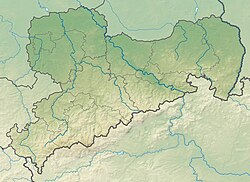
The Karl-Heine Canal ( German Karl-Heine-Kanal ) is an artificial water conduit in the west of the German city of Leipzig in the federal state of Saxony , which connects the Weisse-Elster river with the harbor in Lindenau. With a length of about 3.3 km, [1] the channel is crossed by 15 bridges, and is open for use by small ships. Included in the list of cultural monuments of Leipzig [2] .
| Carl Heine Channel | |
|---|---|
| him Karl-Heine-Kanal | |
 | |
| Location | |
| A country |
|
| Land | Saxony |
| Area | Leipzig |
| Characteristic | |
| Length | 3.3 km |
| Deepest | 2.5 m |
| Watercourse | |
| Head | |
| · Head location | Leipzig is mute. Nonnenbrücke |
| Mouth | |
| · Location of the mouth | Leipzig is mute. Lindenauer hafen |
 - head, - head,  - mouth - mouth | |



The construction of the waterway was carried out from 1856 to 1864 [2] on the initiative of the Leipzig lawyer and industrialization pioneer Karl Heine [2] , and was the first stage in the construction of the navigable canal between the Weisse-Elster and the Saale rivers, which was supposed to provide cheap transport links for the Leipzig industry with large river systems of Europe.
The first section of the canal was opened on June 25, 1864, [1] in 1887, reaching the Prussian Tsaytsky railway station (currently S-Bahn station Plagwitz ). The project, however, could not receive state support, remaining in fact a private initiative of manufacturers from the western suburbs of Leipzig, and constantly faced financial and technical problems that slowed down the progress of work. In 1890–98, the canal [1] was extended to the current Louise Bridge ( German Luisenbrücke ), where construction stopped pending the excavation of the extensive trading harbor at Lindenau ( German Lindenauer Hafen , started in 1938, the project remained unfinished).
At the time of the GDR, the canal became completely neglected, including as a result of a long discharge of untreated industrial waters of textile, chemical and heavy industries, and was reclaimed only in the 1990s. At the same time on the north bank of the channel. Karl Heine was paved with a cycle path that quickly gained popularity among the townspeople.
In 2007, in order to spur the development of water tourism by the city council of Leipzig, it was decided to build the last section of the canal with a length of 665 m, designed to connect the canal with the harbor. July 2, 2015 it was open for shipping [3] .
Notes
- ↑ 1 2 3 Leipzig-Lexikon Channel them. K. Heine in the online encyclopedia Lepzig-Lexikon
- ↑ 1 2 3 № 09290819 // Kulturdenkmale im Freistaat Sachsen
- ↑ 665 Meter: Lindenauer Hafen mit Karl-Heine-Kanal verbunden Art der Leipziger Volkszeitung bei lvz-online.de; abgerufen am 3. Juli 2015.
Literature
- Achtner, Denis: Karl-Heine-Kanal: Streifzug durch die Geschichte und entlang des Kanals. Leipzig, Creativ Werbeagentur Kolb, 2012. ISBN 978-3944992082
- Krüger, Ulrich: Carl Heine. Der Mann der Leipzig zur Industriestadt machte. Erfurt, Sutton Verlag, 2008. ISBN 3-866-80362-1
- Sturm, Wolfram: Das schiffbare Leipzig: Träume, Pläne und Realitäten aus vier Jahrhunderten. Leipzig, Pro Leipzig eV, 2017. ISBN 978-3-9450-2729-5