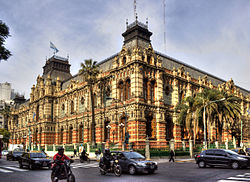
The Palacio de Aguas Corrientes ( Spanish: Palacio de Aguas Corrientes ) is a palace in Buenos Aires , located on 1950 Avenida Cordoba Avenue in the Balvanera district. It was built to house the water tanks of a growing city at the end of the 19th century . The palace is a national historical monument.
| Sight | |
| Palacio de Aguas Corrientes | |
|---|---|
| Palacio de aguas corrientes | |
 | |
| A country |  Argentina Argentina |
| Location | Balvanera , Buenos Aires , Avenida Cordoba 1950 |
| Architectural style | |
| Project Author | Olaf Boyer |
| Building | 1887 - 1894 |
| Site | |
Content
History
In the second half of the nineteenth century, Buenos Aires began to grow rapidly, taking on new migration waves and strengthening. The growing population brought with it the problems of overpopulation and the lack of necessary public services to provide a growing number of people. Epidemics began: in 1867, about 1,500 people were killed by cholera, in 1869 typhus caused the death of 500 people, and in 1871 there was a historical yellow fever epidemic , which affected 14,000 of the 178,000 people living in Buenos Aires at that time . Faced with alarming signs of deterioration in the quality of drinking water, the authorities of the recently united country decided to provide the capital with an advanced water supply network, taking advantage of years of economic abundance and prosperity. Following the plans of the English civil engineer John Bateman in 1886, the national government decided that a drinking water treatment plant would be installed in the north of the city and connected to underground pipes. Generous funding was allocated for the construction of the building, with a budget of 5,531,000 pesos fuerte.
The company "Bateman, Parsons & Bateman" took up the project for the construction of internal equipment [1] . Samuel B. Hale y Co took over the construction of the building, and exterior façade work was entrusted to Juan B. Médici, which was led by Swedish engineer Carlos Nistremer and Norwegian architect Olof Boye (Bateman, Parsons & Bateman employees). Work began in 1887, they hired 400 workers, and completed construction in 1894, the building was opened by President Luis Saens Peña [2] . The building was subsequently used by Obras Sanitarias de la Nación (which was located there in 1930), Aguas Argentinas, and Agua y Saneamientos Argentinos (now). In 1989, by decree 325 of the city government, the Palacio de Aguas Corrientes Palace became a National Historic Landmark.
Description
The building is one of the examples of eclectic architecture that fascinated the elite of the city, which ruled Argentina until 1916. The style of the building is most similar to the buildings of the Second French Empire , and some of the elements stand out against the general background of polychrome ceramics and rich decorations on the facade. At three levels of the building there are 12 water tanks (delivered by the Belgian company Marcinelle et Coulliet on a tender from December 1886) with a total capacity of 72 million liters of water with an estimated weight of 135,000 tons. They are supported by the supporting structure of beams, columns and metal supports. The ceiling is up to 1.80 m thick and is supported by 180 columns spaced six meters apart. In the center of the palace is a courtyard which provides light and air in the building.
However, the facade of the Palacio de Aguas Corrientes Palace is admirable. Its coating was made of 130 thousand enameled bricks and 300 thousand ceramic products imported from Belgium [2] and England and numbered to facilitate their placement. Marble tiles designed to cover the façade in the original design were replaced with terracotta tiles made by Royal Doulton & Co., London and Burmantofts, Leeds . The ceiling was covered with green slate brought from France.
The idea of turning a water tank into a palace received many criticisms, as a rule, due to the lack of need for the construction of such a luxurious building, given its purpose. However, at that time utilitarian function buildings already existed, such as railway terminals, which were surrounded by palace-type elements. [3]
Today
The building houses the Museum of Historical Heritage, Archivo de Planos Domiciliarios and administration companies. In 2015, the state-owned company Aysa began the gradual restoration of the Palace of the Palacio de Aguas Corrientes.
Gallery
Notes
- ↑ Gran depósito distribuidor unopened (inaccessible link - history ) . Catálogo acceder
- ↑ 1 2 Un imponente palacio con corazón de oficinas .
- ↑ http://www.pagina12.com.ar/diario/suplementos/m2/10-2970-2015-08-09.html (inaccessible link - history ) .
Links
- La historia de un edificio emblemático de Buenos Aires Diario "Clarín", 12/30/1996.
- Lista de bienes patrimoniales de la Ciudad de Buenos Aires (Link not available) . Archived November 4, 2011. Comisión Nacional de Museos y Monumentos y Lugares Históricos. (pag. 52)
- El Palacio de las Aguas (por Júlio Cacciatore). Revista "Soles" nº 79, agosto de 2001.
- Símbolo arquitectónico de Buenos Aires: La vistosa apariencia del gran depósito de aguas (por Juan José Nigro). Revista del Notariado nº 885.