Western and central parts of Angola , northern Namibia , Botswana , Western Zambia , Zimbabwe , southern Mozambique , South Africa east of the province of Northern Cape, south-western part of the Eastern Cape . Perhaps Lesotho [2] .
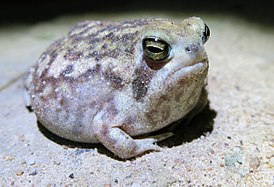
The body is thick and spherical, with a flattened muzzle. The skin color is light or dark brown, with rows of lighter yellow-orange spots with darker borders. The limbs are typical of most digging frogs and toads - short and thick. Females are much larger than males [3] . The songs are a short, blurry whistle. Performed by a continuous series of individual trills or groups of 2, 3 or more trills [4] .
Natural habitats are savannahs , bushes, floodplains and lowlands, arable land , pastures, plantations and urban areas [5] .
They lead an underground lifestyle, coming to the surface only for feeding and mating in the rainy season . Dig holes up to 50 cm deep with their hind legs. In the event of an attack, the frog swells, thereby securing itself inside the hole. They feed on small invertebrates [6] .
Due to the difference in size and very short limbs, males are not able to grasp the female during mating. Therefore, the female secretes a sticky substance that “sticks together” the male and the female during mating. The “glued” pair buries underground to the wet layer, where a hole is made, after which the female lays eggs. The development of these frogs is direct, from the eggs already formed frogs emerge from 3 to 6 centimeters in size [5] [7] .