
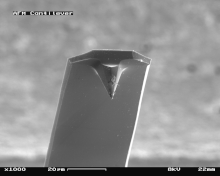


Cantilever ( eng. Cantilever - bracket, console) is the well-established name for the design of the micromechanical probe most common in scanning atomic force microscopy .
Content
Device
The cantilever is a massive rectangular base with dimensions of approximately 1.5 × 3.5 × 0.5 mm, with a beam protruding from it (the cantilever itself), with a width of about 0.03 mm and a length of 0.1 to 0.5 mm. One of the sides of the beam is mirrored (sometimes a thin layer of metal, for example, aluminum, is sprayed onto it to amplify the reflected laser signal), which allows the use of an optical cantilever bending control system. On the opposite side of the beam at the free end is a needle that interacts with the measured sample. The shape of the needle can vary significantly depending on the manufacturing method. The radius of the needle tip of industrial cantilevers is in the range of 5–90 nm, laboratory - from 1 nm.
Principle of Operation
The following two equations are key to understanding how cantilevers work. The first is the so-called Stoney's formula , which relates the deflection of the end of the cantilever beam δ to the applied mechanical stress σ:
where ν is the Poisson's ratio , - Young's modulus , Is the length of the beam, and - the thickness of the cantilever beam. Beam deviation is recorded by sensitive optical and capacitive sensors.
The second equation establishes the dependence of the elastic coefficient of the cantilever from its size and material properties:
Where - applied force, and - the width of the cantilever. The coefficient of elasticity is related to the resonant frequency of the cantilever according to the law of harmonic oscillator :
.
A change in the force applied to the cantilever can result in a shift in the resonant frequency. The frequency shift can be measured with great accuracy by the principle of a local oscillator .
One of the important problems in the practical use of the cantilever is the problem of the quadratic and cubic dependence of the properties of the cantilever on its size. These non-linear dependencies mean that cantilevers are quite sensitive to changes in process parameters. Residual strain control can also be difficult.
See also
- Scanning Atomic Force Microscope
- Scanning Probe Microscope
- Silicon nitride
- Cantilever beam ( English Cantilever , total value)