Let there be an incidence structure consisting of points direct and flags . They say the point direct incident , if . A structure is called finite partial geometry if integers exist such that:
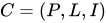


- For any pair of different points and there is a maximum of one line incident to both points.
- Every direct incident points.
- Every point is incidental direct.
- If the point and direct not incidental, exists exactly steam such that incidental , but incidental .


Partial geometry with these parameters is denoted by .

Content
- 1 Properties
- 2 Special cases
- 3 Generalizations
- 4 notes
- 5 Literature
Properties
- The number of points is given by the formula , and the number of lines by the formula .
- Dot graph [1] structure is a strongly regular graph : .
- Partial geometries are dual - a dual structure for is just a structure .
Special cases
- Generalized quadrangles are exactly partial geometries from .
- Steiner systems are exactly partial geometries from .
Generalizations
of order called semi-partial geometry if integers exist such that:
- If the point and direct not incidental, exists either or exactly steam such that incidental and incidental .
- Any pair of noncollinear points has exactly common neighbors.
A semi-partial geometry is partial geometry if and only if .
It is easy to show that the collinearity graph [1] of such a geometry is strictly regular with parameters .
A good example of this geometry is obtained by taking affine points and only those lines that intersect the plane at infinity at a point of a fixed Baire subplane. Geometry has parameters .
Notes
- ↑ 1 2 If a partial geometry P is given in which any two points define at most one straight line, a collinearity graph or a point graph of geometry P is a graph whose vertices are points P and two vertices are connected by an edge if and only if they define a straight line in P.
Literature
- Brouwer AE, van Lint JH Strongly regular graphs and partial geometries // Enumeration and Design / Jackson DM, Vanstone SA. - Toronto: Academic Press, 1984. - S. 85–122.
- Bose RC Strongly regular graphs, partial geometries and partially balanced designs // Pacific J. Math. - 1963.- T. 13 . - S. 389-419 .
- De Clerck F., Van Maldeghem H. Some classes of rank 2 geometries // Handbook of Incidence Geometry. - Amsterdam: North-Holland, 1995. - S. 433-475.
- Thas JA Partial Geometries // Handbook of Combinatorial Designs / Colbourn Charles J., Dinitz Jeffrey H .. - 2nd. - Boca Raton: Chapman & Hall / CRC, 2007. - S. 557-561. - ISBN 1-58488-506-8 .
- Debroey I., Thas JA On semipartial geometries // Journal of Combinatorial Theory Ser. A. - 1978. - T. 25 . - S. 242–250 .