The estate of Vorontsov-Dashkov (the estate of Bykovo , less often - Marino ) is a manor complex in the park of the village of Bykovo near Moscow , near the city of Zhukovsky . An outstanding example of Russian architecture and decorative art of the era of Emperor Nicholas I. Built according to the designs of architects Vasily Bazhenov , Matvey Kazakov and Bernard De Simon , belonged to representatives of influential families of the Russian nobility [1] . The territory of the estate and the adjacent park occupies approximately 30 hectares [2] .
| Homestead | |
| Manor Vorontsov-Dashkova | |
|---|---|
| Bykovo | |
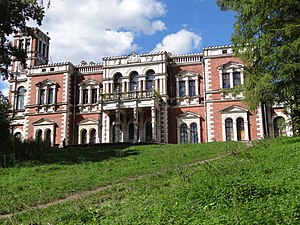 Main house of the Vorontsov-Dashkov Manor, view from the Bykovka River | |
| A country |  Russia Russia |
| Location | Moscow region , Zhukovsky district, Bykovo |
| Architectural style | classicism , russian gothic |
| Project Author | Bazhenov V.I. |
| Founder | Izmailov M.I. |
| First mention | XIV-XVI century |
| Status |  An object of cultural heritage of the peoples of the Russian Federation of federal significance. Reg. No. 501420421310006 ( EGROKN ) An object of cultural heritage of the peoples of the Russian Federation of federal significance. Reg. No. 501420421310006 ( EGROKN ) |
| condition | in desolation, reconstruction is required |
Content
- 1 History
- 1.1 Etymology
- 1.2 The Vorontsov Period
- 1.3 The Izmailov period
- 1.3.1 Church of the Vladimir Icon of the Mother of God
- 2 Return to the Vorontsov
- 3 Ilyins
- 4th XX century
- 5th XXI century
- 6 notes
- 7 Literature
- 8 References
History
Bykovo Manor has a long history; it has changed several owners from famous Russian families. According to some sources, the first mention of the village of Bykovo is in the spiritual letter of Dmitry Donskoy - a testament drawn up before the Battle of Kulikovo [3] . According to other sources, the village was first mentioned during the time of Ivan the Terrible , in documents after the capture of Kazan [4] .
Etymology
It is believed that the name of the village "Bykovo" came from a cattle drive station, which was once located in this area. In its meadows, cattle were fed before distillation to Moscow [3] ; according to other sources, cattle were slaughtered and meat that was already cut was sent to the capital [4] .
Vorontsov Period
The first owner of the village of Bykovo from the Vorontsov clan was governor Illarion - he received it as a gift from Peter I for his services to the Fatherland. From Illarion, the village passed to the heirs of the Vorontsov family until the middle of the 18th century . Ekaterina Romanovna Vorontsova-Dashkova , Mikhail Illarionovich Vorontsov , Ivan Illarionovich Vorontsov and many other representatives of the Vorontsov family played important roles in the fate of the Russian Empire [3] .
Izmailov Period
In the second half of the 18th century, the Vorontsovs were in disgrace and Catherine II granted Bykov’s lands to Mikhail Mikhailovich Izmailov , who participated in the 1762 coup and the Moscow commander in chief . Under him, it was decided to reconstruct the estate, because in its former state it "did not make the Empress absolutely no impression." Izmailov was the head of the Kremlin expedition of palace buildings and for many years collaborated with the first architect of Tsaritsyno near Moscow, Vasily Bazhenov . This gives reason to believe that it was Bazhenov who became the author of the Bykovo estate project. The famous local historian , researcher of estate art Alexey Grech noted a significant stylistic similarity of this ensemble with other famous works of Bazhenov [5] . No documentary evidence of authorship was preserved due to the conflict between the empress and the architect - Catherine II punished Bazhenov for communication with the heir Pavel and the Masonic order , excommunicated him from all projects and ordered to demolish the palace in Tsaritsyno already built according to his plan [3] .
According to the project of Izmailov and Bazhenov, a palace , the Hermitage , a wooden church of the Vladimir Icon of the Mother of God were built in Bykovo, their composition was combined by a landscape park. To build a new estate, the terrain was completely changed - three ponds were dug up and a large hill was built from the resulting land on which the main house was laid. Numerous decorative elements were located in the park: arbors, sculptures, air theater. In addition, Bykovo included numerous outbuildings: houses for servants, a stable, a forge, a farm and greenhouses. From the point of view of architecture, the estate complex combined the directions of its time - classicism , Russian Gothic and the style of Louis XVI [3] [6] .
The central element of the park’s composition was the Hermitage pavilion. The art critic Grech describes him in his article about Bykov:
The Hermitage - a small two-story building with walls dissected by pilasters , with elegant window frames and a frieze with sculpted garlands - was the type of those rare buildings in the estates that date back to the 18th century French academism in its elegant and graceful version, known as Louis style XVI [5] .
In the Hermitage, the hosts greeted the guests and held musical evenings, each of its rooms was individually decorated, one even had a growth glass wall-aquarium [7] .
To work on the interior of the main manor house in 1797, Izmailov invited the famous decorator Giovanni Scotti [1] .
Church of the Vladimir Icon of the Mother of God
Mikhail Izmailov was happily married to Maria Alexandrovna Naryshkina, the granddaughter of the Empress Elizabeth Petrovna . In honor of the owner’s wife, the village and Bykovo estate received their second name - Maryino. Maria Alexandrovna died in 1780, by 1789 the white stone Vladimir Church was erected in memory of her. The project probably belonged to Bazhenov, but Matvey Kazakov was the direct executor [5] . On the facade of the church, the architect placed bas-reliefs with the image of Mikhail Mikhailovich and Maria Alexandrovna [4] .
According to art historians , the church is an architectural masterpiece of world significance [5] . The first floor with the throne of the Nativity of Christ was built in 1783. In 1788, the second floor was completed with a chapel in honor of the icon of the Mother of God "Vladimirskaya", which gave the name of the church. This temple has a unique oval shape and belongs to rare examples of the neo-Gothic style. Two external curved stairs are harmoniously combined with paired bell towers on the sides of the central facade. Scientist-art historian, professor of Moscow University Mikhail Andreevich Ilyin describes the church building as follows:
Despite its relatively large size, the church in Bykovo looks surprisingly light, elegant, like a garden pavilion.
Around the 1830s, near the Church of the Nativity of Christ, a bell tower was built, the authorship of which was assigned to the disciple of Kazakov, Ivan Tamansky [8] [9] .
Return to the Vorontsov
Mikhail Mikhailovich Izmailov did not leave any heirs, therefore, after his death, the Bykovo estate was again transferred to the Vorontsovs. The new owner was the famous diplomat Ivan Illarionovich, who subsequently received personal permission from Emperor Alexander I to bear a double surname - Vorontsov-Dashkov. Wife of Ivan Illarionovich Maria Artemyevna Volynskaya (1725-1793) [10] [3] .
At the beginning of the XIX century, the estate was in disrepair - the park went wild, many trees were cut down by the French in 1812, a major fire destroyed the main house of Bazhenov's work [6] .
For the reconstruction of the estate, Ivan Illarionovich invited the young Swiss architect Bernard de Simon to Bykovo. Significant funds were allocated for the project - the mother of the new owner, Irina Ivanovna Vorontsova-Dashkova , strove to surpass the imperial Count Slavyanka in the wealth and beauty of the estate [11] .
Architect De Simon developed the project of the main house in an eclectic stylized English castle , each of the four facades of the building was individually designed [8] . The main entrance with a baroque staircase and a carriage entrance is located on the north side. The south facade with a balustrade overlooks the river and is decorated with pilasters and classical columns with caryatids . In the western part of the house is a neo-Gothic tower with an observatory. The eastern facade overlooks the park and ponds, decorated in the Renaissance style. The coat of arms of the Vorontsov-Dashkovs was placed on the attic of the northern facade: a shield, in the upper part of which there are angels and guns - heraldic symbols of the Dashkovs, in the lower part - lilies and roses , symbolism of the Vorontsovs surname. The motto of the family is written in Latin at the base of the coat of arms: “Semper immota fides”, in the Russian translation - “Fidelity is always unshakable” [4] [3] .
De Simon changed the purpose of most of the premises and completely redesigned the interior. Basically, it was solved in the English style, but the abundance of decorative elements refers to the rococo [11] . A rich collection of art objects has developed in the palace: a frieze with portraits of representatives of the Vorontsov clan was placed under the ceiling of the new dining room, their sculptures were placed along the main staircase, and decorative fireplaces had a unique finish. In addition, the palace had an extensive library [12] [13] .
In addition to the main house, De Simon completely changed the manor park: they laid out a network of alleys, dug a new pond and restored the greenhouses of the early 18th century [11] .
Ilyins
The last owners of Bykov were the father and son of Ilyina. Nikolai Ivanovich Ilyin, an engineer , co-owner of the first Russian private railway company, bought the estate and village from Ivan Vorontsov-Dashkov in 1874 [4] [8] [14] .
The description of the estate during this period has been preserved in the memoirs of Margarita Kirillovna Morozova , the founder of the Moscow Religious and Philosophical Society and the owner of the publishing house “Path”:
Bykovo was then a wonderful estate. There was a wonderful house-palace (Bazhenov’s building) like a castle made of red brick trimmed with white stone. Huge terraces walked around the house, and the house had huge beautiful rooms. He stood high on the mountain, below was a pond, on the other side of which stood a white and pillared old arbor “Hermitage”. Around was a large park that descended to the Moscow River. From the entrance to the estate there was an alley to the big house, greenhouses and greenhouses stretched along one side of it, and I remember that they were full of pineapples and peaches; on the other side of the avenue there were huge gardens of strawberries and different berries [4] .
From 1891 until the Revolution of 1917, the estate belonged to the son of Ilyin, historian Andrei Nikolaevich [11] [15] . In Bykov, the childhood of the grandson of Nikolai Ilyin, Mikhail, passed, who later became an outstanding historian of architecture and an expert on the work of Bazhenov [16] [13] .
XX century
| External Images | |
|---|---|
| Photos of the estate of Vorontsov-Dashkova in the XX century | |
| Photo of the graduation of the demolition school located in the Bykovo estate [17] | |
| The Hermitage [17] | |
| Grotto [17] | |
After the revolution, the estate was nationalized . Under the Soviet government , it housed a children's colony, and later a demolition school. Gradually the interior items and the collection of the Vorontsov library were plundered, the interior decoration was destroyed. Some pieces of art were transferred to the museum fund , but many were lost - for example, a portrait of Princess Vorontsova-Dashkova by Dmitry Levitsky allegedly sold abroad has not yet been found [12] [8] . After 1930, the Hermitage was destroyed, memorial columns in honor of Catherine II and Paul I disappeared [11] .
After World War II, the estate with the park was transferred to the 4th Directorate of the USSR Ministry of Health [3] . Under his leadership, a tuberculosis sanatorium has been working in Bykovo for over thirty years. From an informal survey of medical personnel it is known that the open form of pulmonary tuberculosis in the sanatorium "Bykovo" was stopped to be treated in 1966 [2] . Since then, patients with tuberculosis of the bone , a closed, non-infectious form of the disease, have undergone rehabilitation in the sanatorium. The manor palace housed a library and a gym of physiotherapy . In the mid-1980s, the tuberculosis sanatorium was still operating, but the territory of the estate was open for access to all comers [18] . Of the decorative buildings in the park, only one arbor was preserved on an island in the middle of the manor pond [7] .
In 1960, the Council of Ministers of the RSFSR decided to assign the status of a monument of federal significance to the estate complex. Since the mid-1960s, restoration work began under the leadership of the Mosoblstroyrestavatsiya trust in the estate [2] . Its employees in 1975 created a project for zoning and guarding the estate, and in the 1980s, a project for reconstructing the park and destroyed buildings. Due to lack of funding, these projects were not implemented [4] .
21st Century
For a long time, media representatives were not allowed into the estate on the pretext that its territory would remain contaminated with Koch’s wand for another 25 years. According to the Mosimushchestvo, in 2015 the estate should have been put up for auction “indicating the special conditions for the use of the facility” [13] . Representatives of VOOPIIK expressed concern over the preservation of the estate - the palace and church are in ruins, supported only by local volunteers [2] . Under the guidance of historian Maria Aleksandrovna Marina, a project was developed to transform Bykovo Manor into a cultural, tourist and educational center. Implementation of the project has not yet begun due to bureaucratic difficulties: the territory of the park, communications and the building of the estate complex belong to different departments, none of which assumes responsibility for the preservation of the monument [18] [1] [19] .
Notes
- ↑ 1 2 3 ≡ Vadim Razumov. Manor BYKOVO. Interiors of the main house. EXCLUSIVE! . LiveJournal (June 10, 2015).
- ↑ 1 2 3 4 Marina, 2016 , p. 43.
- ↑ 1 2 3 4 5 6 7 8 Polina Popova. The Vorontsov Manor in Bykovo (Unavailable link) . Date of treatment August 14, 2017. Archived on September 14, 2017.
- ↑ 1 2 3 4 5 6 7 History of Bykovo . Moscow Patriarchate of the Moscow Diocese of the Russian Orthodox Church. Date of treatment August 14, 2017.
- ↑ 1 2 3 4 Grech, 1994 , p. 169.
- ↑ 1 2 Marina, 2016 , p. 35.
- ↑ 1 2 Kondratieva S. Bykovo Manor: a pseudo-Gothic church and an English park in the Moscow . RIAMO (February 21, 2013). Date of appeal September 27, 2017.
- ↑ 1 2 3 4 Chizhkov, 2005 , p. 163.
- ↑ Bondareva, 2010 , p. 109.
- ↑ Dergacheva, 1998 , p. 285.
- ↑ 1 2 3 4 5 Marina, 2016 , p. 37.
- ↑ 1 2 Grech, 1994 , p. 170.
- ↑ 1 2 3 Marina, 2016 , p. 40.
- ↑ Egorova, 2007 , p. 94.
- ↑ Shamurin, 1912 , p. 92.
- ↑ Wagner, 2014 , p. 99.
- ↑ 1 2 3 Bykovo. Photo graduation group . Pastvu . Date of treatment August 14, 2017.
- ↑ 1 2 They will sell the Bykovo estate, having cleared it from Koch’s wand . Monuments of Architecture of Moscow Region (September 3, 2015). Date of treatment August 14, 2017.
- ↑ Between two fires: who will save Bykovo estate near Moscow from destruction? . REGNUM News Agency (November 6, 2016). Date of treatment August 14, 2017.
Literature
- Dergacheva L.D., Sarabyanov D.V., Sysoeva E.K., Fedosov D.V., Fedorov V.A. Essays on Russian culture of the 19th century. Socio-cultural environment / L. Koshman .. - Moscow: Publishing house of Moscow University, 1998. - T. 1. - P. 285. - 384 p. - ISBN 5-211-03858-4 .
- Grech A.N. Wreath of estates // ”Monuments of the Fatherland”. Almanac of the All-Russian Society for the Protection of Monuments of History and Culture. - 1994. - No. 3-4 (32) . - S. 167-170 .
- Chizhkov A. B. Manors near Moscow / Chernyavskaya E.N., Polyakova M.A. - Moscow, 2005 .-- S. 163. - 280 p.
- Bocharnikov B., Marina M. Bykovo: from splendor to ruins // Culture and Time: Cultural, educational, scientific and journalistic journal. - 2016. - No. 1-2 (58) . - S. 34-43 .
- Wagner B. B. Map tells. Nature and history, names and fates in the geographical names of the Moscow region . - Moscow: Book on demand, 2014. - S. 99. - 764 p. - ISBN 978-5-519-02633-8 .
- Egorova L.A. Surroundings of Moscow . - Moscow: OLMA Media Group, 2007 .-- S. 94. - 320 p. - ISBN 978-5-373-01253-9 .
- Bondareva N. Moscow Region. Guide. - Moscow: AJAKS-Press, 2010 .-- S. 109. - ISBN 978-5-94161-415-8 .
- Shamurin Yu. Moscow Region . - Moscow: Partnership "Education", 1912. - T. 1. - P. 92. - 96 p.
Links
- Photo gallery of interiors
- Photo story about the estate, 2013