Gunboat (KL, gunboat, gunboat) "Usyskin" , river wheeled towing ship "I. Usyskin ” - Volga river wheeled towing steamer .
| Gunboat Usyskin | |
|---|---|
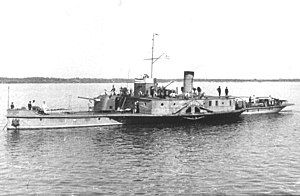 Canlodka Usyskin. Probably 1943: the fodder gun GK has already been removed, instead of it a towbar , instead of a 21-K gun, a 37-mm 70-K gun [1] | |
| Service | |
| Title | "AND. Usyskin ", from July 16, 1941 to July 26, 1943 - "Usyskin" |
| Class and type of vessel | tug boat, from July 16, 1941 to July 26, 1943 - boat Usyskin |
| Sailing area | Inland waterways |
| Organization | Volga military. flotilla |
| Manufacturer | Zelenodolsk shipyard "Red Metal" |
| Commissioned | 1934 the river wheel towing steamer, 12/10/1941 - 07/26/1943 gunboat of the Volga flotilla |
| Withdrawn from the fleet | May 12, 1961 |
| Main characteristics | |
| Displacement | 400 t |
| Length | 56.4 m |
| Width | 8 m (with rims 17 m) |
| Draft | 1.25 m |
| Engines | Steam engine |
| Power | 480 l from. |
| Mover | paddle wheel |
| Speed | 10 knots |
| Sailing range | 1,400 miles |
| Crew | 76 people |
| Armament | |
| Artillery | 2 100-mm guns B-24 |
| Flak | 2 45-mm 21-K guns. 1 12.7 mm and 1 7.62 mm machine guns |
Launched in 1934, decommissioned on May 12, 1961. During World War II, the gunboat of the Volga Military Flotilla , which participated in the Battle of Stalingrad . For military merits, she was awarded the Order of the Red Banner , many members of her crew orders and medals, and all personnel with medals " For the Defense of Stalingrad " [2] .
Content
- 1 Vessel Description
- 2 History
- 2.1 Mobilization
- 2.2 Participation in the Battle of Stalingrad
- 2.3 After the war
- 3 Memory
- 4 notes
- 5 Literature
- 6 References
Ship Description
"AND. Usyskin "refers to wheeled tugs with a steel hull. Length 56.4 meters, estimated width 8.1 m, overall - 17 m, draft 1.25 m, displacement - 400 tons. The maximum speed (without cart) is 18.5 knots , the cruising range of 16.5 knots in an economic course is 2450 km [3] . The tug crew consisted of 28 people. Cabins were made for the crew in the hull, and four cabins for the captain, first assistant, and mechanic were placed above the wheels [4] . Elements of the steel casing were connected by welding, the superstructure is made of wood. Power plant - one steam engine with a capacity of 480 liters. from. working on coal [3] . The fuel supply is 80 tons, placed in two coal bunkers [4] . The ship provided electricity to the ship. The vessel was propelled by two paddle wheels located on the sides. To control and transmit information, a machine telegraph and telephone pipes were used. Internal systems and pipelines consisted of a steam pipeline, a feedwater pipe, a gas exhaust pipe with a chimney, a fire and drainage system, water supply systems, sewage, heating, ventilation of the engine room and rooms in the building and superstructure [5] . The steering device consisted of one semi-balanced steering wheel with a sector steering machine. The anchor system consisted of two bow and one stern Hall anchors located in the gates. The mechanism for lifting the nasal anchors consisted of a steam windlass , stern - of the spire . The towing mechanism included one rotary towing hook and three arches [5] . Mooring devices included eight bollards and four bale strips ; mooring was carried out with a steel cable. In tow were installed foremast and mainmast , as well as the bow flagpole . Four top lights , two circular, green and red onboard and three stern lights were used as signal devices. For the sound alarm a steam whistle was used . In tow, there was one wooden oar boat, which fell overboard on a rotary davit driven by manual hoists . Navigational aids consisted of one manual lot. Traditional fire-fighting means: a hook, a nightmare, a sandbox, fire-fighting scrap, buckets, an ax [6] .
History
Towing ship “I. Usyskin ”was laid in 1933 and launched in 1934. In January of this year, the tragedy of the stratospheric balloon “ Osoaviahim-1 ” occurred with a crew of three people - crew commander Pavel Fedorovich Fedoseenko , flight engineer Andrei Bogdanovich Vasenko and researcher Ilya Davydovich Usyskin . It was in honor of the young physicist that the tugboat launched from the slipways of the Zelenodolsk shipyard "Red Metalist" was named. The ship was part of the People’s Commodity System (from April 9, 1939 - the People’s Commissariat of the USSR River Fleet ), and the operator was the Middle Volga River Shipping Company [7] .
"AND. Usyskin ”was the lead in a series of seven steamships-tugs launched in 1934–37: Gromov (from July 26 to November 6, 1943 - Usyskin [8] ), Rudnev , Kirov , Fedoseenko "," Chapaev "," Schors ". All vessels of the series participated in the Battle of Stalingrad as gunboats, successfully passed through battles and were decommissioned in the post-war years as they were old [9] .
Mobilization
One of the features of the pre-war mobilization plans was the lack of measures to mobilize the ships of the Volga River Basin - the geographical position of the Volga was considered quite remote from the proposed theaters of military operations. This led to the lack of pre-prepared technical documentation, and the vessels themselves in the design and construction did not adapt to the needs of mobilization. Another factor influencing the redesign of ships according to the requirements of the Navy was the switching of shipyards to the production of land military products [4] .
The general course of hostilities in 1941 required a significant revision of the pre-war plans. On October 27, 1941, a decision was made to create the Volga Military Flotilla on the basis of the Training Squad of Ships. All seven tugboats of the type “I. Usyskin ”was mobilized on July 16, 1941 and reconstructed into cannon boats with simultaneous reassignment to the Navy. At the same time, the name of the ship was changed to an abbreviated version of "Usyskin" [8] . Perestroika was spent 20 days, all technical documentation was limited to a tactical and technical task of several pages, and the factories that carried out the work were 300 km apart [4] . Reconstruction of the tug "I. Usyskin ”in the boat in Spassky Zaton [10] . In accordance with the order, the gunboat was supposed to go into operation on August 15, 1941, but due to lack of materials and weapons, and due to poor preparation of the newly formed crew, the ship was ready only at the end of September [11] .
The reconstruction involved a large number of works. Weapons were installed on the gunboat: two 100-mm B-24-BM guns, two 45-mm 21-K guns, three 7.62-mm machine guns and a range finder. They needed to make reinforcements to ensure the safety of ship structures when firing. During the reconstruction, an insufficient longitudinal strength of the tug was revealed (the hull bent during excitement), which required mandatory hull reinforcement. To reduce the work, the bow gun was placed over the transverse bulkhead. The stern gun was installed over the newly created bulkhead enclosing the artillery cellar [4] .
To store ammunition, artillery cellars were created. For this, one of the two coal bins was used. Racks for ammunition, irrigation, drainage, ventilation and lighting systems were installed in it. The drainage system was based on individual steam ejectors. The wiring for lighting was mounted in metal pipes and led to sealed shades. The switches were mounted in the vestibule, where there was a lamp signaling that the lighting was on. The bulkheads and the ceiling were sheathed with waterproofing, for which instead of cork improvised materials were used: plywood, roofing , nightmare . Instead of a wooden deck, a metal one was installed above the cellar [4] .
The building was refitted to accommodate crew accommodation and they accommodated up to 72 people. For this, the crew cabins, which were located in the hull, were re-planned in two cockpits , which accommodated 28 and 38 people. Kubriks were equipped with bunk bunks, lockers and bedside tables, hangers for outerwear and pyramids for personal weapons. In the intercourse passages, tables were established for eating. The captain’s and mechanic’s cabins were rebuilt into four, which were occupied by the commander, commissar, commanders of two combat units (warhead-2 - artillery) and warhead-5 (electromechanical). The third cabin was assigned to the company cabin , and the fourth - under the radio room. The galley, laundry and latrine were not redone, and in the wash basin the number of taps was increased from three to six [4] .
Interphone pipes were made to the guns, cellars and rangefinder. The masts were equipped with means for raising signal flags, and a special box was made to store the flags themselves. On the ship mounted dimming tools. The lack of prepared technical documentation required the production of drawings and diagrams in place, which was complicated by the lack of qualified engineering and working personnel. In addition, there was an acute shortage of metal, including armored steel. But shipbuilders had 8 mm armor at their disposal, which tank builders refused due to substandardness - this armor, over the terms of reference, was sheathed the cabin of the gunboat [4] .
Participation in the Battle of Stalingrad
The gunboat "Usyskin" took part in the hostilities from July 25, 1942 to February 2, 1943 [12] under the command of Captain-Lieutenant I. A. Kuznetsov [13] and military commissar of the political committee A. P. Grishchenko [14] .
On July 24, 1942, by order of the Headquarters of the Supreme High Command No. 8/148, the Volga Military Flotilla was subordinated to the commander of the Stalingrad Front, N. V. Gordov [15] . From August 24, 1942 to January 30, 1943, the gunboat was part of the Northern group of ships of the Volga Military Flotilla . The group was led by Captain 3rd Rank S.P. Lysenko . In addition to Usyskin, the group included the Chapaev gunboat, armored boats No. 14, 23, 34, 51 and 54, as well as a division of minesweepers. The base area of the group was the Akhtuba River in the area from the village of Bezrodnoye to Central Akhtuba . Kanlodka “Usyskin” was based directly at the village of Bezrodnoe [14] . The range of the B-24-BM naval guns was 22.2 km, which made it possible to fire at enemy troops even from the parking position [15] . The main combat mission of the gunboat was to support the fire of a group of Colonel Gorokhov and from November 10 part of the 138th Infantry Division of Colonel I.I. Lyudnikov . An additional task was to maintain contact with the 66th Army, located higher up the Volga [16] .
| External Images | |
|---|---|
| The scheme of the three positions of the Volodsk flotilla’s gunboats on 08/04/13/10/1942, the radius of reach from two of them, observation points (NP) and target numbers in circles | |
On August 27, the Uslaskin gunboat (and the Chapaev of the same type) fired at the enemy: on that day, soldiers of the 32nd Marine Corps of the Volga Military Flotilla went on the offensive with the task of driving the enemy out of Latoshinka village. Marines occupied the southern outskirts of the village, at the same time they suffered heavy losses and were forced to leave the occupied territory in the evening [17] . To correct artillery fire, the head of the artillery combat unit (BC-2) of the Chapaev gunboat, Lieutenant V. M. Zaginailo, who remained at the location of the Gorokhov group until the end of the Battle of Stalingrad, departed for the observation point of the 32nd Marine Corps battalion [18] ] . For courage, heroism and a high result of adjusting artillery fire, Vasily Mikhailovich Zaginailo was awarded the Orders of the Red Banner and the Red Star [19] .
| External Images | |
|---|---|
| Picture. The gunboat "Usyskin" shells the positions of Nazi troops near Stalingrad. Artist Franz R. R. | |
The gunboat took an active part in conducting the unsuccessful advance of the units of the Gorokhov group to the north on September 18-19 with the task of connecting with the units of the 66th Army advancing south. Under the leadership of the flagship artilleryman of the Northern group of ships, Y. V. Nebolsin developed a plan for the joint use of the Usyskin and Chapaev gunboats and the field artillery of the Gorokhov group. During the reconnaissance of the planned offensive area, targets were distributed and the organization of fire control was worked out. Gorokhovets fought two kilometers to the north, but did not achieve their goals [20] . These days the foremen of the groups of commandants and radio operators S. I. Druzhinsky and M. P. Aglodin, gunner I. N. Booth [21] were especially distinguished.
An example of combat work is October 14, 1942. At 9:50 a.m., the gunboat fired at a cluster of enemy infantry and equipment west of the village of Rynok and, after spending 131 high-explosive shells, knocked out three tanks, scattered and partially destroyed the enemy infantry company. At 10:50 min, the Northern group of ships opened fire on the area of the Barricade factory, where up to two enemy infantry regiments went on the offensive with the support of tanks. The total consumption of ammunition amounted to 200 conventional and rockets. At 12:55 a.m., the gunboat again opened fire on the enemy in an area of 101.3 heights southwest of the village of Rynok - ten enemy tanks, with the support of an infantry battalion, were made for attack. At 17:00 "Usyskin" again opened fire on the tanks and mortars of the Wehrmacht. To destroy one mortar and suppress another, 16 HE shells were used [15] .
The overall intensity of artillery fire was high: by October 28, the bow gun fired 925, and the stern gun - 1275 [22] .
In the winter from 1942 to 1943, all artillery vessels of the Volga Military Flotilla, except for the Usyskin and Chapaev cannons, were taken out for wintering and repairs to the Guryev and Fort Shevchenko areas. The two remaining ships were frozen into ice and, disguised, continued fighting against the enemy [15] .
In total, while participating in the Battle of Stalingrad, the gunboat "Usysykin" conducted 212 firing, firing 4630 rounds with the main caliber. During this time, more than 650 enemy soldiers and officers, 19 tanks, 51 vehicles, 5 artillery and 9 mortar batteries, 4 separate guns and 8 six-barreled mortars were destroyed by cannon fire, 4 aircraft were burned at the airfields, more than 40 knots of resistance, bunkers and dugouts were destroyed, 25 machine gun points, 5 warehouses with ammunition, fuel and other property [22] .
The last salvos gunboat "Usyskin" produced January 30, 1943 [2] . On February 27, 1943, the gunboat was awarded the Order of the Red Banner, becoming one of the two ships awarded the Order for military successes in the Battle of Stalingrad.
After the Volga was liberated from the ice cover, the ship took part in towing caravans along the river. May 4, 1943 "Usyskin" was blown up on one of the mines that the Luftwaffe installed to suppress navigation on the Volga. The explosion occurred in the area of Alexandrovsky Roll and, thanks to the dedicated actions of the crew, the ship was saved, although it was seriously damaged [22] .
The damage was so great that on July 26 the gunboat was disarmed and transferred to the Middle Volga River Shipping Company, and on August 13 it was excluded from the lists of the Navy. Simultaneously with the return to civil service on July 26, the tug was returned the full name "I. Usyskin ” [8] .
After the war
In the postwar period, the tugboat continued its peaceful work. 23 марта 1946 года буксир перешёл в подчинение министерства Речного флота СССР. 22 марта 1947 года Главный штаб ВМС и Министерства речного флота СССР приняли совместное решение отметить 23 судна особо отличившихся во время оборонительного периода Сталинградской битвы. Среди награждённых памятными мемориальными досками был пароход «И. Усыскин» [23] . С 6 июня 1956 года пароход работал в системе министерства Речного флота РСФСР. 12 мая 1961 года прославленное судно исключено из списка судов и передано в « Главвторчермет » для разделки на металл [8] .
Memory
В 2013 году почта России в серии «Оружие Победы» выпустила почтовую марку, посвящённую краснознамённой канонерской лодке. 6 мая 2015 года представлен фильм «Ахтуба — река прифронтовая», посвящённый Северной группе кораблей Волжской военной флотилии, который рассказывал и о канонерской лодке «Усыскин» [24] .
Notes
- ↑ Канонерские лодки типа «Усыкин» . Героическая волжская флотилия . Сталинград (2017). Дата обращения 19 апреля 2018.
- ↑ 1 2 Мордвинов Р. Волжская военная флотилия в обороне Сталинграда от немецко-фашистских войск // Исторический журнал : журнал. — 1944. — Июнь ( № 5—6 ). — С. 33—40 . Архивировано 29 мая 2017 года.
- ↑ 1 2 Смирнов , с. one.
- ↑ 1 2 3 4 5 6 7 8 Платонов, 2004 .
- ↑ 1 2 Смирнов , с. 2.
- ↑ Смирнов , с. 3.
- ↑ Бережной, Аммон, 1990 , с. 142.
- ↑ 1 2 3 4 «Усыскин» . Корабли после 1917 . «Военно-Морской флот России». Дата обращения 23 августа 2017. Архивировано 17 августа 2017 года.
- ↑ Хоменко А. И. Тип «Усыскин» — 7 единиц . Корабли ВМФ СССР накануне и в годы Великой Отечественной войны. Дата обращения 16 августа 2017. Архивировано 16 августа 2017 года.
- ↑ Муратов М. А. История Новодевиченского района . Краеведческий сайт села Новодевичье. Дата обращения 20 августа 2017. Архивировано 16 августа 2017 года.
- ↑ Амусин Б. М. Создание и развѐртывание военных речных и озѐрных флотилий в боевой обстановке 1941—1944 гг. // Военно-исторический журнал : журнал. — 2008. — № 9 (581) . — С. 16—19 .
- ↑ Перечень № 21 . Органы управления, соединений, кораблей, частей и учреждений Амурской, Волжской, Днепровской, Дунайской, Каспийской, Онежской, Пинской и Чудской флотилий со сроками вхождения их в состав Действующей армии в годы Великой Отечественной войны 1941—1945 гг. / Н. Миненко. — М. : Министерство обороны, 1960. — С. 48. — 204 с.
- ↑ Пылающая река. Сергей Леонидович Мальчиков. Журнал «Двигатель» № 1 2009
- ↑ 1 2 Опалев М. Н. Заволжский тыл Сталинграда: значение левого берега Волги в Великой Отечественной войне // Грамота : журнал. — 2008. — № 6 (13) . — С. 163—170 . — ISSN 1993-5552 . Архивировано 15 августа 2017 года.
- ↑ 1 2 3 4 Широкорад А. Б. Глава 3 Оборона Сталинграда 12 июля - 18 ноября 1942 г // Артиллерия в Великой Отечественной войне. — М. : АСТ, 2010. — С. 215. — 637 с. — (Неизвестные войны).
- ↑ Самсонов А. М. Волжские переправы осенью 1942 г. // Сталинградская битва. — 4-е изд. — М. : Наука, 1989.
- ↑ Ачкасов и др., 1988 , с. 391.
- ↑ Сыркин Л. И. Если бы Волга могла говорить… // Сыны народов всех / ред. кол. И. М. Логинов [и др.]. — Волгоград: Нижне-Волжское книжное издательство, 1986. — С. 315—415. — 415 с.
- ↑ Ачкасов и др., 1988 , с. 392.
- ↑ Локтионов И., 1974 , с. 68.
- ↑ Локтионов И., 1974 , с. 69.
- ↑ 1 2 3 Бережной, Аммон, 1990 .
- ↑ Чеботарев М. Н., Абоймов А. Н., Амусин М. Д., Нейгольдберг В. Я., Саратов В. Ф., Ягодинский Е. А. Глава восьмая. Речники в Сталинградской битве: На переправах // Советский речной транспорт в Великой Отечественной войне. — М. : Воениздат, 1981. — С. 223. — 328 с. — 25 000 экз.
- ↑ Елена Белова. В Волжском завершается работа над фильмом «Ахтуба – река прифронтовая» . Ahtuba34.ru (29 апреля 2015). Дата обращения 14 августа 2017. Архивировано 14 августа 2017 года.
Literature
- Кузнецов И. А. Залпы с Волги // Битва за Волгу: воспоминания участников Сталинградского сражения / составитель И. К. Морозов, редакторы И. М. Логинов, И. К. Морозов. — Волгоград: Волгоградское книжное издательство, 1962. — 442 с.
- Бережной С.С., Аммон Г.А. Краснознаменная канонерская лодка «Усыскин» // Героические корабли Российского и Советского военно-морского флота. — М. : Воениздат, 1990. — С. 142—143. — 240 с. — 65 000 экз. — ISBN 5-203-00844-2 .
- Платонов А. В. В условиях военного времени // Советские мониторы, канонерские лодки и бронекатера. Часть I. — Галея Принт, 2004. — 120 с. - 500 copies. — ISBN 5-8172-0090-2 .
- Ачкасов, В. И., Басов А. В., Сумин А. И. и др. Глава девятая. Военные флотилии в Великой Отечественной войне // Боевой путь Советского Военно-Морского Флота / Под редакцией доктора исторических наук А. В. Басова. — 4-е. — М. : Воениздат, 1988. — С. 390—399. — 607 с. — 90 000 экз. — ISBN 5-203-00527-3 .
- Локтионов И. И. Огонь с Волги // Волжская флотилия в Великой Отечественной войне. — М. : Воениздат, 1974.
Links
- Ахтуба река прифронтовая
- Волжская военная флотилия . Музей речного флота. Дата обращения 15 августа 2017. Архивировано 24 января 2017 года.
- Смирнов Е. Л. 1934 г. Буксир колёсный п.х. N=480 л.с типа Усыскин Зеленодольского завода . Суда буксирные и толкачи . Речная справочная книжка. Дата обращения 18 августа 2017.
- Амусин Б. М. Создание и развёртывание военных речных и озёрных флотилий в боевой обстановке 1941—1944 гг. // Военно-исторический журнал : журнал. — 2008. — № 9 (581) . — С. 16—19 .