
Maxwell's Fisheye (1854) is an absolute optical system representing an inhomogeneous spherically symmetric medium characterized by a refractive index
,
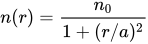
Where - distance to the center of the system , and - options.


Each ray represents a circle not passing through , or a straight line passing through . It is convenient to construct the image of a point created by the system on a direct ray: all rays from an arbitrary point gather at the point lying on a straight line that connects with ; and located on opposite sides of , and the product


.

Therefore, the “fisheye” of Maxwell is an absolute optical system in which the mapping is performed by the inversion transform. Plane not passing through is depicted by a sphere.
In this system, all aberrations are absent, except for distortion and curvature of the image field .
See also
- Fisheye (lens)
Literature
- Born M. , Wolf E. Fundamentals of Optics. M.: 1973, S. 149-150.
- JC Maxwell Solutions of Problems, problem no. 2. Cambridge and Dublin Math. Journal. Vol. 8, 1854. P. 188
- The Scientific Papers of James Clerk Maxwell. Cambridge University Press, 1890, Dover, New York, 1965. P. 74-79