Karshi ( Uzbek. Qarshi / Qarshi ) is the largest city and administrative center of the Kashkadarya region of Uzbekistan .
| City | |||||||||
| Karshi | |||||||||
|---|---|---|---|---|---|---|---|---|---|
| Uzbek Qarshi / Қarshi Persian. قَرشی | |||||||||
| |||||||||
| A country |  Uzbekistan Uzbekistan | ||||||||
| Viloyat | Kashkadarya | ||||||||
| History and Geography | |||||||||
| Founded | VII century BC e. | ||||||||
| Former names | Navtak Nahshab Nasaf Beckbudi | ||||||||
| Area | 42 km² | ||||||||
| Center height | 386 [1] m | ||||||||
| Climate type | Subtropical intracontinental | ||||||||
| Timezone | UTC + 5 | ||||||||
| Population | |||||||||
| Population | ↗ Over 260,000 people ( 2019 ) | ||||||||
| Nationalities | Mostly Uzbeks , also Tajiks , Russians , Tatars , Central Asian Arabs and others | ||||||||
| Denominations | Mostly Muslims are Sunnis , also Christians (mostly Orthodox ), Muslims are Shiites and others | ||||||||
| Official language | Uzbek | ||||||||
| Digital identifiers | |||||||||
| Telephone code | +998 75 | ||||||||
| Postal codes | 180 100-180120 | ||||||||
| Car code | 70 | ||||||||
| qashqadaryo.uz (Uzbek) (Russian) | |||||||||



Content
- 1 Geography
- 2 History
- 3 population
- 4 Economics
- 5 Attractions
- 6 Hokims
- 7 famous people
- 7.1 In the city were born
- 8 Notes
- 9 References
Geography
Karshi is located on the western edge of the Pamir-Alai mountain system , in the Karshi oasis, on the Kashkadarya River, at the foot of the Kungurtau Upland , in the eastern part of the Karshi Steppe . The climate is arid, with precipitation of 200-400 mm per year [2] . In the early 1970s, an irrigation canal from the Amu Darya was carried out.
The city is located 400 km southwest of Tashkent (520 by road). 10 km east of Karshi is the air base of Karshi-Khanabad .
History
For the first time on the territory of Karshi, a settlement began to appear from the 7th century BC. e .. It was then that around the ancient city began to build defensive walls. The remains of the ruins of these walls were first studied by archaeologists in 1999. There is evidence that the city in that era bore the Sogdian name Navtak or Navtaka , which can literally be translated as the New Building .
According to the famous oriental historian V.V. Bartold , the Mongol khan Kebek (1318-1326), the successor of his brother Esen-Buki Khan, moved to Maverannahr , in its southern part, and built for himself a karshi palace at a distance of two and a half farces , that is, about 15 miles, from the city of Nahsheba, along the lower reaches of Kashka-Daria. In Mongolia at that time, the word “karshi” was used in the meaning of “palace” [3] .
Continuing his thoughts about the origin of the name “Karshi”, V.V. Bartold writes that it already appears in the writings of the authors of the 11th century - Yusuf Balasagunsky , the author of the poem “Kutadgu Bilik”, and Mahmud Kashgari - and the latter does not even say whether it was used only by Eastern Turks, or also Western. The Türks, apparently, borrowed it from the language of the indigenous population of Chinese Turkestan. [3]
In this palace, the city of Nahsheb was named Karshi , which he has preserved until now, although the location of the current city does not correspond to the location of either Nahsheb of the pre-Mongol period or the city of the XIV century. [3] . A native of this city was a famous Indo-Persian scholar and writer Nakhshabi . In the XVII century, one of the famous poets of the period of the Bukhara Khanate, Sayido Nasafi Mirobid, was born in this city.
A different version of the origin of the name of the city is given in his notes " Babur-name " by the famous commander and statesman Babur :
"Another district is Karshi, which is also called Nesef and Nehekh. Karshi is a Mughal name; the cemetery in the Mughal language will be“ karshi. "Probably, this name appeared after the conquest of Genghis Khan. This is a low-water place. Spring is beautiful there, the bread and melons are good Karshi lies south of Samarkand, with a slight deviation to the west, in eighteen yigach paths. There is a bird like a bagrikara called “kil-kuyruk.” Since it is countless and infinitely many in Karshi district, it is called in those places "Karshi bird" [4] .
In Soviet historiography, the emergence of the city was usually attributed to the first half of the XIV century [2] .
As part of the Bukhara Khanate, Karshi was the center of beqi . After the capture of Samarkand by the Russian Empire in 1868, Karshi became the second largest city in the Emirate of Bukhara after Bukhara .
Alexander Bournes, a famous English military-political intelligence officer and traveler, visited Karshi in the 1830s and here is how he describes the city in his work “Journey to Bukhara”:
The city is scattered over a mile; it has an extensive bazaar and about 10,000 inhabitants; all houses in it with flat roofs. At the northwestern end of it is an earthen fort, surrounded by a wet moat, and is a significant fortification. The river, which leaves the vicinity of Shahar-Sabz , a city fifty miles from this place and the wonderful birth of Timur , passes from the northern side of Karshi, and gives residents the opportunity to plant countless gardens planted with prolific trees and tall poplars. These latter have a magnificent and beautiful appearance, especially in windy weather, when their leaves turn white and seem to be silver, although in reality they are green: this produces a curious and pleasant effect in the landscape. Nowhere are the beneficial effects of water more palpable than in this place, which without it would have turned into a perfect desert. Along the banks of the river and its tributaries, everything turns green and blooms, while sand deserts creep at some distance. Karshi after the capital is the most significant place in Bukhara possessions. This oasis is about twenty miles wide: a river irrigates all its fields .
From 1926 to 1937 the city was called Bekbudi [5] . During the Second World War, it was renamed Karshi station until 1963. In November 1964, it regained the status of a city [6] .
In modern Uzbekistan, it is believed that the city is 2700 years old; on October 27, 2006, the 2700th anniversary of the city of Karshi was celebrated in the country. President of Uzbekistan Islam Karimov said that "only the fact that the cities of Shakhrisabz and Karshi with a 2700-year history are located on the land of Kashkadarya , and this is recognized by such an authoritative international organization as UNESCO , also testifies to the depth and antiquity of our historical roots" [ 7] .
Population
The population as of January 1, 2014 is 254.6 thousand inhabitants [8] .
| Year | 1939 | 1972 | 1979 | 1999 | 2010 | 2014 |
| Population, thousand inhabitants | 23 | 79 | 108 | 197 | 238.2 | 254.6 |
Economics
The region produces natural gas ( Shurtan and Mubarek deposits), and cultivates cotton and grain.
Attractions
- Karshi bridge
- ancient settlement Erkurgan
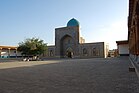
- mosques: Kok-Gumbez (end of the 16th century), Bekmir (XVI), Kilichboy, Khoja Kurban, Magzon, Charmgar and Khuja Abdulaziz (XIX — XX)
- 19th century madrasah buildings.
Hokims
- Tursunov, Shuhrat - February 10, 2013
- Boboev, Sohib February 10, 2013 [9] -
Famous People
Born in the city
- Najmuddin al-Nasafi (1068–1142) - theologian, jurist of the Hanafi madhhab, hadith scholar, interpreter of the Koran
- Ziya ad-Din Nahshabi (d. 1350) is a doctor and writer. The author of philosophical and medical treatises, he is especially famous for the collection of short stories “The Parrot's Book” (“Tuti-nama”).
- Bardina, Olga Vasilievna ( 1932 - 2001 ) - opera singer, People's Artist of the USSR ( 1981 )
- Ishbulyakov, Ideal Davletovich (1926-1998) - opera singer. Honored Artist of TASSR. People's Artist of TASSR. Honored Artist of the RSFSR.
- Halikova, Raisa Halilovna (1934-2005) - Bashkir linguist, Doctor of Philology (1992), Professor (1995), Honored Worker of Culture of the Bashkir Autonomous Soviet Socialist Republic (1987).
Notes
- ↑ Indicated altitude in the city center
- ↑ 1 2 according to TSB
- ↑ 1 2 3 Vladimir Bartold. Twelve Lectures on the History of the Turkish Peoples of Central Asia Archived July 24, 2011 on Wayback Machine
- ↑ Babur-name: Notes of Babur / Per. M. Salier. - Ed. 2nd, revised. - Tashkent: Main edition of encyclopedias, 1993. - P. 74.
- ↑ Modern Explanatory Dictionary: Ed. The Great Soviet Encyclopedia, 1997
- ↑ Uzbekistan celebrated the 2700th anniversary of the city of Karshi . REGNUM (October 28, 2006). Date of treatment August 13, 2010. Archived on August 25, 2011.
- ↑ Uzbekistan celebrated the 2700th anniversary of the city of Karshi . REGNUM (October 28, 2006). Date of treatment August 13, 2010. Archived on August 25, 2011.
- ↑ Statistical booklet “On the Population in the Language of Numbers” Archived October 14, 2014 on Wayback Machine
- ↑ https://www.uzdaily.uz/WOdjX/NTijZ/SoeVQ/articles-id-14433.htm
Links
- TSB : [Karshi Karshi]
- Karshi // Brockhaus and Efron Encyclopedic Dictionary : in 86 volumes (82 volumes and 4 additional). - SPb. , 1890-1907.
- “Uzbektourism”: the 2700th anniversary of Karshi
- Karshi city
- Official site of the administration of the Kashkadarya region, information about organizations, regions of the region, statistics, ...