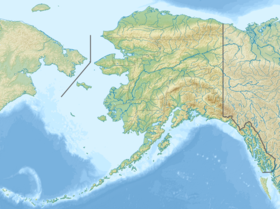
Avak ( Eng. Avak ) - impact crater , the center of which is located about 12 km southeast of the town of Barrow in the US state of Alaska [1] .
| Avak | |
|---|---|
| English Avak | |
| Specifications | |
| Diameter | 8 kilometers |
| Deepest | more than 1225 m |
| Location | |
| A country |
|
| State | Alaska |


Description
Avak is a rounded formation buried under sedimentary rocks with a diameter of about 8 km and a depth of 1 km [2] . The crater’s funnel is bordered by a shaft consisting of metamorphic rocks of the basement thrown upwards and bulk material from emissions from it. In the center there is an uplift with a diameter of about 4 km , where the Lower Cretaceous rocks are elevated to a height of more than 500 m [3] . Avak is not expressed in the surface relief [4] .
The crater formation time is estimated to be in the range from 95 million to 3 million years ago [1] . In it rocks deformed by impact from the Ordovician to Lower Cretaceous age, as well as Pliocene and Pleistocene rocks deposited after the impact were discovered [3] . Palynological studies of emissions from the crater (taken at a distance of about 50 km from it) indicate the Middle Turonian - Late Turonian impact time (about 90 million years ago) [4] .
Avak provides a "trap" for natural gas in the neighboring South Barrow, East Barrow and Sikulik fields. About 1 billion m³ of gas is concentrated in sandstones of the Jurassic period of these deposits [3] .
Research History
Avak was discovered using seismic exploration in the study of oil and gas areas of Alaska, conducted by the US Navy from 1943 to 1953. It manifested itself as a rounded structure not reflecting seismic waves, around which radial faults were visible [5] .
In order to search for oil and gas, as well as study some rocks, in 1951-1952 (within the framework of the same studies), a well was drilled near the center of Avak, reaching a depth of 1225 m [5] . Deformations of rocks in it were found to the very bottom [3] . In particular, characteristic signs of shock were found — [3] [4] . In 1995, researchers from the Geological Survey of Canada and the US Geological Survey discovered in breccia quartz grains obtained from the aforementioned well from a depth of about 700 m, another sign of this effect is [3] .
Notes
- ↑ 1 2 Avak (inaccessible link) . Earth Impact Database . Date of treatment January 16, 2018. Archived on June 25, 2017.
- ↑ CE Kirschner. Impact Origin of the Avak Structure, Arctic Alaska, and Genesis of the Barrow Gas Fields (English) // American Association of Petroleum Geologists Bulletin: journal. - 1992 .-- May ( vol. 76 , no. 5 ). - P. 651-679 .
- ↑ 1 2 3 4 5 6 Therriault, AM Planar Deformation Features in Quartz Grains from Mixed Breccia of the Avak Structure, Alaska // Abstracts of the Lunar and Planetary Science Conference: journal. - 1995. - Vol. 26 . - P. 1043 . - .
- ↑ 1 2 3 Banet AC, Fenton JPG An examination of the Simpson core test wells suggests an age for the Avak impact feature near Barrow, Alaska // The Sedimentary Record of Meteorite Impacts (Geological Society of America Special Paper 437) / KR Evans. - Geological Society of America, 2008. - P. 139. - ISBN 9780813724379 . - DOI : 10.1130 / 2008.2437 (08) .
- ↑ 1 2 Collins FR Avak test well 1 // Core tests and test wells, Barrow area, Alaska. Part 5, Subsurface geology and engineering data (Geological Survey Professional Paper 305-K) . - United States Government Printing Office, 1961. - P. 629-639. Archived February 22, 2017.