Jefferson Randolph "Soapy" Smith II ( born Jefferson Randolph Smith II ; November 2, 1860 , , GA - July 8, 1898 , Skagway , Alaska) - American gangster, a scam who became famous for his trademark trick with soap. The criminal activity of Smith and his gang spread to Round Rock , Denver , Creed, Skagway . The main source of income was fraud, underground casinos. The ability to make the necessary acquaintances among politicians and officials made him so popular that he once sat on the podium next to the Governor of Alaska during the celebration of July 4 [1] . Soapy Smith was killed on July 8, 1898 in Skagway, Alaska, in a shoot-out with a local resident, Frank Reed .
| Soapy Smith | |
|---|---|
| English Jefferson smith ii | |
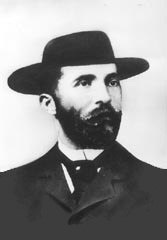 | |
| Birth name | English Jefferson randolph smith ii |
| Nickname | Soapy Smith |
| Date of Birth | November 2, 1860 |
| Place of Birth | Coveta , Georgia |
| Citizenship |  USA USA |
| Date of death | July 8, 1898 (aged 37) |
| Place of death | Skagway , Alaska |
| Cause of death | gunned down |
| Job | cheater, gangster, owner of saloons |
| Crimes | |
| Region of Commission | Texas Colorado Alaska |
Content
Biography
The early years
Jefferson Randolph Smith II was the eldest child of four in the family of a slave owner and practitioner in Covet, Georgia. Until the age of sixteen, Smith helped with household chores on a family farm and, mainly, with his friend Joe Simmons, engaged in grazing cows. In 1876, the Smith family sold the property and set off for Round Rock , Texas. It was here that Jefferson Smith began his fraudulent activities [2] .
Criminal activity
The first documented scam through which Smith and his gang got the nickname was soap fraud. It was carried out as follows: Smith and his accomplices opened an amusement bench in busy streets or fairs and laid out pieces of soap on a chest. He encouraged the public with promises to perform a miracle and give everyone the opportunity to earn easy money. Smith wrapped the soap in banknotes of various denominations and packed it back in paper. After thorough mixing, the fraudster sold each bar of soap for one dollar. A member of his gang, who knew in advance in which bar of soap the greatest bill would be hidden, bought it, becoming the lucky one from the crowd who won the main prize [3] .
Subsequently, his gang took a leading role in the criminal world, controlling underground gambling salons thanks to bribery and mutually beneficial friendships with politicians and police officers. In 1892, Smith and the gang moved from Denver to Creedy, which was associated with a tightening of the struggle of the Denver authorities with illegal casinos. Here, “Soapy” Smith and his accomplices were hunted down by fraud until 1897, when the police came to their trail. During this period, he was close to carrying out a major fraud in Mexico: Smith tried to convince President Porfirio Diaz of the need to recruit a foreign legion, which would consist of American mercenaries; for the recruitment and purchase of uniforms “Soapy” Smith requested an amount of 80 thousand dollars, but the president gave him in advance only 2 thousand dollars. When people sent to test Smith’s activities found out who he really was, the deal was canceled [4] .
From Colorado, Smith and his gang moved to the city of Skagway in Alaska, where the gold rush dawned at that time. In 1898, Smith opened his own drinking establishment, naming it “Jeff Smith's Saloon .” According to the recollections of eyewitnesses, it was in this place, sitting in his office with electricity, that Smith smoked cigars, ate oysters and developed plans for further scams. In order to control and prevent competition from other criminals, “Soapy” Smith organized a volunteer detachment from the local population to maintain law and order and named it “Committee 317” by the number of its participants [5] [6] .
Death
On the eve of the events that became fatal for Smith, a certain gold miner John Douglas Stewart came to the gangster in the saloon to sell a bag of gold worth $ 2.7 thousand. The gang members decided not to miss the opportunity to take possession of gold and offered to play cards with Smith himself. As a result, the leader of the gang won, and the bag of gold was taken away by force, as the gold miner refused to pay [3] . In search of protection, the victim turned to the federal marshal of the city of Skagwayia, who advised him to get more gold from the mines, since he was powerless to do anything [7] . After that, John Stewart spread rumors around the city about the arbitrariness of the gang and the powerlessness of the authorities, and the residents became embittered by scammers. The townspeople invited Smith to find out the relationship on the shore at the pier of Juneau , where he went on July 8. During a skirmish, Smith swung at a resident named Frank Reed , but he waved away and shot a gangster. This was followed by a shot of “Soapy” Smith, after which people saw a dead gangster and Reed who was seriously wounded, who died 12 days later [8] .
After the death of the leader of many members of the Soapy gang, Smith was arrested by federal marshal Josiah M. Tanner [9] .
Family
In Denver, Smith met a local dancer, Mary Noonan, who he soon married. Due to the nature of the criminal life and fears about his wife’s safety, Smith sent her to a newly acquired home in St. Louis . Subsequently, the couple gave birth to three children. Smith never stayed long with his family, limiting himself only to rare visits, although he regularly sent remittances [1] .
References
Mass events
- Every year on July 8, the " " in Hollywood hosts a festival in honor of the "Soapy" Smith, during which performances with magic tricks are organized [10]
Literature
- Service Robert. Polar Argonauts. - Aegitas, 2015 .-- 429 p. - ISBN 9781772464740
- Stan Sauerwein. Soapy Smith: Skagway's Scourge of the Klondike. - Heritage House Publishing Co, 2005 .-- 148 p. - ISBN 9781554390113
- Catherine Holder Spude. “That Fiend in Hell”: Soapy Smith in Legend. - University of Oklahoma Press, 2012-294 p. - ISBN 9780806188188 .
Notes
- ↑ 1 2 Catherine Holder Spude. "That Fiend in Hell": Soapy Smith in Legend . - University of Oklahoma Press, 2012-09-28. - 294 p. - ISBN 9780806188188 . Archived July 29, 2017.
- ↑ Stan Sauerwein. Soapy Smith: Skagway's Scourge of the Klondike . - Heritage House Publishing Co, 2005 .-- 148 p. - ISBN 9781554390113 . Archived on September 19, 2017.
- ↑ 1 2 JP Walker Walker. The American Old West: Gangs, Outlaws & Gunfights . - Lulu.com, 2015-02-26. - 508 s. - ISBN 9781312948969 . Archived August 2, 2017.
- ↑ Phyllis Perry. Speaking Ill of the Dead: Jerks in Colorado History . - Rowman & Littlefield, 2011-06-01. - 235 p. - ISBN 9780762768028 . Archived July 28, 2017.
- ↑ James P. Devereaux. Spirits of Southeast Alaska: The History & Hauntings of Alaska's Panhandle . - Epicenter Press, 2016-10-31. - 116 p. - ISBN 9781935347736 . Archived July 28, 2017.
- ↑ Dennis Lattery. Northern Verses: Poems of Alaska and the Yukon . - Publication Consultants, 2015-01-05. - 79 p. - ISBN 9781594335259 . Archived on September 19, 2017.
- ↑ Erin H. Turner. Outlaw Tales of the Old West: Fifty True Stories of Desperados, Crooks, Criminals, and Bandits . - Rowman & Littlefield, 2016-06-03. - 409 p. - ISBN 9781493023295 . Archived July 28, 2017.
- ↑ Smith, Jeff. Alias Soapy Smith: The Life and Death of a Scoundrel. - Klondike Research. - 2009. - S. 576. - ISBN 0-9819743-0-9 .
- ↑ William Wilbanks. Forgotten Heroes of Alaska . - Turner Publishing Company, 1999 .-- 200 p. - ISBN 9781563115110 . Archived on September 19, 2017.
- ↑ Alex Stone. Fooling Houdini: Adventures in the World of Magic . - Random House, 2012-07-05. - 323 p. - ISBN 9781446473306 . Archived on September 21, 2017.