In mathematics, the screened Poisson equation is a partial differential equation of the form:
- {\ displaystyle \ left [\ nabla ^ {2} - \ lambda ^ {2} \ right] u (\ mathbf {r}) = - f (\ mathbf {r}),}
![{\ displaystyle \ left [\ nabla ^ {2} - \ lambda ^ {2} \ right] u (\ mathbf {r}) = - f (\ mathbf {r}),}](https://wikimedia.org/api/rest_v1/media/math/render/svg/3af8ce3ac85d32173b2ab4971d03828a413d383a)
Where {\ displaystyle {\ nabla} ^ {2}}  - Laplace operator , {\ displaystyle \ lambda}
  Is a constant {\ displaystyle f}
  Is an arbitrary position function (known as a “source function”), and {\ displaystyle u}
  Is the desired function. The screened Poisson equation is often used in physics , including the Yukawa theory of meson screening and screening of an electric field in a plasma .
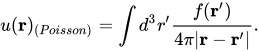
When {\ displaystyle \ lambda} equal to zero, the equation turns into a Poisson equation . Therefore when {\ displaystyle \ lambda} very small, the solution approaches the solution of the unshielded Poisson equation, which is a superposition {\ displaystyle 1 / r}  functions, statistically weighted source function {\ displaystyle f} :
- {\ displaystyle u (\ mathbf {r}) _ {(Poisson)} = \ int d ^ {3} r '{\ frac {f (\ mathbf {r}')} {4 \ pi | \ mathbf {r } - \ mathbf {r} '|}}.}
On the other hand, when {\ displaystyle \ lambda} very big {\ displaystyle u} approaching the value {\ displaystyle f / \ lambda ^ {2}}  , which in turn approaches zero when {\ displaystyle \ lambda} goes to infinity. As we will see, the solution for averages {\ displaystyle \ lambda} behaves like a superposition of shielded (or fading) {\ displaystyle 1 / r} functions, and {\ displaystyle \ lambda} will be the power of shielding.
The screened Poisson equation can be solved for the general {\ displaystyle f} using the Green function . Green function {\ displaystyle G}  defined as
- {\ displaystyle \ left [\ nabla ^ {2} - \ lambda ^ {2} \ right] G (\ mathbf {r}) = - \ delta ^ {3} (\ mathbf {r}).}
![{\ displaystyle \ left [\ nabla ^ {2} - \ lambda ^ {2} \ right] G (\ mathbf {r}) = - \ delta ^ {3} (\ mathbf {r}).}](https://wikimedia.org/api/rest_v1/media/math/render/svg/2b2cef47a601e15ebba528f831701fb78d48a6b5)
Assuming that {\ displaystyle u} and its derivatives are negligible at large {\ displaystyle r}  , we can perform the Fourier transform in spatial coordinates:
- {\ displaystyle G (\ mathbf {k}) = \ int d ^ {3} r \; G (\ mathbf {r}) e ^ {i \ mathbf {k} \ cdot \ mathbf {r}}}
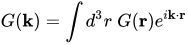
where the integral is taken over the entire space. Then it can be shown that
- {\ displaystyle \ left [k ^ {2} + \ lambda ^ {2} \ right] G (\ mathbf {k}) = 1.}
![{\ displaystyle \ left [k ^ {2} + \ lambda ^ {2} \ right] G (\ mathbf {k}) = 1.}](https://wikimedia.org/api/rest_v1/media/math/render/svg/27acf02726ad134ec56cf1194802bbb2ee9a8f95)
Therefore, the Green's function on {\ displaystyle r} is given by the inverse Fourier transform:
- {\ displaystyle G (\ mathbf {r}) = {\ frac {1} {(2 \ pi) ^ {3}}};; \ int d ^ {3} \! k \; {\ frac {e ^ {-i \ mathbf {k} \ cdot \ mathbf {r}}} {k ^ {2} + \ lambda ^ {2}}}.
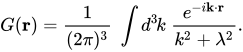
This integral can be estimated using spherical coordinates in {\ displaystyle k}  -space. Integration over angular coordinates is not difficult, and the integral is simplified - now you need to integrate only along one radial coordinate {\ displaystyle k} :
- {\ displaystyle G (\ mathbf {r}) = {\ frac {1} {2 \ pi ^ {2} r}} \; \ int \ limits _ {0} ^ {\ infty} dk \; {\ frac {k \, \ sin kr} {k ^ {2} + \ lambda ^ {2}}}.
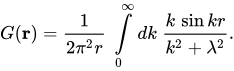
This integral can be estimated by integration over the contour ( residue theory ). As a result, we get:
- {\ displaystyle G (\ mathbf {r}) = {\ frac {e ^ {- | \ lambda | r}} {4 \ pi r}}.}
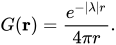
The final solution to the entire problem:
- {\ displaystyle u (\ mathbf {r}) = \ int d ^ {3} r'G (\ mathbf {r} - \ mathbf {r} ') f (\ mathbf {r}') = \ int d ^ {3} r '{\ frac {e ^ {- | \ lambda || \ mathbf {r} - \ mathbf {r}' |}} {4 \ pi | \ mathbf {r} - \ mathbf {r} ' |}} f (\ mathbf {r} ').}

As stated above, this is a superposition of shielded {\ displaystyle 1 / r} functions statistically weighted by the source function {\ displaystyle f} , and {\ displaystyle \ lambda} is the shielding factor. Shielded {\ displaystyle 1 / r} a function often appears in physics as a screened Coulomb potential, and the Yukawa potential is also known.