Clever Geek Handbook
📜 ⬆️ ⬇️

Lagerra polynomials

In mathematics, the Lagerr polynomials , named after Edmond Lagerr (1834–1886), are canonical solutions of the Lagerr equation :

Lagerra polynomials
general information
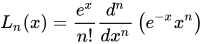
FormulaLn(x)=exn!dndxn(e-xxn){\ displaystyle L_ {n} (x) = {\ frac {e ^ {x}} {n!}} {\ frac {d ^ {n}} {dx ^ {n}}} \ left (e ^ { -x} x ^ {n} \ right)} L_n (x) = \ frac {e ^ x} {n!} \ Frac {d ^ n} {dx ^ n} \ left (e ^ {- x} x ^ n \ right)
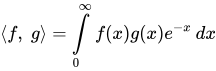
Scalar product⟨f,g⟩=∫0∞f(x)g(x)e-xdx{\ displaystyle \ langle f, \; g \ rangle = \ int \ limits _ {0} ^ {\ infty} f (x) g (x) e ^ {- x} \, dx} \ langle f, \; g \ rangle = \ int \ limits_0 ^ \ infty f (x) g (x) e ^ {- x} \, dx
Domainx≥0{\ displaystyle x \ geq 0} x \ ge 0
additional characteristics
Differential equationxy″+(one-x)y′+ny=0,{\ displaystyle x \, y '' + (1-x) \, y '+ n \, y = 0,} x \, y '' + (1-x) \, y '+ n \, y = 0,
Named afterLagerr, Edmond Nicola
xy″+(one-x)y′+ny=0,{\ displaystyle x \, y '' + (1-x) \, y '+ n \, y = 0,} x \, y '' + (1-x) \, y '+ n \, y = 0,

which is a linear differential equation of the second order. In physical kinetics, these same polynomials (sometimes accurate to normalization) are usually called Sonin or Sonin – Lagerra polynomials [1] . Laguerre polynomials are also used in the Gauss - Laguerre quadrature formula for the numerical calculation of integrals of the form:
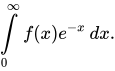
∫0∞f(x)e-xdx.{\ displaystyle \ int \ limits _ {0} ^ {\ infty} f (x) e ^ {- x} \, dx.} \ int \ limits_0 ^ \ infty f (x) e ^ {- x} \, dx.

Lagerra polynomials, usually denoted asL0,Lone,... {\ displaystyle L_ {0}, \; L_ {1}, \; \ ldots} L_0, \; L_1, \; \ ldots are a sequence of polynomials that can be found by the Rodrigue formula

Ln(x)=exn!dndxn(e-xxn)=∑k=0n(-one)kk!(nk)xk.{\ displaystyle L_ {n} (x) = {\ frac {e ^ {x}} {n!}} {\ frac {d ^ {n}} {dx ^ {n}}} \ left (e ^ { -x} x ^ {n} \ right) = \ sum _ {k = 0} ^ {n} {\ frac {(-1) ^ {k}} {k!}} {n \ choose k} x ^ {k}.} L_n (x) = \ frac {e ^ x} {n!} \ Frac {d ^ n} {dx ^ n} \ left (e ^ {- x} x ^ n \ right) = \ sum ^ {n} _ {k = 0} \ frac {(- 1) ^ k} {k!} {n \ choose k} x ^ k.

These polynomials are orthogonal to each other with a scalar product :
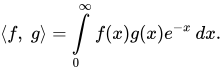
⟨f,g⟩=∫0∞f(x)g(x)e-xdx.{\ displaystyle \ langle f, \; g \ rangle = \ int \ limits _ {0} ^ {\ infty} f (x) g (x) e ^ {- x} \, dx.} \ langle f, \; g \ rangle = \ int \ limits_0 ^ \ infty f (x) g (x) e ^ {- x} \, dx.

The Laguerre polynomial sequence is a Schaeffer sequence .

Lagerra polynomials are used in quantum mechanics, in the radial part of the solution of the Schrödinger equation for an atom with one electron.

There are other applications of Lagerra polynomials.

Content

The first few polynomials

The following table lists the first few Lagerra polynomials:

n{\ displaystyle n}  Ln(x){\ displaystyle L_ {n} (x)}  
0one{\ displaystyle 1}  
one-x+one{\ displaystyle -x + 1}  
2one2(x2-fourx+2){\ displaystyle {\ scriptstyle {\ frac {1} {2}}} (x ^ {2} -4x + 2)}  
3one6(-x3+9x2-18x+6){\ displaystyle {\ scriptstyle {\ frac {1} {6}}} (- x ^ {3} + 9x ^ {2} -18x + 6)}  
fourone24(xfour-sixteenx3+72x2-96x+24){\ displaystyle {\ scriptstyle {\ frac {1} {24}}} (x ^ {4} -16x ^ {3} + 72x ^ {2} -96x + 24)}  
fiveone120(-xfive+25xfour-200x3+600x2-600x+120){\ displaystyle {\ scriptstyle {\ frac {1} {120}}} (- x ^ {5} + 25x ^ {4} -200x ^ {3} + 600x ^ {2} -600x + 120)}  
6one720(x6-36xfive+450xfour-2400x3+5400x2-4320x+720){\ displaystyle {\ scriptstyle {\ frac {1} {720}}} (x ^ {6} -36x ^ {5} + 450x ^ {4} -2400x ^ {3} + 5400x ^ {2} -4320x + 720)}  
 
The first 6 polynomials of Lagerra.

Recurrence Formula

Lagerra polynomials can be defined by the recurrence formula:

Lk+one(x)=onek+one[(2k+one-x)Lk(x)-kLk-one(x)],∀k⩾one,{\ displaystyle L_ {k + 1} (x) = {\ frac {1} {k + 1}} {\ bigl [} (2k + 1-x) L_ {k} (x) -kL_ {k-1 } (x) {\ bigr]}, \ quad \ forall k \ geqslant 1,}  

by predefining the first two polynomials as:

L0(x)=one,{\ displaystyle L_ {0} (x) = 1,}  
Lone(x)=one-x.{\ displaystyle L_ {1} (x) = 1-x.}  

Generalized Lagerra polynomials

Generalized Lagerra polynomialsLna(x) {\ displaystyle L_ {n} ^ {a} (x)}   are solutions of the equation:

xy″+(a+one-x)y′+ny=0,{\ displaystyle x \, y '' + (a + 1-x) \, y '+ n \, y = 0,}  

so thatLn(x)=Ln0(x) {\ displaystyle L_ {n} (x) = L_ {n} ^ {0} (x)}   .

Notes

  1. ↑ Lifshits, E.M. , Pitaevsky, L.P. Physical Kinetics. - ( Theoretical Physics , Volume X).


Source - https://ru.wikipedia.org/w/index.php?title=Lagerra_Members&oldid=98047226


More articles:

  • Ginter, Evgeny Konstantinovich
  • Della Scala, Paolo Alboino
  • British Citizenship
  • Sexy (magazine)
  • Ducoli, Giovanni Maffei
  • Shuklin, Vladimir Nikolaevich
  • Ivlev, Yury Vasilyevich
  • Christian David Hinsburg
  • Helmut Rode
  • NGC 1026

All articles

Clever Geek | 2019