Evgeny Alekseevich Preobrazhensky [February 15 ( 27 ), 1886 , Bolkhov , Oryol province, July 13, 1937 , Moscow ] - leader of the Russian and international communist movement, Soviet economist and sociologist. The author of the book " New Economy ".
| Evgeny Alekseevich Preobrazhensky | |
|---|---|
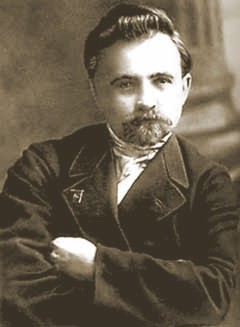 | |
| Date of Birth | February 15 (27), 1886 |
| Place of Birth | Bolkhov |
| Date of death | July 13, 1937 (51 years old) |
| Place of death | |
| Citizenship |  the USSR the USSR |
| Occupation | revolutionary economist |
| The consignment | VKP (b) |
Biography
Parents, study, and the beginning of revolutionary activity
Born in the family of Archpriest Alexei Alexandrovich Preobrazhensky (from August 15, 1883 to February 17, 1895 - priest of the Bolkhov Intercession Church, from February 17, 1895 - priest of the Bolkhov Trinity Church, at the same time in 1890-1894 - a member of the Bolkhov branch of the Diocesan School Council [1] , from March 1, 1899, he was the chairman of the Bolkhov branch of the Diocesan School Council, in 1900-1903 he was a representative from the clergy in the Bolkhov district zemstvo assembly, in 1902-1903 he was dean of all the churches of the city of Bolkhov, subsequently He was a member of the religious renovationist movement within the Russian Orthodox Church, in particular, in 1922, representatives of one of the main groups of the renovationist movement, the Living Church, with the support of local organs of Soviet power, elected him the head of the renovation leadership of the Bolkhov diocese; in 1936 he was arrested , and died in custody) and Varvara Alekseevna Preobrazhenskaya (nee Levitskaya) [3] .
He studied at a parish school, then, in 1895-1897, at the Bolkhov city school, and from 1897, at the Oryol classical male gymnasium, which he graduated in 1905 [4] . “In childhood, he was very religious ...” - E. A. Preobrazhensky himself recalled. - In the fourteenth year (in 1900), I independently came to the conclusion that God does not exist, and from that moment I began a stubborn struggle within the family against attending church and other religious rites. This aversion to religion was further strengthened by the fact that I watched all the religious cuisine from its backstage side with my own eyes. My atheistic views were further strengthened when I read two volumes of Kolba's History of Culture. This superficial work had such a strong influence on me precisely because the author consistently exposes all religious superstitions and religious ignorance, not being able, however, to understand their historical laws. The latter, however, was rather a plus, rather than a minus, for my development at that time. At that time I was interested not so much in explaining religion as in its absolute denial ” [5] .
In 1901 or 1902, Preobrazhensky first became acquainted with illegal literature [6] . “Before the first clandestine work fell into my hands,” he recalled, “I was already quite radically influenced by the reading of“ Russian Wealth ”,“ Russian Vedomosti ”,“ Domestic Notes ”, Saltykov-Shchedrin, and especially Dobrolyubov and Pisarev. On the other hand, during the holidays I constantly observed in the villages of Bolkhovsky, Mtsensky and Bryansk districts, where I often spent vacations, the plight, poverty and overwhelming of the peasantry ” [7] . So the spontaneous revolutionism of Preobrazhensky arose, which had not yet decided on its ideological and political platform. Remembering the summer of 1902, E. A. Preobrazhensky wrote: “At a certain moment, a purely practical question arose before me in its entirety: what should I do. Do I agree to join the ranks of revolutionaries, with all the ensuing consequences, such as expulsion from the gymnasium, separation from my family, prison, exile, etc. And here I made a decision and firmly said to myself: yes, I will join the ranks revolutionaries, no matter what happens ” [7] .
In 1902-1903, Preobrazhensky, together with the student of the Oryol classical male gymnasium, the son of the merchant I. Anisimov, conducted revolutionary propaganda among the students of the gymnasium, “started a couple of circles, entered into relations with the supervised cities of Orel” [7] .
During this period, - E. A. Preobrazhensky recalled, - I have a mystical passion for the propagation of illegal literature. [...] Printing on a hectograph of some small things just did not satisfy me, although we received one hundred copies from the same mass of a hectograph [8] .
From the autumn of 1903 to February 1904, Preobrazhensky, being a member of the Social Democratic troika in the Oryol classical men's gymnasium, acting as a cell of the Oryol Committee of the Russian Social Democratic Labor Party (RSDLP), conducted social democratic propaganda among students of various educational institutions of Orel, and kept illegal literature [6] .
Actually, since the end of 1903, I consider myself a member of the party, ”wrote A. A. Preobrazhensky,“ although the formal solemn admission of me, Litkens and Anisimov to the party took place two or three months later [7] .
In February 1904, the Oryol Committee of the RSDLP, “after some easy colloquium”, accepted Preobrazhensky as a member of the RSDLP and assigned it to the group of propagandists at the Oryol Committee of the RSDLP.
In the spring of 1904, the Oryol Committee of the RSDLP instructed E. A. Preobrazhensky to conduct a small Social Democratic circle of 2 workers from the Khrushchev Mechanical Plant [6] . As Preobrazhensky himself recalled, in the classroom, he "rather long, but not very convincingly," explained to his wards the party program " [7] .
In the summer of 1904, Preobrazhensky conducted social-democratic propaganda among the workers of the Maltsevsky factory district (mainly the Maltsevsky crystal factory in the village of Dyatkovo, Bryansk district, Orel province).
In April and May 1905, Preobrazhensky acted as one of the organizers of the general strikes and rallies of students of educational institutions of Orel [6] .
Revolution of 1905-1907 in Russia
In October 1905, Preobrazhensky was co-opted [9] as a member of the Oryol Committee of the RSDLP. By this time he was already firmly in the Bolshevik political position. In October 1905, after the publication of the Manifesto of October 17, 1905, “On Improving the Public Order,” Preobrazhensky participated in the struggle against the counter-revolutionary pogroms in Orel.
In October - November 1905, E. A. Preobrazhensky conducted party work at one of the Bryansk factories.
In November-December 1905, Preobrazhensky was the responsible propagandist of the Presnensky District Committee of the RSDLP in Moscow; participated in the December armed uprising of 1905 in Moscow [10] : E. A. Preobrazhensky, according to his own recollections,
... attended the meetings of the district committee that led the Presnensky uprising, when he commanded Seda with our forces. My function at that time was mainly to hold rallies in striking factories, already firing at that time artillery from the Vagankovsky cemetery. When Presnya was already cordoned off by Semenovtsi and was burning, I, having hidden my browning in the water closet of my apartment, made my way through the chain of soldiers at night to the city center, went to Orel for a few days and then returned to the disposal of the bureau of our central committee in Moscow ... [7] .
In December 1905 - March 1906, Preobrazhensky was a member of the Perm Committee of the RSDLP.
March 18, 1906, "by provocation of the notorious Votinov in Motovilikha", E. A. Preobrazhensky was arrested in Perm [6] . This was his first "prison cell." Five months later, in August 1906, after a four-day hunger strike, he was released from prison for lack of evidence under police supervision. " [7]
In August 1906, Preobrazhensky again became a member of the Perm Committee of the RSDLP, conducted party work in Yekaterinburg , Chelyabinsk and Ufa .
In the same August 1906, Preobrazhensky, sent by the Perm Committee of the RSDLP to Petersburg to purchase automatic pistols for the fighting squad of the Perm Committee of the RSDLP, was arrested at the Kazan station in Moscow, as he wrote in his autobiography, provoked by Thomas Lebedev, in 1919 by accident identified by him in Orel, and later executed in Perm. Preobrazhensky was sent to a Perm prison. During the investigation, he was detained alternately in a Perm prison, Nikolaev correctional arrest unit of the civil department (about 8 months) and a Kazan prison.
In 1907, the Criminal Department of the Kazan Court of Justice released Preobrazhensky from custody "for lack of evidence."
After his release from prison, Preobrazhensky was a member of the Ural Regional Committee of the RSDLP in 1907-1908, conducted party work in the Southern Urals, mainly in the cities of Ufa and Zlatoust; was present as a delegate from the Ural Regional Committee of the RSDLP at the III conference of the Russian Social Democratic Labor Party (1907), where he met V. I. Lenin [6] . In March 1908, Preobrazhensky “... was arrested at the Chelyabinsk city conference, swallowed the order of the day and encrypted addresses, and that very night safely escaped from the police station” [7] .
Between Two Revolutions
At the end of April 1908, E. A. Preobrazhensky was arrested on the street in Ufa by police agents and was detained in Ufa, Chelyabinsk and Perm prisons in the years 1908-1909. In the fall of 1909, Preobrazhensky was sentenced to exile in the settlement. In January 1911, Preobrazhensky, with the assistance of lower-Ilim exiled revolutionaries, fled from the place of exile to the village of Tulun, Nizhneudinsky district, Irkutsk province.
In 1911-1912, E. A. Preobrazhensky was an employee of the legal Marxist newspaper "Ob Life" in the city of Novo-Nikolaevsk (now Novosibirsk) of the Tomsk province and county and a member of the Novo-Nikolaev Committee of the RSDLP.
In the fall of 1912, Preobrazhensky “by provocation” was arrested by the tsarist authorities [6] . In 1915, the tsarist authorities allowed E. A. Preobrazhensky to move from the place of exile to the city of Irkutsk.
In 1915-1917, Preobrazhensky conducted party work in Irkutsk and Chita: he was a member of the Irkutsk Committee of the RSDLP [6] .
After the February Revolution of 1917
After the February bourgeois-democratic revolution of 1917 in Russia, Preobrazhensky, from mid-March to April 1917, held the posts of comrade (deputy) chairman of the Chita Council of Workers 'and Soldiers' Deputies and a member of the Presidium of the Chita Committee of Public Organizations. He advocated the cooperation of organizations - members of the Chita Committee of Public Organizations, for conditional support by the Soviets of the Provisional Government, since he believed that the ongoing revolution "is bourgeois in its tasks, but is carried out by the forces of the revolutionary proletariat and the peasantry" (Zabaikalsky Worker, Chita, 1917, March 31): in order to achieve socialism, “we need not only a second, this time a socialist revolution, but also the development of our industry to such an extent that the elimination of capital can lo be accomplished easily and painlessly. In the meantime, we are far from that ”(Transbaikal Worker, Chita, 1917, March 22). He was a delegate to the I East Siberian Congress of Soviets of Workers, Soldiers, and Peasants' Deputies (April 7–13, 1917), and a member of the Presidium of the Congress. At the congress, he declared:
I do not agree that the seizure of power by the working class leads to the realization of socialism ... It is possible that the Council of Workers 'and Soldiers' Deputies will be forced to show demands within the bourgeois system "( V. Agalkov , Soviets of Siberia 1917-1918, Novosibirsk, 1978, p. 20 —21) [11] .
In April 1917, E. A. Preobrazhensky was elected a delegate to the First All-Russian Congress of Soviets of Workers 'and Soldiers' Deputies and went to Petrograd [10] .
On the way to the First All-Russian Congress of Soviets, in May-June 1917, Preobrazhensky stopped in Zlatoust, where he conducted party work, was a member of the Zlatoust Committee of the RSDLP.
On June 3–24 (June 16 – July 7), 1917, E. A. Preobrazhensky participated as a delegate in the work of the First All-Russian Congress of Soviets of Workers 'and Soldiers' Deputies. He introduced a resolution from the Bolshevik faction condemning the policies of the Provisional Government, which delayed the resolution of issues related to the exercise of the national rights of oppressed peoples; the congress did not adopt a resolution (First All-Russian Congress of Soviets of Workers 'and Soldiers' Deputies. [Shorthand report], vol. 2, M. — L., 1931, p. 182). At a meeting of the congress on June 22, he issued a resolution on the fight against anti-Semitism from the congress commission on a national issue, which was unanimously adopted (First All-Russian Congress of Soviets of Workers 'and Soldiers' Deputies. [Shorthand report], vol. 2, M. —L., 1931 , pp. 239-240) [11] .
In June – July 1917, E. A. Preobrazhensky was a member of the Zlatoust Committee of the RSDLP.
October Revolution and Civil War
From July 18, 1917 to January 5 (18), 1918, Preobrazhensky, a member of the Ural Regional Committee of the RSDLP (b) [12] , was delegated by the Ural Committee to the VI Congress of the RSDLP (b) , which was held from July 26 to August 3 (August 8–16) ) 1917. He argued at the congress with JV Stalin, who spoke with the Political Report of the Central Committee and argued that the peaceful period of the revolution had ended and the slogan “All power to the Soviets!” Should be removed. The Congress rejected the Preobrazhensky amendment [11] . After the victory of the October armed uprising of 1917 in Petrograd, E. A. Preobrazhensky in October 1917 participated in the establishment of Soviet power in Zlatoust and the Zlatoust mountain district [10] .
During the Civil War of 1918-1920 in Russia, E. A. Preobrazhensky from January 5 (18) to April 29, 1918 was a candidate member of the Ural Regional Committee of the Russian Communist Party (Bolsheviks) [RCP (b)] and a member of the Editorial Board of the newspaper "Ural Worker" - the press organ of the Ural Regional Committee of the RCP (b), from April 29, 1918 to January 16, 1919 - a member of the Ural Regional Committee of the RCP (b), from May 1918 to January 16, 1919 - Chairman of the Presidium of the Ural Regional Committee of the RCP ( b), in 1919-1920 - a member of the Editorial Board the collegium of the newspaper Pravda, the printing organ of the Central Committee and the Moscow Committee of the RCP (b) and the authorized representative of the All-Russian Central Executive Committee of the Soviets of Workers, Peasants and Cossack Deputies (All-Russian Central Executive Committee) in the Oryol Province, in 1920 - secretary of the Ufa Provincial Committee of the RCP (b), c April 5, 1920 to March 16, 1921 - Secretary of the Central Committee of the RCP (B.); was one of the organizers of the armed struggle against the rebellion of the Separate Czechoslovak Corps and against the Kolchak forces in 1918. As a delegate to the V All-Russian Congress of Soviets of Workers, Peasants, Red Army and Cossack Deputies (1918), as a member of the Bolshevik faction of the congress, he participated in the suppression of the Left Socialist Revolution in 1918 in Moscow and was easily shell-shocked in the left temple during the Soviet offensive on the Central telegraph (July 7, 1918), occupied by the Left Socialist-Revolutionary rebels [13] ; in July 1918, "he was sent for several days by the Revolutionary Council to the Kursk region in order to maintain discipline in our troops standing on the border with Ukraine" [5] . He was present at a terrorist attack (a bomb of great destructive force) in the building of the Moscow Committee of the RCP (B.) In Leontief Lane in Moscow, committed on September 25, 1919 by organizations of the "underground anarchists" and the Left Social Revolutionaries [6] .
In January – August 1918, Preobrazhensky was part of the core of the “ Left Communists ” group inside the RCP (B.); argued that "a paper agreement with Germany, not based on a real balance of power, does not represent any protection for the Soviet government ... A revolutionary war, however weakly prepared for it, is inevitable ... This war will strengthen Soviet power inside the country and no defeat on the external front will not be able to dump it ”(“ Ural Worker ”, 1918, March 3), and also that“ the whole plan of comrade. Lenin is, essentially speaking, an attempt to save the life of Soviet power through suicide ”(“ Ural Worker ”, 1918, March 6) [12] . During the discussion on trade unions that took place in the RCP (B.) In late 1920 - early 1921, E. A. Preobrazhensky, together with N. I. Bukharin and others, formed a “buffer” group.
In April-June 1920, he was the first head of the Propaganda Department of the Central Committee of the RCP (B.).
NEP Period
В 1921—1924 годах Преображенский — председатель Финансового комитета ЦК РКП(б) и Совета народных комиссаров (СНК) Российской Социалистической Федеративной Советской Республики (РСФСР), одновременно в 1921 году — председатель Главного управления профтехнических школ и высших учебных заведений Народного комиссариата просвещения РСФСР, с 14 сентября 1921 по 6 марта 1922 годов — заведующий отделом журнала «Коммунистический Интернационал», в 1921—1923 годах — член Коллегии Народного комиссариата финансов РСФСР, в 1923 году — член Аграрной комиссии Исполнительного Комитета Коммунистического Интернационала [14] . В 1924—1927 годах Е. А. Преображенский — заместитель председателя Главного концессионного комитета при СНК Союза Советских Социалистических Республик (СССР), одновременно член Коллегии Народного комиссариата финансов СССР, в 1926—1928 годах — член Главной редакции 1-го издания Большой советской энциклопедии.
С 1923 года Евгений Преображенский принадлежал к Левой оппозиции , был одним из инициаторов и авторов «Заявления 46-ти» и в августе или 13 октября 1927 года был исключён из партии «за организацию нелегальной антипартийной типографии», 28 ноября исключен из Общества старых большевиков, а в январе 1928 года — выслан из Москвы в казахский город Уральск , где работал в плановых органах.
В 1928—1930 годах Е. А. Преображенский работал в аппарате Государственного планового комитета Татарской Автономной Советской Социалистической Республики. После начала индустриализации в СССР Преображенский перешёл на сторону Сталина , считая, что его фракция выполняет программу Левой оппозиции, — в то время он не имел представления о том, что творится в деревне [15] . В июле 1929 года вместе с К. Б. Радеком и И. Т. Смилгой Преображенский направил в ЦК ВКП(б) письмо, в котором заявил об идейном и организационном разрыве с оппозицией и в январе 1930 года был восстановлен в партии [16] .
В 30-х годах
В 1930—1932 годах Е. А. Преображенский — заместитель председателя Нижегородского краевого планового комитета, в 1932—1933 годах — член Коллегии Народного комиссариата лёгкой промышленности СССР [17] .
Познакомившись со сталинской политикой в деревне не по статьям в «Правде» , Преображенский из условного союзника вновь превратился в убеждённого противника (в отличие от своего былого обличителя Бухарина) и вместе с И. Н. Смирновым создал подпольную оппозиционную организацию [6] . На допросах в тюрьме на Лубянке в 1937 году он признал существование в 1931—1932 гг. этой организации и так объяснил позицию «смирновцев»:
1. Темпы коллективизации взяты не по силам. Деревня отошла от середняцкого хозяйства и не освоила коллективное, а в результате резкое падение производительных сил сельского хозяйства; огромные продовольственные затруднения, и ряд совершенно ненужных жестокостей в борьбе с кулачеством.
2. Темпы индустриализации взяты непосильные. В результате невыполнение плана капиталовложений, срыв сроков ряда строек, сокращение личного потребления рабочих, перенапряжение в труде и как результат — общее ухудшение материального положения пролетариата.
3. Неверная политика в Коминтерне, приводящая к изоляции компартии в борьбе с фашизмом, особенно в Германии.
4. Невыносимый партийный режим, при котором невозможно обсуждение ни одного больного вопроса, волнующего страну. Партийной дисциплине противопоставлялась троцкистская внутрипартийная демократия.
5. На идеологическом фронте — полнейший застой. Это результат политики ЦК, которая доводит дисциплину мысли до централизации мысли и, культивируя бездарности, задерживает всякое умственное развитие молодёжи.
Из всего этого, естественно, делался вывод о необходимости борьбы с политикой ЦК и руководством партии. [18]
В январе 1933 года Е. А. Преображенский был вновь исключён из ВКП(б), арестован и привлечён в качестве обвиняемого по делу так называемой «контрреволюционной троцкистской группы И. Н. Смирнова, В. А. Тер-Ваганяна, Е. А. Преображенского и других» [19] . Преображенскому было предъявлено обвинение в участии в нелегальной «контрреволюционной троцкистской группе», которая «ставила себе целью воссоздание подпольной троцкистской организации на основе новой тактики двурушничества с целью проникновения в ВКП(б) и государственный и хозяйственный аппарат для организации и сплочения контрреволюционных и антипартийных элементов, имея в виду возглавить контрреволюционное движение», а также, как члену «контрреволюционной троцкистской группы». Следствие по делу было проведено Секретно-политическим отделом ОГПУ при СНК СССР с грубейшими нарушениями норм уголовно-процессуального законодательства. Преображенский был арестован без санкции прокурора. Е. А. Преображенскому вообще не предъявлялось постановление о привлечении его в качестве обвиняемого. 16 января 1933 года постановлением Особого совещания при Коллегии ОГПУ при СНК СССР Преображенский был приговорён к высылке в Казахстан сроком на 3 года. Допрос же Е. А. Преображенского состоялся 17 января 1933 года, то есть уже после его осуждения [20] .
На основании статьи 1 Указа Президиума Верховного Совета СССР от 16 января 1989 года «О дополнительных мерах по восстановлению справедливости в отношении жертв репрессий, имевших место в период 30 — 40-х и начала 50-х годов» [21] , 6—7 апреля 1989 года постановление Особого совещания при Коллегии ОГПУ при СНК СССР от 16 января 1933 года, вынесенное в отношении Е. А. Преображенского, было отменено, а сам Преображенский — посмертно реабилитирован [20] .
В декабре 1933 года Преображенский был восстановлен в партии. В 1933—1936 годах был заместителем начальника Центрального планово-финансового отдела Народного комиссариата зерновых и животноводческих совхозов СССР. В 1936 году он был снова исключён из ВКП(б) [22] .
20 декабря 1936 года [23] или 2 января 1937 года [24] Преображенский был вновь арестован. 13 июля 1937 года уголовное дело по обвинению Преображенского в руководстве «Молодёжным троцкистским центром» и участии в контрреволюционной террористической организации было рассмотрено Военной коллегией Верховного суда СССР; Е. А. Преображенский был приговорён к расстрелу, и в тот же день приговор в отношении него был приведён в исполнение. Посмертно реабилитирован 22 декабря 1988 года Пленумом Верховного суда СССР [25] .
16 мая 1990 года Комитет партийного контроля при ЦК Коммунистической партии Советского Союза (КПСС) посмертно восстановил Е. А. Преображенского в рядах КПСС [12] .
Членство в высших партийных и государственных органах
Кандидат в члены ЦК РСДРП(б) в 1917—1918 годах; член ЦК РКП(б) в 1920—1921 годах; член Организационного Бюро ЦК РКП(б) с 5 апреля 1920 по 16 марта 1921 годов. Член Контрольной Комиссии РКП(б) в 1920—1921 годах. Кандидат в члены Президиума ВЦИК в 1917—1918 годах. Был членом Центрального Исполнительного Комитета СССР [26] .
Научные и политические взгляды
E. A. Preobrazhensky is the author of a number of propaganda and political economic works. In October 1919, Preobrazhensky, together with N. I. Bukharin, wrote the book "The ABC of Communism." The book popularly set forth the Program of the RCP (B.), Adopted at the VIII Party Congress (1919), printed in huge print runs, was translated into all the major languages of the world, and for a decade played the role of a basic textbook of the communist doctrine for young members of the communist and workers parties and communist parties youth unions of Soviet Russia and foreign countries. The authors of the ABC of Communism suggested that the proletarian power of Soviet Russia will systematically expand the policy of "war communism" in all sectors of the economy, introduce central industrial planning in place of market mechanisms, and push for collectivization in agriculture in the form of voluntary state farms, communes and collective farms that will start on the market compete with personal peasant farming. The European socialist revolution will be able to stretch the bridge between the distribution-leveling policy of “war communism” compelled under the conditions of a civil war and the expanded construction of a socialist society based on material abundance [27] .
In 1920, E. A. Preobrazhensky wrote a pamphlet, “Paper Money in the Epoch of the Proletarian Dictatorship,” in which he investigated the problem of money and money circulation in the transitional era of the dictatorship of the proletariat. In this pamphlet, Preobrazhensky put forward the thesis of the systematic abolition of the market and money and a smooth transition to communist distribution. In 1926, E. A. Preobrazhensky wrote a book, The New Economy , in which he launched his analysis of Soviet economy, describing how it combines elements of socialist planned production with spontaneous market forces. He substantiated the concept of “two regulators” of the economy of the USSR: the market law of values was opposed by the law of “initial socialist accumulation”, that is, “exploitation of pre-socialist forms of economy” in order to ensure savings for industrialization. The practical consequence of this law was the increased taxation of prosperous peasants, “price scissors” (overpriced for products of state-owned industry, underestimated for products of peasant farms), paper-money expansion. As a promising result - the crowding out of state regulation of market principles. The concept of Preobrazhensky aroused indignation of the chairman of the Council of People's Commissars A. I. Rykov that Preobrazhensky had “a village is only a cash cow for industry” and non-partisan economists (especially ND Kondratiev ) and was sharply criticized by N. I. Bukharin in the press, however adopted by the "Left Opposition" [28] . Being an opponent of the NEP , Preobrazhensky believed that it could not be destroyed with one blow, but that a conscious “devouring” of the private economy should be systematically carried out by the accelerated development of the socialist system [29] .
The widespread belief that Preobrazhensky was an opponent of the NEP was disputed by I. Deutscher [30] . In his opinion, the polemic between Preobrazhensky and Bukharin in Russian historiography is studied, as a rule, according to one source - according to Bukharin, who in his writings distorted the views of the Left Opposition, attributing anti-Nep aspirations to its members: Preobrazhensky was just a champion of modernization of the economy and did not see for industrialization sources other than agriculture. Bukharin did not indicate them, however [31] . V. Z. Rogovin adheres to the same point of view [32] .
Compositions
- Anarchism and Communism, M. —Pg., 1916;
- About peasant communes. (A conversation between a Bolshevik communist and a peasant), M. —Pg., 1918;
- Is a grain monopoly necessary ?, Moscow, 1918;
- With whom should the peasant poor go ?, Smolensk, 1918;
- Peasant Russia and socialism, Pg., 1918;
- The ABC of Communism, M., 1919 (together with N. I. Bukharin);
- Three years of the October Revolution, M., 1920;
- Prospects for a new economic policy // Krasnaya nov . 1921, No. 3. P. 201-212;
- Russian ruble during the war and revolution // Krasnaya nov. 1922, No. 2. P. 242-257;
- The collapse of capitalism in Europe // Krasnaya nov. 1922, No. 5. P. 151-165;
- On morality and class norms, M. —Pg., 1923;
- E. A. Preobrazhensky: Archival documents and materials: 1886-1920, M., Publishing House of the Moscow Archive, 2006;
- New economy (theory and practice) : 1922-1928, vols. I — II, M., Publishing House of the Glavarchive of Moscow, 2008;
- Money and world capitalism (research, popular science): 1921-1931, Moscow, Publishing House of the Main Archival Administration of Moscow, 2011.
Notes
- ↑ Diocesan College Council - an institution that managed local church parish schools.
- ↑ Deanery - a priest who oversees several parishes, whose responsibilities included managing parochial schools, overseeing deanery in temples, and the behavior of students in religious schools.
- ↑ See: Gorinov M. , Eugene Preobrazhensky: Bolshevik from priests, “Russia XXI”, M., 2011, September — October, No. 5, p. 93-95, 98-99.
- ↑ See: Preobrazhensky, Evgeni Alekseevich (1886-1937; autobiography ), Biography.ru: Biographical Encyclopedia, URL: http://www.biografija.ru/show_bio.aspx?id=109131 ; Gorinov M. , Eugene Preobrazhensky: Bolshevik from the priests, “Russia XXI”, M., 2011, September — October, No. 5, p. 97.
- ↑ 1 2 Preobrazhensky, Evgeni Alekseevich (1886-1937; autobiography ), “Biography.ru: Biographical Encyclopedia”, URL: http://www.biografija.ru/show_bio.aspx?id=109131 .
- ↑ 1 2 3 4 5 6 7 8 9 10 See: Ibid.
- ↑ 1 2 3 4 5 6 7 8 Ibid.
- ↑ Ibid
- ↑ Cooptation (from lat. Cooptatio - additional election) - the introduction of new members to an elected collegial body by his own decision, without holding additional elections.
- ↑ 1 2 3 See: Preobrazhensky, Evgeni Alekseevich (1886-1937; autobiography ), Biography.ru: Biographical Encyclopedia, URL: http://www.biografija.ru/show_bio.aspx?id=109131 .
- ↑ 1 2 3 See: Preobrazhensky, Evgeny Alekseevich (1886-1937; autobiography
- ↑ 1 2 3 See: Preobrazhensky Evgeny Alekseevich, "CHRONOS", URL: http://www.hrono.info/biograf/bio_p/preobrazen_ea.php .
- ↑ See: Preobrazhensky, Evgeni Alekseevich (1886-1937; autobiography ), Biography.ru: Biographical Encyclopedia, URL: http://www.biografija.ru/show_bio.aspx?id=109131 ; Civil war and military intervention in the USSR: Encyclopedia, Ch. ed. S. S. Khromov, M., Order of the Red Banner of Labor Publishing House "Soviet Encyclopedia", 1987, p. 623; Central Committee of the CPSU, CPSU (b), RCP (b), RSDLP (b): Historical and Biographical Reference, Comp. Goryachev Yu. V., M., CJSC Publishing House Parad, 2005, p. 102, 339; Preobrazhensky Evgeny Alekseevich, “CHRONOS”, URL: http://www.hrono.info/biograf/bio_p/preobrazen_ea.php .
- ↑ See: Preobrazhensky, Evgeni Alekseevich (1886-1937; autobiography ), Biography.ru: Biographical Encyclopedia, URL: http://www.biografija.ru/show_bio.aspx?id=109131 ; Civil war and military intervention in the USSR: Encyclopedia, Ch. ed. S. S. Khromov, M., Order of the Red Banner of Labor Publishing House "Soviet Encyclopedia", 1987, p. 152; Adibekov G.M., Shakhnazarova E.N., Shirin K.K. , Organizational structure of the Comintern. 1919-1943, M., Publishing House "Russian Political Encyclopedia" (ROSSPEN), 1997, p. 45-46, 79-80; Central Committee of the CPSU, CPSU (b), RCP (b), RSDLP (b): Historical and Biographical Reference, Comp. Goryachev Yu. V., M., CJSC Publishing House Parad, 2005, p. 339.
- ↑ V. Rogovin. Power and opposition.
- ↑ See: A. Chernev , 229 Kremlin Leaders. Politburo, Organizing Bureau, Secretariat of the Central Committee of the Communist Party in persons and figures. Directory, M., Editorial Office of the journal "Homeland" - Scientific Center "Russika", 1996, p. 241; Trotsky Archive, vol. 1, Volume editors Yu. G. Felshtinsky, M. G. Stanchev, Kharkov, “Eye”, 1999, approx. 313; Central Committee of the CPSU, CPSU (b), RCP (b), RSDLP (b): Historical and Biographical Reference, Comp. Goryachev Yu. V., M., CJSC Publishing House Parad, 2005, p. 339
- ↑ See: Central Committee of the CPSU, CPSU (b), RCP (b), RSDLP (b): Historical and Biographical Reference, Comp. Goryachev Yu. V., M., CJSC Publishing House Parad, 2005, p. 339
- ↑ Cit. by: V. Rogovin. Power and opposition.
- ↑ See: A. Chernev , 229 Kremlin Leaders. Politburo, Organizing Bureau, Secretariat of the Central Committee of the Communist Party in persons and figures. Directory, M., Editorial Office of the journal "Homeland" - Scientific Center "Russika", 1996, p. 241
- ↑ 1 2 See: Kryuchkov V., Sukharev A. , Information on the case of the so-called “counter-revolutionary Trotskyist group of Smirnov I.N., Ter-Vaganyan V.A., Preobrazhensky E.A. and others”, prepared on the basis of archival materials stored in the Central Archive of the KGB of the USSR [Appendix No. 13.9 to the protocol No. 11 of the meeting of the Commission of the Politburo of the Central Committee of the CPSU for the additional study of materials related to repressions that took place during the period of the 30s and 40s and early 50s. May 29, 1990], “Alexander N. Yakovlev Foundation”, URL: http://www.alexanderyakovlev.org/fond/issues-doc/67974 .
- ↑ See: Decree of the Presidium of the Supreme Soviet of the USSR of January 16, 1989 “On Additional Measures to Restore Justice in Relation to Victims of Repressions during the Periods of the 30s – 40s and the Early 50s”, “Vedomosti of the Supreme Soviet of the USSR”, 1989, No. 3, Article nineteen.
- ↑ See: A. Chernev , 229 Kremlin Leaders. Politburo, Organizing Bureau, Secretariat of the Central Committee of the Communist Party in persons and figures. Directory, M., Editorial Office of the journal "Homeland" - Scientific Center "Russika", 1996, p. 241; Central Committee of the CPSU, CPSU (b), RCP (b), RSDLP (b): Historical and Biographical Reference, Comp. Goryachev Yu. V., M., CJSC Publishing House Parad, 2005, p. 339; Preobrazhensky Evgeny Alekseevich, “CHRONOS”, URL: http://www.hrono.info/biograf/bio_p/preobrazen_ea.php .
- ↑ See: Gorinov M. , Eugene Preobrazhensky: Bolshevik from priests, “Russia XXI”, M., 2011, September — October, No. 5, p. 99.
- ↑ See: Preobrazhensky Evgeny Alekseevich, “Victims of Political Terror in the USSR” (inaccessible link)
- ↑ See: On the activities of the Supreme Court of the USSR in 1988 for the rehabilitation of people who were subjected to unreasonable repressions during the 30s – 40s and early 50s, Bulletin of the Supreme Court of the USSR, 1989, No. 3, p. 17; Preobrazhensky Evgeny Alekseevich, “Victims of Political Terror in the USSR”
- ↑ See: A. Chernev , 229 Kremlin Leaders. Politburo, Organizing Bureau, Secretariat of the Central Committee of the Communist Party in persons and figures. Directory, M., Editorial Office of the journal "Homeland" - Scientific Center "Russika", 1996, p. 241; Central Committee of the CPSU, CPSU (b), RCP (b), RSDLP (b): Historical and Biographical Reference, Comp. Goryachev Yu. V., M., CJSC Publishing House Parad, 2005, p. 5, 7, 100, 104, 339, 340.
- ↑ See: Party activity of Evgeny Alekseevich Preobrazhensky (1886-1937), Iskra-Research, URL: http://web.mit.edu/fjk/www/Marxists/Preobrazhensky/biografiia.html ; Gorinov M. , Eugene Preobrazhensky: Bolshevik from the priests, “Russia XXI”, M., 2011, September — October, No. 5, p. 90.
- ↑ BDT .
- ↑ Valentinov N. New economic policy and the crisis of the party after the death of Lenin. - M .: Sovremennik, 1991 .-- S. 216–218.
- ↑ Deutscher I. , Disarmed Prophet. M., 2006. S. 256—258
- ↑ Deutscher I. , The Disarmed Prophet. M., 2006. S. 259-262
- ↑ V.Z. Rogovin. Was there an alternative?
Literature
- Preobrazhensky // Big Russian Encyclopedia : [in 35 vols.] / Ch. ed. Yu.S. Osipov . - M .: Great Russian Encyclopedia, 2004—2017.
- The discussion of 1923. Materials and documents M. - L., 1927
- Discussion of 1925: materials and documents M., 1929
- Gorinov M.M., Tsakunov S.V. Evgeny Preobrazhensky: The tragedy of a revolutionary. // Domestic history , 1992, No. 2
- RCP (b): Intraparty struggle in the twenties: Documents and materials. 1923. M., 2004
- Rogovin V.Z. Power and Opposition
- The theory of catch-up development of E. A. Preobrazhensky and modernity. / Ed. M.I. Voeikova. - M.: Institute of Economics of the Russian Academy of Sciences, 2011. - 81 p.