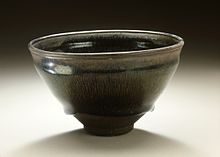
Tyavan ( 茶碗 , чай - teapot) - a cup- bowl for the Japanese tea ceremony . Cups are an important element of the ceremony, in particular, after drinking tea, it is customary to inspect the cup and then pass it on to the next guest. Many tyavans are works of Japanese pottery , some are given the status of a national treasure . Famous tea accessories (including tea cups) have their own names and often continue to be used, even if stored in museums [1] .
History and Design
Potters from the XVI century began to produce yoghurt specifically for the tea ceremony [1] . Tyavans are especially popular in the styles of raku , seto , hagi , , and oribe [1] .
Cups are required to be stable, but light, and also have a smooth inner surface. At the same time, “imperfections” are valued in tyavans: traces of the fingers of a potter, uneven patterns on the surface and so on [2] . The size of the cup should allow the placement of a broom, spoon and napkin, but at the same time it should fit comfortably in the palms of your hands. When contemplating a cup, the beholder assesses the harmony of the combination of the upper edge, body, and base [2] .
Role in the ceremony
The tyavan occupies a special place in the tea ceremony; it, like other utensils, is endowed with deep symbolism; the attitude to the cup resembles the attitude to the participant in the tea party: the famous cups are given the names [1] [2] .
The tyavan is kept in a special casket wrapped in a special kind of silk, and the history of the cup is recorded on the walls of the casket. Among the cups there is a hierarchy, determined, inter alia, by the peculiarities of their design: strict style, connection with the traditions of specific pottery workshops, place of origin and so on. Some masters give first place to Korean cups of the ido style ( 井 戸 型 ) (meaning “well”, which should reflect a sense of depth when looking at the cup [3] ), others - to cups of raku, Karatsu ceramics are also highly valued [2] . The cup, standing above the others in the hierarchy, is served to the most important guest, in special cases, the cup after tea drinking becomes a memorial object and is no longer used for its intended purpose [2] .
After tasting the tea, an examination of the tawan takes place, starting with a bow; the cup is transferred from one guest to another [2] .
Notes
- ↑ 1 2 3 4 Edmonds, 2008 .
- ↑ 1 2 3 4 5 6 Chu Feng Lei, 2007 .
- ↑ So-Oku, 2010 , p. 36.
Literature
- Chu Feng Lei. A cup in the context of the Japanese tea ceremony (Russian) // News of the Kharkiv State Academy of Design and Mystery. - Mystical tribute. Architecture, 2007. - P. 155—161 . - ISSN 1993-6419 .
- Richard Louis Edmonds, et al. Japan, §XV: Tea ceremony . - Oxford University Press , 2008. - (Grove Art Online). (subscription required)
- Sen So-oku. Chapter 6 The Essentials of Chanoyu Implements // Tea - Seeking the Missing Link to Rikyu. - Shinchosha. - Tokyo, 2010. (English)