Guadalors [1] ( Spanish: Guadalhorce ; Arabic: wādī l-jurs , 'river of silent') - a river on the Iberian Peninsula , flows through the south of Spain and flows into the Mediterranean Sea . This is the main river of the province of Malaga and the South catchment.
| Guadalors | |
|---|---|
| Spanish Guadalhorce | |
 | |
| Characteristic | |
| Watercourse | |
| Mouth | Mediterranean Sea |
| • Height | 0 m |
| • Coordinates | |
| Location | |
| Water system | Mediterranean Sea |
| A country |
|


Content
Etymology and Other Names
The term Guadalors comes from the Arabic wādī l-jurs , which means "river of the quiet", or, "watchdog".
Also, the Guadalorsa River received other names reflected in various historical texts, such as “The Malaga River”, or “Guadalquibirejo” (from the Arabic . Wādī l-kabīr , the “big river”), now not used.
History
On August 29, 1326, during the reign of Alfonso XI of Castile, his troops under the command of the famous writer Don Juan Manuel , grandson of Fernando III of Castile , defeated Muslims at the Battle of Guadalors, where about 3,000 Muslims were killed. According to some authors, this battle took place in the immediate vicinity of You in the upper reaches of the Guadalors, although others claim that the battle took place in the Archidona Valley.
River
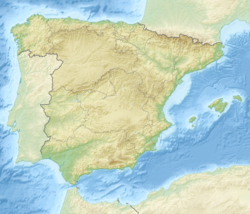
The source of the river is on the Los Alasores mountain pass in the Sierra de San Jorge (in Villanueva del Trabuco ), then the river flows through the Antequera Valley and flows into the Mediterranean Sea in the western part of the city of Malaga . Its length is 166 km, and the average annual flow rate is 8 m³ / s. This is the longest and richest river (along with Guadiaro ) of the province of Malaga , and the third in Andalusia.
In its course, the Los Gaitanes Gorge, a natural canyon of 7 km long, which separates the mosquito Baye del Guadalors from the Antequer Valley, was formed. The lower course of the river, together with Guadalmedina, forms an alluvial plain in the coastal lowlands of Malaga.
The mouth of the Guadallors River consists of two branches, one of them is artificially created due to constant floods. Because of this, natural deposition was disrupted, resulting in a loss of habitat for the chunket. Wetlands formed between the two arms, which have been preserved as the last stronghold for migratory birds in this zone and which make up the Guadalors River Estuary. Near the mouth there is a water purification system of Malaga and the remains of the Phoenician settlement of Cerro del Villar, they can study how two marine earthquakes destroyed this area, resulting in 584 BC. e. he was abandoned in order to found Malaka.
The Guadalorsa River crosses the municipal borders of Villanueva del Trabuco, Villanueva del Rosario , Archidona , Antequera , Alaurina el Grande , Alaurina de la Torre , Almogia , Alora , Cartama , Coin , Pizarra , Baye de Abdalah and Malaga .
Geology
Geologically, during the Upper Miocene , in the valley of Guadalors there was an estuary, which through the Andalusian lowland , which was the ocean floor, connected the waters of the Mediterranean Sea and the Atlantic. In the Lower Pliocene , the next geological period, this estuary turned into a large sea bay, bounded by the Sierra de Mijas and the western slopes of the Malaga Mountains , which did not extend beyond the Alora and in the center of which rose like the island of Sierra de Cartama . In the rest of the Pliocene, the lowlands of Guadalors acquire their current geological parameters.
Guadalorce supplies Malaga with electricity and water through the power plants of Gobantes, Paredones, Gaitanejo and El Chorro. There is also a project for a new power station at the mouth of the river.
Major tributaries
- Pereilas
- Rio grande
- Arroyo El Bayeux
- Nascimento
- Turon
- Cabayos
- Guadalteba
- Faala
- Campanias
- Arroyo Marine
- Arroyo del Quinto
Notes
- ↑ Map sheet J-30-B .
Literature
- El Santo Reino y su reacción frente a la historia (unknown) . - ISSN 0561-3590 .
- 1ª parte: Siete siglos sin una solución , 04/11/2012