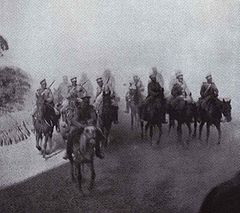
Detachment is a historical military term of the pre-war period, which denoted a horse patrol , performing the functions of an intelligence unit in the cavalry and artillery units of the Soviet army , as well as in the armed forces of some foreign states [1] [2] [3] .
In the cavalry units, the number of detachments could be from unit to platoon , it could be allocated from the cavalry regiment or even separately operating squadron for reconnaissance for two to three days at a distance of 25–35 kilometers from their forces [1] . In addition to reconnaissance of the enemy and the terrain, he could perform other tasks, for example, sentinel functions or updating data on enemy forces in separate directions with and without firing contact [1] .
In artillery units, a detachment was sent from a battery , division or regiment, and depending on its purpose and situation, it performed different tasks [1] :
- forward detachment was engaged in reconnaissance of the enemy along the routes of the movement of its forces;
- the near and far junction of the track assessed the patency of communications for artillery passage along them, eliminated minor obstacles on the route or chose ways to bypass obstacles and difficult sections;
- the quarterly drive was searching for the location of the personnel;
- the commander’s detachment was engaged in reconnaissance of the enemy, in choosing places for deploying observation posts and firing positions .
Notes
- ↑ 1 2 3 4 Departure // Soviet Military Encyclopedia . - Moscow: Military Publishing House of the Ministry of Defense of the USSR , 1980. - V. 7. - P. 44.
- ↑ Departure // Military Encyclopedic Dictionary. - Moscow : Military Publishing House of the Ministry of Defense of the USSR , 1986. - S. 618. - 863 p. - 150,000 copies.
- ↑ Departure // Military Encyclopedic Dictionary / A.P. Gorkin. - Moscow: Big Russian Encyclopedia, Ripol Classic, 2001. - T. 2. - P. 444. - ISBN 5-7905-0996-7 .