
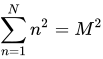
The cannonball problem (the cannonball problem ) is the problem of finding the number of cannonballs that can be laid in one layer in the form of a square, and in the form of a pyramid with a square in the base, that is, in finding square numbers , which are also square pyramidal numbers . Finding this number is reduced to solving the Diophantine equation or . The equation has two solutions: and that is, one cannonball, and and that is, 4900 cannonballs.



Content
Task history
The questions of laying cannonballs were already of interest to Sir Walter Raleigh and his contemporary Thomas Harriott [1] , but in the form given above it was formulated in 1875 by Edouard Luke , who suggested that in addition to and there are no other solutions [2] . Partial evidence was proposed by More-Blanc (1876) [3] and by Luke himself (1877) [4] . The first complete proof was proposed by Watson (1918) [5] ; the proof used elliptic functions [6] . Another proof was proposed by Lynggren (1952) [7] using the Pell equation [8] . Evidence using only elementary functions was proposed by Ma (1985) [9] and Englin (1990) [10] [6] .
Evidence
Watson's Proof
Watson's proof [5] is based on the observation that out of three numbers , and one must be divisible by 3; and either either must be even; and that all other factors should be squares. Thereby, six options are possible:
However, since when divided by 3, only residues 0 or 2 may be present, the first option leads to a contradiction. Similarly, you can exclude the second, third and fourth options.
The fifth option leads to the solution . Really, possible only with odd and that is, there are integers and such that or . But, leads to a contradiction . Consequently, , i.e, and . As shown by Gerono , and are the only solutions to the last system of equations [11] . Happening impossible because ; happening leads to . Alternative proof of the uniqueness of the solution in this case uses the fact that the only solutions are and is given in chapter 6.8.2 of Cohen's book [12] .
The proof of the absence of non-trivial solutions in the sixth variant requires the use of elliptic functions. Indeed, the sixth option can be brought to mind . Instead of these equations, Watson considers a more general case. and shows that solutions of these equations must satisfy where - non-negative integer, given , , , but , , and - Jacobi elliptic functions . Watson further proves that numerically equal to one, only if , i.e and the only possible solution in this case .
Proof of Ma
The proof of the uniqueness of the above solutions, proposed by Ma, is based on the consistent proof of the following statements [12] :
- The only even solution to the nuclear stacking problem is . Indeed, parity allows to exclude options 1, 4 and 6 from Watson’s proof, options 2 and 3 lead to a contradiction (see Watson’s proof), and - the only solution possible for option 5.
- Let be . Then for non-negative , has the appearance only for .
- The only odd satisfying the nuclear stacking problem is . Indeed, arguing as in Watson’s proof, the odd must satisfy option 6, that is, . As for any , and This is also true for . Substituting and instead and get , i.e, . Insofar as generates a group of units , exists such that where defined above and . Insofar as positively, and by definition , . By the previous lemma, , i.e and .
Details of the proof are given in chapter 6.8.2 of Cohen's book [12] .
Generalizations of the task
Except for the trivial case there is no number of cannonballs that could be laid in the form of a pyramid with a square at the base, and which at the same time would be a cube, fourth or fifth power of a natural number [13] . Moreover, the same is true for nuclear packing in the form of a regular tetrahedron [13] .
Another generalization of the problem is the question of finding the number of nuclei that can be laid in the shape of a square and a truncated pyramid with a square at the base. That is looking for consecutive squares (not necessarily starting from 1), the sum of which is a square. It is known that many such infinitely, has an asymptotic density of zero and for non-squares, there are infinitely many solutions [8] . Number elements of the set not exceeding rated as . First elements sets and the corresponding lowest values such that is a square given in the following table [8] :
n 2 eleven 23 24 26 33 47 49 50 59 a 3 18 7 one 25 7 539 25 7 22
For and the solution is the Pythagorean triple . For and The solution is the above solution of the problem of laying cannonballs. The sequence of elements of the set - the sequence A001032 in OEIS [14] .
Another generalization of the problem was considered by Kaneko and Tachibana [15] : instead of the question of the equality of the sum of the first square numbers and another square number, they considered the question of the equality of the sum of the first polygonal numbers and another polygonal number and showed that for any there are infinitely many sequences first -countable numbers such that their sum is equal to another polygonal number, and that for any there is an infinite number -gonal numbers representable as a sum of sequences of the first polygonal numbers. Moreover, Kaneko and Tachibana found that for any natural the following relationships are performed:
Where - th is a angular number, and - th -corner pyramid number , i.e., sum the first -carbon numbers [15] .
Relationship with other areas of mathematics
Nontrivial solution leads to the construction of the Litch lattice (which, in turn, is associated with various areas of mathematics and theoretical physics - the theory of boson strings , monster ). This is done with an even unimodular lattice. in 25 + 1-dimensional pseudo-Euclidean space . Consider the vector of this lattice . Insofar as and - solution of the problem of laying cannonballs, this vector is light - like , , whence, in particular, it follows that it belongs to its own orthogonal complement . According to Conway [16] [17] , the vector allows you to build a lattice Lich
- as a factor set which is correctly determined due to light-likeness ;
- as the set of all vectors such that . Such vectors constitute a set of so-called fundamental lattice roots. . In all cases when it is possible in this way to construct the set of fundamental roots of an even unimodular lattice in a pseudo-Euclidean space , you can always use an integer vector with spatial components running from zero in a row; and for this set to form a lattice, this vector must be light-like. And since - the only nontrivial solution of the problem of laying cannonballs, the 24-dimensional Litch grid is the only grid that can be obtained from .
See also
- Dense packing of equal spheres
Notes
- ↑ David Darling. Cannonball Problem . The Internet Encyclopedia of Science .
- ↑ Édouard Lucas. Question 1180. // Nouv. Ann. Math - 1875. - Vol. 14. - p. 336.
- ↑ Claude Séraphin Moret-Blanc. Question 1180. // Nouv. Ann. Math - 1876. - Vol. 15. - p. 46-48.
- ↑ Édouard Lucas. Question 1180. // Nouv. Ann. Math - 1877. - Vol. 15. - p. 429-432.
- ↑ 1 2 GN Watson. The Problem of the Square Pyramid. // Messenger Math. - 1918. - Vol. 48. - p. 1-22.
- ↑ 1 2 Eric W. Weisstein. Cannonball Problem (English) . MathWorld - A Wolfram Web Resource . The appeal date is July 6, 2017.
- ↑ W. Ljunggren. New solution of a problem proposed by E. Lucas // Norsk Mat. Tid .. - 1952. - Vol. 34. - p. 65-72.
- 2 1 2 3 Richard K. Guy. Unsolved Problems in Number Theory / KA Bencsath, PR Halmos. - 3rd. - Springer. - P. 223-224. - 454 p. - (Problem Books in Mathematics). - ISBN 978-1-4419-1928-1 .
- ↑ DG Ma. An Elementary Proof of the Diophantine Equation . // Sichuan Daxue Xuebao. - 1985. - Vol. 4. - p. 107-116.
- ↑ WS Anglin. The Square Pyramid Puzzle. // Amer. Math Monthly. - 1990. - Vol. 97. - pp. 120-124.
- ↑ C.-C. Gerono. Démonstration d'une formule dont on peut déduire, comme cas particulier, le binôme de Newton // Nouvelles annales de mathématiques: journal des candidats aux écoles polytechnique et normale. - 1857. - T. 16. - p. 237-240.
- ↑ 1 2 3 Henri Cohen. Number Theory. - 2007: Springer. - T. Volume I: Tools and Diophantine Equations. - P. 424—427. - 653 p. - ISBN 978-0-387-49922-2 .
- ↑ 1 2 Elena Deza, Michel Marie Deza. Figurate Numbers. - Singapore: World Scientific, 2012. - P. 98. - 456 p. - ISBN 981-4355-48-8 .
- ↑ NJA Sloane . A001032 Numbers n consecutive integers ≥ 1 is a square. (eng.) The On-Line Encyclopedia of Integer Sequences . The date of circulation is July 10, 2017.
- ↑ 1 2 Masanobu Kaneko and Katsuichi Tachibana. When is a polygonal number pyramid again polygonal? : [ eng ] // Rocky Mountain Journal of Mathematics. - 2002. - V. 32, № 1. - P. 149-165.
- ↑ JH Conway. The automorphism group of the 26-dimensional even unimodular Lorentzian lattice // Journal of Algebra. - 1983. - Vol. 80. - P. 159-163. - DOI : 10.1016 / 0021-8693 (83) 90025-X .
- ↑ JH Conway, NJA Sloane. 26. Lorentzian Forms for the Leech Lattice. 27. The Automorphism Group of the 26-Dimensional Lorentzian Lattice // Sphere Packings, Lattices and Groups. - 3rd ed. - Springer-Verlag New York, 1999. - ISBN 978-1-4757-6568-7 , 978-0-387-98585-5.