Green rocker [1] [2] ( Aeschna viridis ) - a species of dragonflies of the family of the rocker ( Aeshnidae ).
| Green rocker |
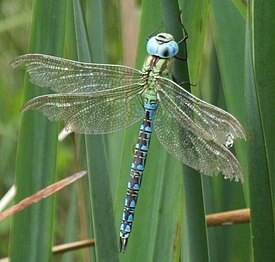
Male |
| Scientific classification |
|---|
| No rank : | Bilateral symmetrical |
| Subtype : | Tracheo-breathing |
| Infraclass : | Ancient winged insects |
| Suborder : | Damselfly Dragonflies |
|
| International scientific name |
|---|
Aeschna viridis
Eversmann , 1836 |
|
The body length of dragonflies reaches 65–75 mm [1] . Male abdomen 48–52 mm long, females 47–54 mm long. The length of the hind wings of the male is 38–41 mm, and that of the female is 41–45 mm. Very large view. Eyes touch each other. The body is variegated, light green or blue (in the male) color. On the forehead is a full T-shaped black pattern. There are blue spots on the chest at the base of the wings. The pre-humeral stripes are light green, full and wide, wider than the dark stripes between them. The sides of the chest are green, at the seams with narrow black stripes. The 8th and 9th tergites of the abdomen are on top with a pair of isolated blue or green spots each. Above segments of the abdomen with dark impressions in the form of dashes and dots. Wings are transparent, pterostigma is dark gray in color, with a diameter of more than 3 mm. Veins of wings of black color. Ovipositor in a female with lateral plates, its main plate behind without deep excavation. The ovipositor is short; its posterior end does not extend beyond the end of the last abdominal segment.
Trans-Palaearctic species.
In Ukraine, the species is registered in Polesie , Western Forest-Steppe, Kiev, Chernihiv, Poltava, Kherson regions [3] . It lives in the Crimea [3] . In Belarus, the range covers the territory of the whole country - it is found in lowland marshes and in floodplains, it is rare throughout the republic [4] .
Flight time : end of June - beginning of October. Dragonflies are found at lakes, ponds, elders and backwaters of rivers with floating hydrophytes. It inhabits stagnant and low-flowing water bodies with a muddy bottom, with the obligatory presence of thickets of teloresis, cattail, reeds and shrubbery. The species is closely related to teloresis , in the leaves of which females usually lay eggs. However, the species is found in the complete absence of this plant. Often flies into the territory of cities. When planting a dragonfly, take a pose with the abdomen hanging down. They hunt near water bodies, flying off no more than 500 m from them. Most active in the evening hours. Overnight in the crowns of coastal trees and in thickets of aquatic plants. They show territorial behavior - males protect individual sites along the shore of the reservoir. Females lay eggs while falling into the water, while sliding down the stems of plants. The egg stage lasts about 9 months. The stage of development of the larvae lasts 1.5-2 years. They lead a sedentary lifestyle. They feed on larvae of mosquitoes, mayflies and other insects, daphnia , water donkeys. Having eaten a certain body mass, they leave for the winter. After at least 5 molts, in June they are selected from the water along the stems of the plants and on them they turn into adult dragonflies.
The species is included in the Red Book of the Republic of Belarus (category II) [2] , and in the Red Book of Lithuania. Protected in Europe (Annex II of the Berne Convention ).
- ↑ 1 2 Skvortsov V. E. Dragonflies of Eastern Europe and the Caucasus: Atlas-determinant. - M .: Partnership of scientific publications of KMK, 2010. - 624 p. - 1000 copies. - ISBN 978-5-87317-657-1 .
- ↑ 1 2 Red Book of the Republic of Belarus: Rare and Endangered Species of Wild Plant Plants / Ch. editorial : I. M. Kachanovsky (pres.). M.E. Nikiforov, V.I. Parfenov [et al.]. - 4th ed. - Minsk: Belarus. Encekl. Name P. Brokki. - 2015 .-- 448 p. ISBN 978-985-11-0843-1 . Publishing House l 49.39. Circulation 1500 copies.
- ↑ 1 2 Gorb S.N., Pavlyuk R.S., Spuris Z. D. Dragonflies (Odonata) of Ukraine: faunistic review = Grandmothers (Odonata) of Ukraine: faunal look // Bulletin of Zoology. - K. , 2000. - T. Separate issue 15 . - S. 1-155 . (Ukrainian)
- ↑ Red Book of the Republic of Belarus - Green Rocker Arm (Neopr.) . Date of treatment June 26, 2012. Archived on August 17, 2012.
