"Scharnhorst" ( German: Scharnhorst ) - battleship (sometimes referred to as a battlecruiser , in connection with the caliber of guns) of the German Navy in World War II . Named after the general and reformer of the Prussian army Gerhard von Scharnhorst and in memory of the World War I cruiser Scharnhorst , sunk in the Battle of the Falkland Islands in December 1914 .
| Scharnhorst | |
|---|---|
| Scharnhorst | |
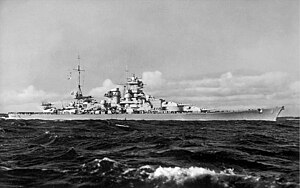 Battleship Scharnhorst in 1939 | |
| Service | |
 Germany Germany | |
| Named after | |
| Class and type of vessel | Scharnhorst Battleship |
| Organization | Kriegsmarine |
| Manufacturer | |
| Construction started | May 16, 1935 |
| Launched | October 3, 1936 |
| Commissioned | January 7, 1939 |
| Withdrawn from the fleet | December 26, 1943 |
| Status | Sunk in battle at the North Cape |
| Main characteristics | |
| Displacement | 31 552 t - standard 38 900 t - full |
| Length | 235.4 m - total 229.8 m - waterline |
| Width | 30.0 m |
| Draft | 9.91 m - full |
| Reservation | Main belt - 350 mm deck - 95 mm |
| Engines | 3 Brown, Boveri & Cie turbines |
| Power | 161 164 liters with. (119 M W ) |
| Mover | 3 three-blade screws with a diameter of 4.8 m |
| Speed | 31 knots (57.4 km / h ) |
| Sailing range | 10,100 nautical miles at a speed of 19 knots |
| Crew | 1968 people (60 officers, 1909 sailors) |
| Armament | |
| Artillery | 3 × 3 283 mm 4 × 2 + 4 × 1 150 mm |
| Flak | 14 × 105 mm 16 × 37 mm 10 × 20 mm |
| Mine torpedo armament | 2 three-pipe 533 mm torpedo tubes |
| Aviation group | 3 Arado Ar 196 A-3 1 catapult |
Design
The ship was built in Wilhelmshaven , Germany , laid down on June 15, 1935, launched on October 3, 1936 , [1] became operational on January 7, 1939 . After the first tests in mid-1939, the ship was modernized: a new mainmast was installed on it, located closer to the stern, and the straight stem was replaced with the “Atlantic” to improve seaworthiness . However, from the very beginning of his career (a fight with Rinaun), Scharnhorst had problems with filling his bow [2] .
The beginning of the war
The first military operation of Scharnhorst was to patrol the passage between Iceland and the Faroe Islands at the end of November 1939 together with the Gneisenau , where they sank the English armed transport Rawalpindi . In the spring of 1940, Scharnhorst and Gneisenau provided the invasion of Norway ( Operation Weserübung ). On April 9, 1940, near Norway, they met with the British battle cruiser Rinaun , the British disabled the 1st tower of the Gneisenau Group, the German battleship hit the cruiser with 2 283-mm shells, but did not cause serious damage to it. Scharnhorst was damaged by the elements, in the flooded tower of the Anton Group of Companies (1st main caliber), a short circuit occurred in the chains of the ammunition supply electric drives and the tower failed. In addition, due to the need to keep full speed, the right Scharnhorst car was damaged, but the Germans still managed to break away from the obsolete British cruiser. On June 8, 1940, the Scharnhorst and Gneisenau in the Norwegian Sea in the battle known as Operation Juneau (the first and only case of a battleship’s collision with an aircraft carrier in which the battleships won) sank the British aircraft carrier Glories and its escort: destroyers Acasta and Ardent . During the battle, the Scharnhorst was damaged by a torpedo from the Akasta, 50 sailors were killed and the left propeller shaft was damaged. Soon, due to flooding, the middle car had to be turned off. The cellars of the Caesar GC tower (3rd main caliber) were flooded. On June 13, Skua dive bombers from the Ark Royal aircraft carrier made a raid on the Scharnhorst in the harbor. The attack was ineffective: out of 15 aircraft, 8 were shot down, only one bomb hit the target, but even it did not explode.
Due to the injuries received on June 8, the Scharnhorst was sent to the dry dock in Kiel, where he stayed until the end of 1940.
At the end of December 1940, Scharnhorst and Gneisenau tried to break through the British blockade and enter the North Atlantic trade routes, but were forced to turn back due to the breakdown of Gneisenau.
Atlantic Raid
From January 22 to March 22, 1941, Scharnhorst and Gneisenau operated in the Atlantic under the leadership of Admiral Gunter Lutens . On February 3, they crossed the Danish Strait and the next day reached the southern tip of Greenland . An attempt to attack the convoy HX-106 on February 8 failed due to the appearance of the British battleship Ramilles . On February 22, four allied merchant ships were spotted and sunk east of Newfoundland . Amid very weak air patrols in this sector of the Atlantic, raiders were able to avoid a clash with the British fleet . Between March 7 and 9, they attacked the SL-67 convoy, but were forced to retreat when the Malaya battleship arrived . On March 15, an unguarded convoy of Allied tankers was attacked southeast of Newfoundland. The next day, another mixed convoy was discovered and attacked, with 13 ships sunk, four of them by the Scharnhorst. This was the last attack before returning to the port of Brest on March 22. During the trip, Scharnhorst sank 8 vessels, with a total tonnage of 49,300 tons, with a total group count of 22 sunk vessels and a total tonnage of 115,600 tons [3] .
English Channel Break
While in Brest, German ships became targets of constant air raids. In July 1941, Scharnhorst relocated to the port of La Rochelle , south of Brest. Warned about the departure of Scharnhorst from the port by aerial reconnaissance and resistance agents, the Allies were convinced that this was another raid. To prevent the raid, they took off in the air 15 heavy bombers " Halifax " British Air Force. The damage caused by the bombing was serious enough to force the Scharnhorst to return to the port of Brest for repair. Damage from the bombardment, along with the ones suffered during the raids, as well as problems with cooling the boilers, delayed the Scharnhorst in the port until the end of 1941, when it was decided to send the Scharnhorst and Gneisenau, as well as the heavy cruiser Prince Eugen back to Germany. Since it was very risky to try to break through the North Atlantic, on February 11-13, 1942, three large ships, accompanied by dozens of minesweepers and other auxiliary vessels, made a break through the English Channel , called Operation Cerberus . The British were not ready for such a decisive and unexpected breakthrough, their coast guard was not ready to stop the breakthrough, and the jamming of the English radars by the Germans did not allow an attack from the air. However, both Scharnhorst and Gneisenau were damaged by mines: Scharnhorst two, and Gneisenau one.
Repair fixed the Scharnhorst at the docks until March 1942, after which he went to Norway to meet the battleship Tirpitz and other German ships to attack the Arctic convoys going to the Soviet Union . The next few months were devoted to training and acclimatization, ending with the bombing of Svalbard together with Tirpitz.
Death of Scharnhorst
On Christmas Day 1943, the Scharnhorst and several German destroyers under the command of Rear Admiral Erich Bay went to sea to attack the northern convoys JW 55B and RA 55A . Unfortunately for the Germans, their orders were decrypted by English cryptographers and the British Admiralty was able to prepare in advance. The next day, due to difficult weather conditions, Bay was unable to locate the convoy and sent destroyers to search him south, leaving the Scharnhorst alone. In less than 2 hours, the battleship stumbled upon the Belfast , Norfolk , and Sheffield convoy cruisers . The Belfast discovered the Scharnhorst at 08:40 at a distance of about 17 miles using radar. Covering the convoy, the British approached the Scharnhorst, made eye contact and opened fire, causing minor damage to the battleship. In particular, the bow of the Scharnhorst radar was destroyed, which may have caused further problems for the ship. Considering the main purpose of the convoy transports, the battleship broke away from the British cruisers, but trying to break through to the transports was overtaken by them again and came off again, while causing damage to the Norfolk cruiser. After the second failure, Bay decided to stop the operation and return. Destroyers received orders to return. However, the English battleship Duke of York was already between Scharnhorst and Norway, and the Germans turned off the stern radar, fearing to betray themselves by the radiation of this device and not particularly trusting it. Around 16:50, the Duke of York opened fire from a short distance at a German battleship pre-illuminated by lighting shells. Scharnhorst almost immediately lost the towers of the Anton and Bruno Group of Companies (the latter temporarily), but the higher speed allowed him to break away from the Duke of York. However, an hour later the Scharnhorst boilers failed, since a thin upper armor belt and a glacis of the main boiler compartment (80 mm), which was 70-80 cm above the main armor deck, were pierced by the hit of a 356-mm armor-piercing shell of the GK English battleship . After that, the speed of the battleship dropped to 8 knots, although the operational repair allowed to increase it to 22 knots, but the fate of the ship was already decided. Due to the surprise, the Duke of York escaped with minimal damage, while the Scharnhorst, despite a powerful reservation [4] , lost speed and lost most of its artillery and became vulnerable to destroyers. Several torpedo attacks turned out to be successful, as did the Duke of York firing from a pistol range, and the ship’s agony soon set in, but continued until 19:45 when the Scharnhorst went under water. After diving from British ships heard powerful underwater explosions.
Of the entire crew in 1968, only 36 sailors [5] and not a single officer escaped. 30 took on board the Scorpion and 6 on the Matchless.
Later that evening, Admiral Bruce Frazer , gathering officers aboard the Duke of York, said:
| Gentlemen, the battle with the Scharnhorst ended in victory for us. I hope that any of you who ever have to lead your ship into battle with a much stronger enemy will command your ship as valiantly as they commanded the Scharnhorst today [6] . |
Discovery
The search for the sunken battleship has been undertaken since the late 90s of the 20th century. In September 2000, a joint expedition began, organized by the BBC , the Norwegian Broadcasting Corporation and the Norwegian Navy . The expedition was based on the Sverdrup II research vessel, owned by the Norwegian Center for Defense Research. The wreckage was discovered by a side-scan sonar and identified as the wreckage of the Scharnhorst battleship on September 10, 2000 using a remotely controlled device. The location of the debris is 72 ° 31 ′ N, 28 ° 15 ′ E (the coordinates differ from those indicated in the logbook of the battleship HMS Duke of York ), about 120 kilometers north-north-east of Cape Nordkapp , at a depth of 290 meters. The surviving part of the hull, about 160 meters long, lies upwards with a keel. The bow (60-70 m long) is torn off (in the area of the captain’s bridge), badly damaged and lies almost at right angles to the surviving part of the hull. Presumably, the bow of the hull was torn off due to the detonation of the gun cellar of tower A of the main guns, caused by a torpedo entering the bridge area. Part of the aft end is also absent (immediately behind the surviving screws and rudders). The surviving main part of the hull split along its entire length (probably from a bottom strike when diving) - there is a crack 2-3 cm wide along the keel. There are numerous traces of the effects of shells and torpedoes of British ships that hit the battleship during his last battle. Around the wreckage a sediment was formed from bottom sediments 15–20 meters high [7] [8] .
Commanders
- Captain Zur See Otto Tsiliaks (January 7 - September 23, 1939)
- Captain Zur See Kurt Hoffmann (September 23, 1939 - March 31, 1942)
- Captain Zur See ( Rear Admiral October 1, 1943) Friedrich Huffmeier (March 31, 1942 - October 13, 1943)
- Captain Zur See Fritz Hintze (October 13 - December 26, 1943, died)
Notes
- ↑ KBismarck.com. Scharnhorst career timeline . KBismarck.com (1998-2013).
- ↑ The battle of Scharnhorst with the battleship Duke of York turned out to be the last for Scharnhorst
- ↑ Scharnhorst General Information
- ↑ The Duke of York consumed 446 GK shells, 31 shots fired, and at least 13 hits were recorded.
- ↑ According to some reports, two of the survivors died in an accident as soon as they reached the shore: “The Mystical Secrets of Wars” on the site abc-people.com
- ↑ Scharnhorst. The history
- ↑ BBC - History - World Wars: The Sinking of the 'Scharnhorst' (English ) ? . www.bbc.co.uk. Date of treatment February 24, 2019.
- ↑ Alf Jacobsen. Battleship SCHARNHORST. - Moscow: Eskmo, 2006 .-- S. 237-249. - 304 p. - ISBN 5-699-14578-8 .
Links
- Historic Center, US Navy Official Publications Department (en) .
- The story of the battleship Scharnhorst: professionalism versus heroism .
- Scharnhorst videos on youtube.com
- Royal Navy: World War II 1939-1945
- Scharnhorst : Timeline and Charts at KBismarck.com (en)
- Operation Berlin
- Maritimequest: Scharnhorst photo gallery (en)
- Video (en)
- Collection of private photos of the battleship
- S.V. Suliga. Scharnhorst Battleships
Literature
- Breyer, Siegfried Battleships and Battlecruisers 1905-1970. (Doubleday and Company; Garden City, New York, 1973) (originally published in Germany under the title Schlachtschiffe und Schlachtkreuzer 1905-1970 , JF Lehmanns, Verlag, Munchen, 1970). It contains various diagrams and drawings of the ship, how it was planned and how it was built.
- Busch, Fritz-Otto The Sinking of the Scharnhorst. (Robert Hale, London, 1956) ISBN 0-86007-130-8 . The story of the Battle of Nordkapp told by the Scharnhorst survivor
- Claasen, ARA Hitler's Northern War: The Luftwaffe's Ill-Fated Campaign, 1940-1945. Lawrence: University Press of Kansas, 2001. pp. 228-234. ISBN 0-7006-1050-2
- Garzke, Willliam H., Jr. and Robert O. Dulin, Jr. Battleships: Axis and Neutral Battleships in World War II. (Naval Institute Press, Annapolis, 1985). Includes stories about the creation of the ship and its combat operations, information about weapons and other statistical information about the Scharnhorst
- Alf Jacobsen. Battleship Scharnhorst = Alf R. Jacobsen SHARNHORST. - M .: Eksmo , 2005 .-- 304 p. - ISBN 5-699-14578-8 .