Butterfly stingrays [1] [2] , or gimnurs [1] [2] ( lat. Gymnura ) - currently recognized as the only genus of stingrays of the monotypic family anthem [2] from the order of caudate . The genus includes 14 species. Previously, the anthem family was divided into two genera - stingrays-butterflies and etoplate ( Aetoplatea ) on the basis of the presence of the dorsal fin in the latter. However, recent taxonomic studies have given grounds for the unification of these genera [3] . The name of the family and clan comes from the words dr. γυμνός - “naked”, “naked” and Greek. οὐρά - “tail” [4] .
| Butterfly Rays |
|---|
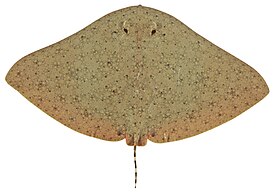
Gymnura australis |
|
| No rank : | Bilateral symmetrical |
| Family: | Gymnastics ( Gymnuridae Fowler, 1934 ) |
|
|
Gymnura van Hasselt , 1823 |
|
- Aetoplatea Valenciennes in Müller & Henle, 1841
- Phanerocephalus Gratzianov, 1906
- Pteroplatea Müller & Henle, 1837
|
|
The pectoral fins of stingrays-butterflies form a disc whose width is much greater than the length. The tail is very short. The tail spike is not available in all species. Despite the presence of a spike, the short tail does not allow these ramps to deliver strong blows, so they are generally not as dangerous as other stingrays [5] . Gymnurs live in the subtropical and tropical waters of all oceans, sometimes they swim in the estuaries. Most often they are found in the upper part of the continental shelf . Lead a bottom lifestyle. The diet consists of various invertebrates and small fish. Like other caudate-like stingrays, butterflies reproduce by egg production [6] [7] . Gymnastic - rather large slopes. Most species reach a wingspan of 1.5 to 2.5 m; in the Atlantic butterfly stingray ( Gymnura altavela ), it can even reach 4 m [8] .
The pectoral fins of butterfly rays are extended in the form of very wide “wings”, thanks to which these fish got their name, exceeding the length by more than 1.5 times. They merge, forming a diamond-shaped disk. The head ends with a blunt short snout. In some species, for example, a smooth stingray butterfly , the snout of females is more rounded compared to males. The dorsal surface of the disc is brown, grayish, purplish or greenish in color, sometimes with dark or light spots. The skin of some species is covered with small scales . The slopes when looking sideways have a flattened shape. The eyes are located on the sides of the upper part of the head, behind them there are splashes . On the ventral side of the disc are a rather large mouth, nostrils and 5 pairs of gill slits. To take water, stingrays-butterflies use rather a spray, rather than a mouth oriented to the bottom. If the gills are covered with sand, with the help of a sprayer, the fish push out the water. Butterfly stingrays have small pointed teeth that do not form crushing plates. Dorsal fins, if present, small. Anal fin missing. The end of the caudal stem carries the dorsal and ventral ridges. The length of the thin tail is much less than the length of the disk. Some species of butterfly stingrays have a venomous thorn behind the ventral fins. The length of the hymnur ranges from 0.5 to 2 m [6] [9] [10] [11] [12] .
Like other tailed-like stingrays, butterfly rays breed by egg-production. Embryos develop in the womb, feeding on the yolk and histotroph . For a smooth stingray butterfly, for example, the weight of a newborn stingray is 4900% of the weight of an egg, and its length is approximately 15-22 cm. The intrauterine development phase lasts 2-4 months. Newborns of Natal’s anthem at birth have an almost triangular shape, “wings” begin to form later. Females bring offspring annually. The number of litters ranges from 2 to 6 newborns. According to one study, young stingrays are born rolled up in a tube like a cigar, then they flatten the disk and float away. The poisonous spike on the tail is hidden in a soft shell and is not able to injure the mother [6] [12] [13] [14] [15] [16] [17] [18] .
Butterfly stingrays use a thorn located on the tail stem for protection. They feed on crabs, shrimp, shellfish and small fish. In turn, they can become prey for sharks and other large fish [6] [16] .
In general, butterfly rays are not the subject of commercial fishing. Aborigines of Australia have traditionally used them for food for centuries. They determined the time of the start of the hunt by the condition of the rays of the skates: if it was pink and greasy, then fishing could begin. Stingrays with two spikes were considered unfit for food. Compared to other stingrays, stingrays do not pose a serious danger to humans, since the length of the tail does not allow them to deliver strong blows [6] [12] [13] .
Currently, 14 species are classified as butterfly stingrays [19] :
- Gymnura afuerae Hildebrand , 1946 - Peruvian stingray butterfly [1]
- Gymnura altavela Linnaeus , 1758 - Atlantic stingray butterfly [2]
- Gymnura australis ( Ramsay & Ogilby , 1886)
- Gymnura bimaculata ( Norman , 1925)
- Gymnura crebripunctata ( Peters , 1869) - Mexican stingray butterfly [1]
- Gymnura crooki Fowler , 1934
- Gymnura hirundo ( Lowe , 1843)
- Gymnura japonica ( Temminck & Schlegel , 1850) - Japanese stingray butterfly [2]
- Gymnura marmorata ( JG Cooper , 1864) - Marble stingray butterfly [1] [2]
- Gymnura micrura ( Bloch & JG Schneider , 1801) - Smooth stingray butterfly [1] [2]
- Gymnura natalensis Gilchrist & Thompson , 1911) - Natal Gimnur [2]
- Gymnura poecilura ( Shaw , 1804) - Ring-tailed stingray butterfly [1]
- Gymnura tentaculata ( Müller & Henle , 1841)
- Gymnura zonura ( Bleeker , 1852)
