Zhanghenglong (lat.) - genus of herbivorous ornithopod dinosaurs of the superfamily Hadrosauroidea from the Cretaceous of Asia . The type and only species Zhanghenglong yangchengensis was named and described by Xing and colleagues in 2014. The name of the genus is formed on behalf of the Chinese philosopher, statesman, scientist and inventor Zhang Heng (he was born on the outskirts of Nanyang County, the territory of the modern Henan province) and the Chinese word "long", which means "dragon". The species name is given by the name of the ancient administrative area of Yangcheng, which included the modern province of Henan, and existed in the Period of Woosen and Autumn [1] .
| † Zhanghenglong |
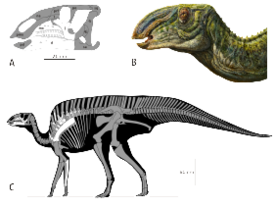
Reconstruction |
| Scientific classification |
|---|
| No rank : | Bilateral symmetrical |
| Infraclass : | Archosauromorphs |
| No rank : | Archosauriformes |
| Infrastructure : | † Ornitopods |
| Parvotryad : | † Iguanodonts |
| Superfamily : | † Hadrosavroids |
|
| International scientific name |
|---|
Zhanghenglong Xing et al. , 2014 |
| Single view |
|---|
† Zhanghenglong yangchengensis
Xing et al. , 2014 |
Geochronology
Santon Age86.3-83.6 Ma | million years | Period | Era | Aeon |
|---|
| 2,588 | Even | | | Ka | F
but
n
e
R
about
s
about
th | | 23.03 | Neogene | | 66.0 | Paleogen | | 145.5 | a piece of chalk | M
e
s
about
s
about
th | | 199.6 | Yura | | 251 | Triassic | | 299 | Permian | P
but
l
e
about
s
about
th | | 359.2 | Carbon | | 416 | Devonian | | 443.7 | Silur | | 488.3 | Ordovician | | 542 | Cambrian | | 4570 | Precambrian |
◄ Nowadays◄ Cretaceous-Paleogene extinction◄ Triassic extinction◄ Perm mass extinction◄ Devonian extinction◄ Ordovician-Silurian extinction◄ Cambrian explosion |
|---|
|
Content
The holotype XMDFEC V0013 and the paratype XMDFEC V0014 were discovered in a quarry 400 meters from the Zhoujiagou village in the layers of the Matszyatsun formation dating from the middle of Santon , Henan Province, China .
The holotype is an incomplete, dissected skull, consisting of an almost complete right jaw bone, an incomplete right zygomatic bone and a dental bone. The paratype is an incomplete, dissected postcranial skeleton, including 5 dorsal vertebrae (some lack spinous processes), fragments of the dorsal ribs and almost complete full right scapula and ulna [1] .
Jawbone in lateral (A), medial (B), dorsal (C), and anterior (D) projections
Zhanghenglong is a medium-sized hadrosaroid diagnosed by the following autapomorphies : the posterior third of the jawbone is strongly deflected posteriorly relative to the anterior two-thirds of the bone; the crowns of the dentary teeth have median main crests displaced distally. Zhanghenglong also has the following combination of unique features: 5 holes of the jawbone include 4 small holes located in a row in the anteroposterior direction, and one large, located near the ventral edge of the zygomatic articular surface of the jawbone; maxillary and dentar occlusal surfaces convex in the dorsal direction; the body of the jawbone is approximately 150% longer than its height; the large anterior opening is limited by the anterior half of the anterodorsal surface of the jawbone and is located laterally to the premaxillary articular surface of the jawbone; relatively long, well-developed ectopterygoid crest; the low, dorsoventrally directed anterior process of the zygomatic bone along the posterior border has a joint surface for the palatine bone in the shape of a crescent; deep hollow along the ventral margin of the zygomatic bone; tooth bone has 26 alveoli; the long axis of the dentar occlusal surface is parallel to the lateral side of the branch of the dental bone; crowns of maxillary teeth have sigmoid and almost straight main crests; 1 or 2 functional teeth in the alveolus on most of the dental occlusal surface; no more than 4 teeth in the alveoli of the dental bone; the neck of the scapula is strongly compressed dorsoventrally; the dorsal edge of the scapula has an arcuate appearance.
Zhanghenglong Residue
Spot (Orange Star)
The morphology of the skeleton of Zhanghenglong is typical of non-hadrosaurid hadrosaroids , since it has a number of plesiomorphic characters. It differs significantly from all known hadrosaroids in two autapomorphies and a unique combination of characters. Despite the presence of plesiomorphies , Zhanghenglong has several advanced features observed in hadrosaurids, as well as two transitional signs that are intermediate between the corresponding plesiomorphic and advanced features of hadrosaroids. Thus, Zhanghenglong is a relatively advanced non-hadrosaurid hadrosauroid, considered one of the closest relatives of hadrosaurids [1] .
To clarify the phylogenetic position of Zhanghenglong and to construct a complete tree of basal hadrosaroids, a volume analysis was performed using 346 characters (235 cranial and 111 postcranial) for 61 taxa (4 iguanodonts for the outer group and 57 hadrosaroids). The strict consensus tree, derived from the 54 most economical trees, demonstrates that Zhanghenglong , Nanyangosaurus, and hadrosaurids form a monophyletic group with insoluble polytomy. This treasure is diagnosed by five unambiguous synapomorphies , although only three of them were known at Zhanghenglong at the time of publication: the median main crests are present on most or all of the dental crowns of the dental battery; the ratio of the height of the jawbone from the top of the dorsal process to the ventral margin to its length along the ventral margin is from 0.35 to 0.45; the dorsal edge of the scapula in lateral projection has an arched shape. In the majority tree, Zhanghenglong is positioned as a sister taxon to the treasure Nanyangosaurus + hadrosaurids. In general, the topology of basal hadrosaroids of a strictly consensus tree is almost identical to the majority tree.
Cladogram based on a 2014 study by Xing and colleagues (strong consensus tree) [1] :
|
| Ouranosaurus |
| | Hadrosauriformes |
| |
|
|
| Jinzhousaurus |
| | Hadrosauroidea |
| Equijubus |
|
|
| Xuwulong |
|
|
| Probactrosaurus |
|
|
| Jintasaurus |
|
| |
|
|
| Levnesovia |
|
|
| Tanius |
|
|
| Bactrosaurus |
|
|
| Gilmoreosaurus |
|
|
| Shuangmiaosaurus |
|
|
| Nanningosaurus |
|
|
|
| Telmatosaurus |
|
| Tethyshadros |
|
|
|
|
| Claosaurus |
|
|
| Zhanghenglong |
|
| Nanyangosaurus |
|
| Hadrosauridae |
|
|
|
|
|
|
|
|
|
|
|
|
|
|
|
|
|
|
|
|
|
|
|
|
|
|
|
|
|
|
|
|
|
According to a cladogram from a 2014 study by Xing and colleagues, two Asian basal hadrosaroids Zhanghenglong and Nanyangosaurus are the closest relatives of hadrosaurids. The oldest known lambeosaurin, Jaxartosaurus (Asia), dates from the late Santon to the early Campanian , and the oldest known hadrosaurin, Gryposarus latidens ( North America ), dates from the late Santon to the Early Campanian. Thus, the emergence of hadrosaurins and lambaeosaurins should have occurred no later than the early Santon, which is quite close to the stratigraphic age of Zhanghenglong (Middle Santon). Another basal hadrosaroid Nanyangosaurus (Asia) dates from early to mid- cognac , which is older than the estimated time for the separation of hadrosaurids into two groups. It was discovered in the same Henan province of China as Zhanghenglong . Thus, the close kinship between Nanyangosaurus and Zhanghenglong with hadrosaurids supports the Asian hypothesis of the origin of the latter.
Since the most basal lambeosaurins Aralosaurus , Tsintaosaurus, and Jaxartosaurus are found in Asia, the site of the subfamily origin is probably limited to this part of the world. On the other hand, in 3 of the 4 main groups of the hadrosaurin subfamily, the most basal members are of Asian origin. These are Wulagasaurus , Shantungosaurus and Kerberosaurus . And each of these three groups has at least three North American species. This phenomenon can be explained by the radiation of representatives of these hadrosaurine treasures that migrated from Asia to North America. However, one cannot exclude the version of the North American origin of hadrosaurins and their resettlement in Asia [1] .
- ↑ 1 2 3 4 5 Xing, H .; Wang, D .; Han, F .; Sullivan, C .; Ma, Q .; He, Y .; Hone, DWE; Yan, R .; Du, F .; Xu, X. (2014). "A New Basal Hadrosauroid Dinosaur (Dinosauria: Ornithopoda) with Transitional Features from the Late Cretaceous of Henan Province, China." PLOS ONE. 9 (6): e98821.
