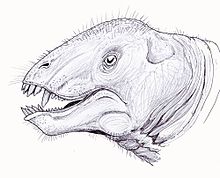
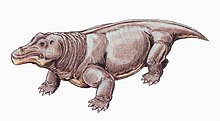
Most of the representatives are large animals (weighing up to 1-1.5 tons). The body is massive, rounded, the tail is very short. The limbs are very massive, the front slightly longer than the rear. Probably, during life, the front half of the body was raised (perhaps this indicates the nutrition of some vegetation raised above the soil). The muzzle in the normal position of the head is lowered somewhat down (the back of the head is sharply slanted back). The skull is very massive, with extremely developed pachyostosis in the infraorbital and fronto-parietal regions. The thickness of the skull bones in some species reached 30 cm. The orbits and temporal cavities are small, temporal cavities open from above. The teeth are few, the incisors are usually very powerful. There are no palatine teeth. Fangs are expressed only in the most primitive forms.
It is assumed that pachyostosis of the bones of the skull was necessary for intraspecific contractions (as in sheep or mountain goats). Nevertheless, this is disputed by domestic scientists who indicate that the bones of the forehead were not covered by horn formations and served for thermoregulation (they were pierced by blood vessels). The skin of tapinocephalus was probably soft and devoid of scales, with numerous glands. On the front part of the skull, in some species, grooved depressions were found, possibly containing skin glands. Footprints from South Africa are known.
Tapinocephals were herbivorous, and for chopping food they used powerful incisors equipped with heel-like protrusions. The basis of their nutrition could be the dead trunks of calamites, which accumulated along the shores of water bodies.
According to the Paleobiology Database website, as of May 2019, the following extinct taxa up to and including genus are included in the infraorder [3] :
- Childbirth incertae sedis
- Genus Deuterosaurus Eichwald, 1848 (2 species)
- Superfamily Niaftasuchoidea Ivakhnenko, 1990
- Family Niaftasuchidae Ivakhnenko, 1990
- Genus Niaftasuchus Ivakhnenko, 1990 - Nyaftazukh (1 species)
- Superfamily Tapinocephaloidea Owen, 1876
- Family Tapinocephalidae Owen, 1876 (or directly in the infraorder tapinocephalus)
- Genus Keratocephalus Huene, 1931 (1 species)
- Genus Taurosaurus
- Subfamily Moschopinae Boonstra, 1969
- Genus Avenantia Boonstra, 1952 (1 species)
- Genus Criocephalosaurus Kammerer & Sidor, 2002 (1 species)
- Genus Delphinognathus Seeley, 1892 (1 species)
- Genus Moschops Broom, 1911 - Moschops (3 species)
- Subfamily Riebeeckosaurinae Boonstra, 1969
- Genus Riebeeckosaurus Boonstra, 1952 (1 species)
- Subfamily Struthiocephalinae Boonstra, 1969
- Genus Struthiocephaloides Boonstra, 1952 (2 species)
- Genus Struthiocephalus Haughton, 1915 - Strutiocephalus [2] (1 species)
- Genus Struthionops Boonstra, 1952 (1 species)
- Genus Taurocephalus Broom, 1928 (1 species)
- Subfamily Tapinocephalinae Lydekker, 1890
- Genus Mormosaurus Watson, 1914 (1 species)
- Genus Phocosaurus Seeley, 1888 (1 species)
- Genus Tapinocaninus Rubidge, 1991 (1 species)
- Genus Tapinocephalus Owen (1 species)
- Family Ulemosauridae Ivakhnenko, 1994
- Genus Ulemosaurus Riabinin, 1938 - Ulemosaurs (2 species)
Styracocephals ( Styracocephalus Haughton, 1929 ), previously assigned to this infraorder, are assigned to a separate suborder Styracocephalia .
Individual Representatives
Tapinocephals include about 18 genera predominantly from South Africa. The true number of genera is unknown, since many of them turned out to be synonyms, because they were described on the basis of the remains of heterosexual and heterogeneous individuals of the same species. They can be grouped into the following subfamilies:
- Tapinocephalinae are short-mouthed tapinocephals with relatively weak teeth. Pachyostosis is extremely developed, sometimes in the form of dome-shaped outgrowths on the roof of the skull. The most famous is Tapinocephalus ( Tapinocephalus ). The largest species is Tapinocephalus atherstonei , up to 4 meters long.
- Strutiucephalinae - long-mouthed short-legged tapinocephals. Pachyostosis is significantly developed, the transition from the front to the roof of the skull is smooth. Perhaps semi-aquatic animals (the presence of muscle valves around the nostrils is not ruled out). 4 genera, the most famous is strutiocephalus ( Struthiocephalus ), up to 4 meters long.
- Riebeeckosaurus is the only representative of the subfamily Riebeeckosaurinae. Medium in size (about 2.5 meters long). The muzzle is very long, narrow. The occiput is also narrow; large temporal cavities are separated by a sagittal crest.
All African tapinocephals characterize different horizons of the Tapinocephalus zone of South Africa and are not found outside it.
Perhaps the most primitive tapinocephalus is Tapinocaninus pamelae from the Eodicynodon zone of South Africa. He retained prominent upper fangs, but otherwise very similar to later relatives.