Commewijne ( Dutch: Commewijne ; Sranan Tongo Kawina-liba ) is a river in the northern part of Suriname . Its source is located in the same district of the state, from the territory of which flows north, where the winding flows into it from the right, then, turning west, in the Nieuw-Amsterdam area it enters the Suriname river running from south to north and, passing 30 km, included in the Atlantic Ocean . The catchment area of the river is 6,600 km².
| Communevine | |
|---|---|
| niderl. Commewijne | |
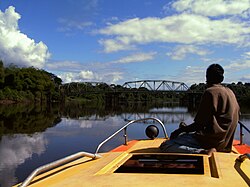 The only bridge over the river in the Stalkertsaver area , erected in 1980 The only bridge over the river in the Stalkertsaver area , erected in 1980 | |
| Characteristic | |
| Pool | 6,600 km² |
| Watercourse | |
| Mouth | Suriname |
| • Coordinates | |
| Location | |
| Water system | Suriname → Atlantic Ocean |
| A country |
|
| Region | Communevine |


Historically, Kommevejne was important for shipping: ocean vessels carried large barges with bauxites transported from Mungo to the east, before merging with Suriname and from there already heading south, through Paramaribo , to the Paranamsky oil refinery, Trinidad island and to the United States . Previously, hard tropical wood was rafted down the river to the capital of Suriname. Currently, bauxite reserves in the Mungo area have been significantly depleted and trucks are transporting hardwood. Ocean ships traded on the river in 1986. Also illegal trade is carried out by local residents and tourists sailing in boats.
In the XVI-XVII centuries it was called "Camivini" and "Kammavini". The current name, Kommevejne, is supposedly derived from the Arawak words kama ( tapir ) and vini (water / river).
Literature
- CFA Bruijning, J. Voorhoeve. Encyclopedie van Suriname. - Amsterdam : Elsevier , 1977 .-- P. 124-125. - 716 p. - ISBN 90-10-01842-3 .