Apollo 8 is the second manned spacecraft within the framework of the Apollo American space program . As a result of his flight, people first reached the vicinity of another celestial body, the Moon , and entered a lunar orbit. Flight marked the beginning of a new era in space exploration and in the history of mankind. During it, people first left near-Earth space and saw their planet entirely from afar, first left the Earth’s gravitational field and ended up in the satellite’s gravitational field, were first exposed to solar radiation outside the Earth’s magnetic field, and for the first time they saw with their own eyes the back of the Moon and the Earth’s rise above the lunar horizon, for the first time temporarily found themselves (being behind the lunar disk) in a state where there was no contact with the Earth, and for the first time entered the Earth’s atmosphere with a return speed phenomena from the moon [1] .
| Apollo 8 | |
|---|---|
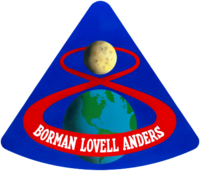 | |
| General information | |
| Organization | |
| Ship flight data | |
| Launch vehicle | Saturn-5 SA-503 |
| Launch pad | Kennedy Space Center Complex 39A, Florida , USA |
| Launch | December 21 , 1968 12:51:00 GMT |
| Ship landing | December 27 , 1968 15:51:00 GMT |
| Flight duration | 6 days 3 hours 0 minutes |
| Weight | command module 28817 kg lunar module 9026 kg |
| NSSDC ID | 1968-118A |
| SCN | 03626 |
| Crew flight data | |
| Crew members | 3 |
| Call sign | Apollo 8 (Apollo 8) |
| Crew photo | |
 from left to right: James Lovell, William Anders, Frank Borman | |
| Associated Expeditions | |
The launch of Apollo 8 with astronauts Frank Borman , James Lovell and William Anders on board took place on December 21, 1968 . This was the first manned launch of the three-stage Saturn-5 launch vehicle. The flight to the moon lasted less than three days, 66 hours 16 minutes and 21.79 seconds. The spacecraft entered orbit around Christmas Eve on December 24 and stayed on it for 20 hours, 10 minutes and 13 seconds, making 10 orbits around the moon. Astronauts checked the operation of the ship’s systems in the conditions of lunar space, first photographed the surface of the moon from close range, giving priority to places of future lunar landings, broadcasting and tracking navigation landmarks. The most risky maneuver during the expedition was considered a return start to Earth. If the main engine failed, the crew could not return. However, the engine worked flawlessly, and after two and a few days (57 hours 23 minutes and 32.5 seconds), on December 27 , the ship entered the dense layers of the Earth’s atmosphere and was soon splashed into the Pacific Ocean . The expedition lasted 6 days 3 hours 00 minutes and 42 seconds. During it, records were set for the speed of the spacecraft, 11,040 m / s, and the maximum distance from Earth - 377,349 km . According to experts, during the flight, Apollon-8 flew 933,419 km [2] . He became the first American spacecraft to deliver film to the Earth, captured from the moon (the Soviet " Probe-5 " did this earlier, in September 1968).
Content
Making a decision
On September 20, 1967, NASA leadership adopted a plan in which all Apollo flights (missions) were signed in seven steps from A to G (in the order of the letters of the English alphabet), where G meant achieving the goal - a flight with astronauts landing on the moon [ 3] .
| Mission | Flight number | Goals | Launch vehicle | Trajectory | Duration |
|---|---|---|---|---|---|
| A | 4 and 6 | Lapping the launch vehicle and the spacecraft; Entry into the Earth’s atmosphere at a rate of return from the moon | Saturn 5 | Apogee 16 600 km | About 8.5 hours |
| B | five | Refining the lunar module (LM), propulsion system and stage separation technology | Saturn-1B | Low Earth Elliptical Orbit | About 6 hours |
| C | n | Assessment of the operation of the command and service module systems (KSM) and crew actions | Saturn-1B | Low Earth Orbit | Up to 11 days |
| D | n +1 | Assessment of the operation of LM systems, KSM and crew actions; joint maneuvering KSM and LM | Saturn 5 or two Saturn 1B | Low Earth Orbit | Up to 11 days |
| E | n +2 | Joint maneuvering KSM and LM | Saturn 5 | High Earth Orbit | Up to 11 days |
| F | n +3 | Evaluation of the work of the lunar mission in deep space | Saturn 5 | Lunar orbit | Up to 11 days |
| G | n +4 | Landing on the moon | |||
| n - the number depends on the success of missions A and B | |||||
Between February 1966 and April 1968, five unmanned flights were carried out. The mission A program was completed by Apollo 4 and Apollo 6 . During their flights, unmanned tests of the command and service module were carried out and the reliability of the Saturn 5 launch vehicle was confirmed, which could be trusted to send people into space. Apollo 5 with an unmanned lunar module in January 1968 completed the B-mission program [4] . As a result of the Apollo 7 flight on October 11–22, 1968, the C-mission program was successfully completed [5] . The following were to be missions D (the first manned tests of the lunar module) and E (tests of the lunar module in a very high Earth orbit). However, due to serious problems, the production of the lunar module was delayed [6] . By the end of the summer of 1968, it became clear that he would not be ready on schedule. Grumman Corporation , the manufacturer of the lunar module, got out of schedule, working to reduce its mass and increase the reliability of electrical wiring [7] . In addition, in early August 1968, NASA received information from the CIA that the USSR plans to undertake a manned overflight of the moon at the end of the year. It was suggested that the next ship without a lunar module be launched into a really high orbit, extending 380,000 km to the moon. No one raised serious objections. The mission was decided to re-qualify in C '( Eng. C-prime , Sea Prime). On August 19, a decision was announced - Apollo 8 will fly to the moon. Instead of the lunar module, he will take a cylindrical blank of a similar mass. And the first manned tests of the lunar landing ship will be carried out by the Apollo 9 crew [7] . The final decision was made public on November 12, 1968. [8]
LV and QC preparation
In the flight of Apollo 8, it was planned to use the Saturn-5 launch vehicle, numbered as AS-503, which meant: "the third flight of the fifth series of the Apollon-Saturn rocket." The year before the flight, when the second stage of the S-II AS-503 launch vehicle first arrived at the Kennedy Space Center , it was intended for the third unmanned test of Saturn-5 with a rough model of the spacecraft instead of a real command and service module. However, by the end of April 1968, the Apollo program management decided that two flights of Saturn-5 were enough to understand its features. It was decided to send the crew on the CSM-103 command-and-service module (KSM) together with the first lunar module (LM-3) suitable for real space flight. This would be the first test of the complete Apollo rocket system in space. But for the final approval of such a decision, it was necessary to evaluate the second stage of S-II for its safety for astronauts. On April 29, S-II was removed from the launch vehicle [9] and sent to the John Stennis Space Center in Mississippi for further testing. They successfully completed on May 30, 1968. The second stage was again delivered to the Kennedy Space Center on June 27 .
General information
The ship included only the main unit in the composition: the command compartment (sample SM-103, weight - 28.9 tons) and the service compartment (SM-103). Instead of the lunar module, a mockup was installed on the carrier (it did not fly to the moon). To launch, the Saturn-5 rocket (AS-503 sample) was used. This was the first copy of a rocket used to launch a manned ship.
The purpose of the flight is a comprehensive test of the main unit with the conclusion to the selenocentric orbit .
The flight provided the USA with priority in reaching the orbit of the moon with a manned spacecraft. It was a serious leap forward in the "moon race" .
Flight Tasks
It was envisaged flight tests of a modified launch vehicle, testing the ability of the third stage of the launch vehicle to transfer the ship from a geocentric orbit to the flight path to the moon, test the components and assemblies of the command module in flight to the moon, television broadcasts from the board and photographing the surface of the moon.
Crew
- Commander - Frank Bormann (2nd Flight)
- Command Module Pilot - James Lovell (3rd Flight)
- Lunar Module Pilot (some features) - William Anders (1st Flight)
Bormann and Lovell were astronauts with experience in the Gemini program, among other things, they flew together on the Gemini 7 . Anders was a freshman. Initially, the crew included Michael Collins , but at the last moment, for medical reasons, he was replaced by Lovell.
Start
Prelaunch preparation and launch of the ship passed without serious complications. The Apollo 8 ship launched on December 21, 1968 at 12 51 hours GMT , 65 seconds later than the estimated time. The ship entered a geocentric orbit close to the calculated one.
Flight to the Moon
After the last stage of the launch vehicle with the ship entered the initial geocentric orbit, the ground services and crew checked the on-board systems for about two hours and made sure that they were working.
The engine of the last stage of the launch vehicle was turned on to transfer the ship to the flight path to the moon at 2 hours 50 minutes 31 seconds of flight time and worked for 317 seconds. An engine torch was visually observed in the Hawaiian Islands .
After entering the flight path to the Moon, Bormann unfolded a step with the ship so that the ship was facing the front of the Sun , which provided the necessary lighting for the upcoming photographs . At 3 hours 21 minutes of flight time, the ship separated from the stage, turned 180 ° and for some time made a group flight with it. Astronauts photographed the stage and the model of the lunar module mounted on it.
After completing the group flight, the astronauts turned on the auxiliary engines of the ship to ensure distance from the stage. Then, the remaining oxygen was drained through the stage engine and the auxiliary engines were turned on. As a result, a calculated increment of speed was provided, however, due to insufficient control of orientation, the step approached the ship and followed it at a distance of about three hundred meters. The flight leaders considered this dangerous, and as a result, at 4 hours 45 minutes of flight time, the auxiliary engines of the ship were turned on, which was not provided for by the initial flight program, for its removal from the last stage of the launch vehicle to a safe distance.
At the eleventh hour of flight time and at a distance of approximately 96,000 km from the Earth, the first flight path correction was made.
At about the nineteenth hour of flight, Bormann felt nausea and pain in his stomach. Some malaise was experienced by other crew members . Having taken a tablet against motion sickness and a tablet of a fixing agent, astronauts felt better.
At the thirty-second hour of the flight, when the ship was at a distance of 255,000 km from Earth, the first television broadcast session began on board. The image quality was satisfactory when shooting the cockpit and astronauts, and unsatisfactory when shooting the Earth with a telephoto lens. During the second session (sixty-sixth hour of flight), the quality was improved by selecting filters. The Earth was shown from a distance of approximately 330,000 km .
55 hours 38 minutes after the start of the flight, the ship left the Earth's gravitational field and entered the moon's gravitational field. At the sixty-second hour of the flight, the second and last correction of the trajectory on the “Earth - Moon” route was made.
Orbit around the moon
Astronauts received permission to transfer to the selenocentric orbit at 68 hours 04 minutes of flight time. After about an hour, the ship went beyond the Moon, at a distance of about 126 km from it the main engine was turned on, which worked for 246.5 seconds and transferred the ship to an elliptical selenocentric orbit with a height of resettlement of 113 km, a height of settlement of 312 km and a circulation period of 2 hours 10 minutes . Bormann's pulse during engine operation rose to 130 beats per minute.
During the period of rotation in an elliptical orbit, astronauts took photographs of the surface of the moon, conducted visual observations and carried out navigation experiments.
At the seventy-second hour of the flight, the third television session was held. Astronauts showed the moon.
At 73 hours and 35 minutes, having made two turns in an elliptical selenocentric orbit, the astronauts switched on the main engine of the ship, which worked for 9 seconds and transferred the ship into an almost circular orbit with a height of resettlement of 112.1 km, a height of settlement of 112.7 km and a circulation period of approximately 2 hours.
During the flight in a circular orbit, the astronauts continued shooting the moon, the Earth and navigation experiments. At the sixth turn, Bormann ordered to stop all experiments in connection with overfatigue of the crew.
At 85 hours and 40 minutes of flight time, the fourth television session was held. Due to the great interest shown in this session, it lasted twenty-five minutes instead of the planned twenty. Astronauts showed the moon, accompanied by commentary on the show. Bormann then said that they have a message for all the inhabitants of the earth. The crew members took turns reading an excerpt from the first chapter of the Bible, Genesis. 1: 1-10 , then Bormann, completing the session, said: “On behalf of the crew, we end the broadcast with the wishes of good night, good luck, Merry Christmas and God bless all of you there, on the beautiful Earth”, after which the ship went over the moon for the last time .
At the tenth turn, in the absence of a radio contact, at 89 hours 19 minutes of flight time, the main engine was turned on to ensure the transition to the flight path to the Earth.
The radio signal from the ship was recorded on Earth at the estimated time, but the resumption of voice communications occurred 6 minutes later, which created greater tension in the flight control center.
After the restoration of the radio contact, in connection with the upcoming Christmas , Bormann jokingly declared: “Please keep in mind that Santa Claus is present here”, to which the astronaut Thomas Mattingly, who is in touch, answered: “Well, without a doubt, you know better ...” .
Return to Earth
Astronauts rested for a long time on the Moon-Earth route: nervous tension and overwork were affected. Anders fell asleep for 45 minutes while on duty.
On the flight path to the Earth, only one correction was made - at the one hundred and fifth hour of flight, when the ship was at a distance of 310,000 km from the Earth. Soon after, the fifth television session was held. Astronauts showed Earth, as well as cockpit equipment, accompanying the show with comments.
At one hundred twenty-eighth hour of the flight, the last session of the television program from the side was carried out. Astronauts showed the Earth from a distance of about 180,000 km. The total duration of the television sessions was approximately 2 hours.
At 146 hours 31 minutes of flight time, the crew compartment was separated from the engine compartment of the command module, and the latter was withdrawn from the crew compartment using auxiliary engines, after which the crew compartment entered the atmosphere.
The loss of radio signal lasted 6 minutes. The brake parachutes opened at 146 hours 54 minutes of flight time.
The flooding of the crew compartment occurred at a point with coordinates 5 km from the Yorktown aircraft carrier . The flight lasted 147 hours 00 minutes 11 seconds.
When splashed, the crew compartment turned upside down, but with the help of inflatable balloons, floats was quickly installed in the calculated position (bottom down). The helicopter reached the compartment almost immediately after the splashdown and hovered above it, illuminating it with a searchlight. Rescue operations began only at dawn, that is, approximately 35 minutes after landing.
Astronauts opened the hatch, were lifted aboard the helicopter and delivered to the aircraft carrier 1 hour 16 minutes after the splashdown. The crew compartment was also lifted aboard the aircraft carrier.
Flight Results
NASA announced the exceptional success of the flight. The main achievements are: conducting a detailed exploration of the lunar surface, which was extremely important for planning the landing of astronauts on the moon; demonstration of the ability of the command module of the ship to perform complex space flights with a great distance from the Earth with virtually no failures and malfunctions; safety demonstration for the crew of such flights; receiving a lot of important information and a sharp increase in the popularity of the space program in the United States and abroad.
See also
- Apollo Program
- Apollo spacecraft series
Notes
- Comments
- Sources
- ↑ Hamish Lindsay. Apollo 8. (Eng.) . A Tribute to Honeysuckle Creek Tracking Station . Date of treatment September 18, 2014.
- ↑ Richard W. Orloff. Apollo 8. The Second Mission: Testing the CSM in Lunar Orbit . Apollo By The Numbers: A Statistical Reference . NASA (2000). Date of treatment September 18, 2014.
- ↑ Brooks, Courtney G .; Grimwood, James M. Swenson, Loyd S. Chapter 9 - Tragedy and Recovery. Apollo 4 and Saturn V. Chariots for Apollo: A History of Manned Lunar Spacecraft . NASA (1979). Date of appeal September 26, 2014.
- ↑ Phillips, Samuel C. Chapter 9.3. An Early Trip Around the Moon . Apollo Expeditions to the Moon . NASA (1975). Date of appeal September 26, 2014.
- ↑ Wilhelms, 1993 , p. 181.
- ↑ Wilhelms, 1993 , p. 180.
- ↑ 1 2 Woods, David W. and O'Brien, Frank. Day 1: Launch and Ascent to Earth Orbit . Apollo Flight Journal . NASA (2002-2011). Date of treatment August 9, 2018.
- ↑ Wilhelms, 1993 , p. 182.
- ↑ Orloff, Richard W. Apollo 8 Spacecraft History . APOLLO 8 The Second Mission: Testing the CSM in Lunar Orbit December 21 – December 27, 1968 . NASA (2000). Date of treatment August 16, 2018.
Literature
- Wilhelms, Don E. To a Rocky Moon: A Geologist's History of Lunar Exploration . - Tucson, Arizona: University of Arizona Press, 1993 .-- 477 p.
- Bilstein, Roger E. Stages to Saturn: A Technological History of the Apollo / Saturn Launch Vehicles . - Washington, DC: NASA, 1996. - ISBN NASA SP-4206.
- Brooks, Courtney G. Chariots for Apollo: A History of Manned Lunar Spacecraft / Courtney G. Brooks, James M. Grimwood, Loyd S. Jr. Swenson - Washington, DC: Scientific and Technical Information Branch, NASA, 1979. - ISBN NASA SP-4205.
- Chaikin, Andrew. A Man on the Moon: The Voyages of the Apollo Astronauts. - New York: Viking, 1994. - ISBN 978-0-670-81446-6 .
- Chaikin, Andrew. A man on the moon. - New York: Penguin Books, 1998 .-- ISBN 978-0-14-027201-7 .
- Collins, Michael. Carrying the Fire: An Astronaut's Journeys. - New York: Cooper Square Press, 2001 .-- ISBN 978-0-8154-1028-7 .
- Cunningham, Walter. The All-American Boys. - ipicturebooks, 2010. - ISBN 978-1-876963-24-8 .
- De Groot, Gerard J. Dark Side of the Moon: The Magnificent Madness of the American Lunar Quest. - New York: New York University Press, 2006 .-- ISBN 978-0-8147-1995-4 .
- The Apollo Spacecraft - A Chronology. Vol. IV. Part 3 (1969 3rd quarter) . Washington, DC: NASA (1978). Date of appeal October 24, 2017.
- Hacker, Barton C. On the Shoulders of Titans: A History of Project Gemini / Barton C. Hacker, James M. Grimwood. - Washington, DC: National Aeronautics and Space Administration, 1977. - ISBN SP-4203.
- Kluger, Jeffrey. Apollo 8: The Thrilling Story of the First Mission to the Moon. - Henry Holt, 2017.
- Kranz, Gene. Failure Is Not An Option. - New York: Simon & Schuster, 2000 .-- ISBN 978-0-7432-0079-0 .
- Lattimer, Dick. All We Did Was Fly to the Moon. - Alachua, Florida: Whispering Eagle Press, 1985 .-- ISBN 978-0-9611228-0-5 .
- Logsdon, John M. The Decision to Go to the Moon: Project Apollo and the National Interest. - Chicago: University of Chicago Press, 1976.
- Lovell, Jim. Lost Moon: The Perilous Voyage of Apollo 13 / Jim Lovell, Jeffery Kluger. - Boston: Houghton Mifflin, 1994 .-- ISBN 0-395-67029-2 .
- Murray, Charles. Apollo: The Race to the Moon / Charles Murray, Catherine Bly Cox. - New York: Simon & Schuster, 1990. - ISBN 978-0-671-70625-8 .
- Orloff, Richard W. Apollo by the Numbers: A Statistical Reference . - Washington, DC: NASA History Division, Office of Policy and Plans, 2000. - NASA ISBN SP-2000-4029.
- Phillips, Samuel C. Apollo Expeditions to the Moon . - Washington, DC: NASA, 1975. - ISBN NASA SP-350.
- Poole, Robert K. Earthrise: How Man First Saw the Earth. - New Haven, Connecticut: Yale University Press, 2008 .-- ISBN 978-0-300-13766-8 .
- Schefter, James. The Race: The Uncensored Story of How America Beat Russia to the Moon. - New York: Doubleday, 1999 .-- ISBN 978-0-385-49253-9 .
- 100 Photographs That Changed the World. - New York: Time, Inc. Home Entertainment, 2003. - ISBN 1-931933-84-7 .
- Wilford, John Noble. We Reach the Moon. - Putnam Publishing Group, 1973. - ISBN 978-0-448-26152-2 .
- Woods, W. David. How Apollo Flew to the Moon. - Brelin; New York: Springer, 2008 .-- ISBN 978-0-387-71675-6 .
Links
- Apollo 8 Flight Section on NASA
- Apollo 8 Flight Journal
- Apollo 8 on the Apollo Facts website
- Apollo 8 in Encyclopedia Astronautica
- Academician V.P. Mishin "How We Lost to the Moon"
- N.P. Kamanin. Diaries
- "Apollo 8" at Encyclopedia Astronautica
- Jackson, Albert A. The Essence of the Human Spirit: Apollo 8 (Neopr.) // Horizons. - Reston, Virginia: American Institute of Aeronautics and Astronautics (AIAA). - T. 34 , No. 1 . - S. 24-28 .