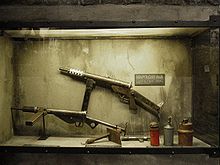
“Blyskavitsa” ( Polish: Błyskawica - lightning) is a submachine gun developed by engineers Wenceslas Zawrotný and Severin Velanera for the Home Army . It was produced underground in Poland during the German occupation.
| Błyskawica | |
|---|---|
 Błyskawica | |
| Type of | submachine gun |
| A country |  Poland Poland |
| Service History | |
| Adopted | |
| In service | Poland |
| Wars and conflicts | The Second World War |
| Production history | |
| Designed by | 1943 |
| Manufacturer | |
| Total released | ~ 700 |
| Specifications | |
| Weight kg | 3.22 |
| Length mm | 556/730 |
| Barrel length mm | 197 |
| Cartridge | 9 × 19 mm Parabellum |
| Work principles | free shutter |
| Rate of fire rounds / min | 600 |
| starting speed bullets , m / s | 400 |
| Sighting range , m | 200 m |
| Type of ammunition | 32 round magazine |
History
In 1942, Vaclav Zavrotny invited the AK command to develop a submachine gun adapted for serial production in clandestine conditions. Together with Severin Velaneroy, he developed a weapons project, for the production of which one could use the technologies available in craft workshops. Therefore, in PP, threaded connections were widely used. In developing the design, the authors relied on the best of the available samples: MP40 and Sten . From the first they borrowed the general layout of the weapon with a folding metal butt, from the second - the device of the mechanism.
Technical documentation was developed from January to April 1943 and the prototype was ready in August or September 1943. He was tested in the vicinity of the town of Zielonka in the Masovian Voivodeship, and then introduced to the head of the “ Kedyva ” (sabotage department of the main command of the Home Army) Colonel Feldorf. It was decided to deploy production. Until the end of November, the finalization of design documentation continued. In November, the weapon received the name "Blyskavitsa" - from the emblem in the form of three lightnings, knocked out on the butt plate of the butt.
The Blyskavitsy were assembled and tested in the workshop of Frantisek Makovetsky, who was engaged in the manufacture of garden fences. The first batch consisted of five pieces. After testing, Kedyv ordered another 100 units, and then another 300. Until July 1944, 600 copies were made, and by the time the Warsaw Uprising began, parts were ready for another hundred. During the uprising, production went on in the weapons workshop on Baudouin Street (about 40 pieces). A total of about 700 Bliskavits were produced.
Design
In the Blyskavits submachine guns, the design of the trigger and locking mechanisms standard for this class of weapons was used. A free shutter with a striking motionlessly fixed on the mirror is supported from behind by a coil spring on the stock, when moving forward it sends the cartridge out of the magazine into the chamber, at the same time it locks the barrel channel and strikes the cartridge with the striker.
Links
- Blyskawica (Poland) (inaccessible link)
See also
- Borz (submachine gun)