Dorylus helvolus (lat.) - a species of nomadic ants of the genus Dorylus from the subfamily Dorylinae ( Formicidae ). Africa.
| Dorylus helvolus |
Soldier Dorylus helvolus |
| Scientific classification |
|---|
| No rank : | Bilateral symmetrical |
| Subtype : | Tracheo-breathing |
| Infraclass : | Winged insects |
| Treasure : | Fully Transformed Insects |
|
| International scientific name |
|---|
Dorylus helvolus ( Linnaeus , 1764) |
| Synonyms |
|---|
- Dorylus planifrons Mayr, 1865
- Mutilla dorylus Lamarck , 1817
- Typhlopone europaea Roger, 1859
- Typhlopone punctata Smith, F., 1858
- Vespa helvola Linnaeus, 1764
|
|
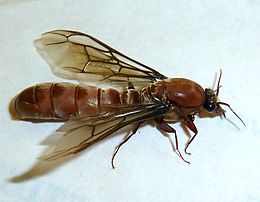
The male nomadic ant
Dorylus helvolus was first described as a wasp
Vespa helvola Linnaeus, 1764 .

Male
Dorylus helvolus attacked by small ants.
Content
Workers of reddish-red color have a length from several mm (from 1.7 mm for minima and 5 mm for medium-sized workers) to one cm (for large soldiers ), blind ( facet eyes and ocelli are developed only in the caste of males). Winged males are tan, up to 25 mm long (including 13 mm abdomen). The uterus is large, with a body length of up to 4 cm (including a 25 mm abdomen). The sides of the soldiers' heads are almost parallel to each other. The antennae of workers and females are 11-segmented (males have 13-segmented) [1] . The males are so different from other ants that the Swedish naturalist Karl Linney first described males of the species Dorylus helvolus (Linnaeus, 1764) as Vespa helvola Linnaeus, 1764 , and the French biologist Jean Baptiste Lamarck described them as wasps Mutilla dorylus Lamarck, 1817 [ 2] [3] .
The species belongs to the nominative subgenus Dorylus ss Shuckard, 1840 (species group helvolus- group) and was first described only by males (Linnaeus, 1764) [4] . Workers were later described (Linnaeus, 1767) [5] . The uterus was described only in 1888 by the Italian worldmecologist Carl Emery [6] . The genus Dorylus was included in 1793 by the Danish entomologist Johann Fabricius ( Fabricius , 1793) [7] [2] .
- ↑ Arnold, G. 1915. A monograph of the Formicidae of South Africa. Part I. Ponerinae, Dorylinae. Ann. S. Afr. Mus. 14: 1-159 (pages 116-119)
- ↑ 1 2 Bolton, B. (1995). A new general catalog of the ants of the world. Cambridge, Mass., Harvard University Press. pp. 1-504.
- ↑ Orphan army ants adopted
- ↑ Linnaeus, C. 1764. Museum SRM Ludovicae Ulricae Reginae Svecorum, Gothorum, Vandalorumque, & c. In quo animalia rariora, exotica, imprimis. Insecta & Conchilia describuntur & determinantur. Prodromi instar. Holmiae [= Stockholm]: Salvius, 8+ (page 412, male description)
- ↑ Linnaeus, C. 1767. Systema naturae, per regna tria naturae, secundum classes, ordines, genera, species, cum caracteribus, differentiis, synonymis, locis. Tomus I. Pars 2. Editio duodecima, reformata. Holmiae [= Stockholm]: L. Salvii, pp. 533-1327. (page 968, description of working ants)
- ↑ Emery, C. 1888. Le tre forme sessuali del Dorylus helvolus L. e degli altri Dorilidi. Bull. Soc. Entomol. Ital. 19: 344–351 (page 344, description of the queens)
- ↑ Fabricius, JC 1793. Entomologia systematica emendata et aucta. Secundum classes, ordines, genera, species, adjectis synonimis, locis observationibus, descriptionibus. Tome 2. Hafniae [= Copenhagen]: CG Proft, 519 pp. (page 365, combination of the genus Dorylus )
- Bolton B. (2003). Synopsis and classification of Formicidae. - Mem. Am. Entomol. Inst. 71: 1-370.
- Raignier, A. and JKA van Boven. (1955). Etude taxonomique, biologique et biometrique des Dorylus du sous-genre Anomma (Hymenoptera, Formicidae). - Annales du Musee Royal du Congo Belge., Tervuren, Sciences Zoologiques, Serie 8to, 2: 1-359.
