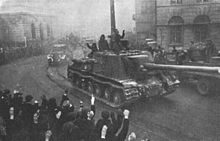
(1945 year)
Escort artillery is a historical term of the Great Patriotic War , which designated individual artillery guns, as well as units of regimental , battalion and attached self-propelled artillery , intended for direct fire support of advanced units leading the offensive [1] [2] [3] [4] .
In accordance with modern concepts, the tasks of directly supporting the advancing troops are no longer the prerogative of escort artillery ; they are carried out by self-propelled artillery, mobile artillery systems from the regiment and battalion artillery, recoilless guns and ATGM systems [3] .
Content
- 1 combat use
- 2 notes
- 3 Further reading
- 4 References
Combat use
The escort artillery consisted of fire weapons capable of acting in tactical and technical parameters and organizational data in the battle formations of the advancing infantry and tanks, moving with them and suppressing targets in their interests [3] [4] . Its main tasks were the destruction of enemy forces, delaying the development of the offensive, repelling counterattacks and ensuring consolidation at the captured lines [3] ; as a rule, she fired direct fire [1] [2] .
During the battles on the fronts of the Great Patriotic War, the Soviet troops widely practiced the following procedure for using self-propelled artillery escort guns: self-propelled artillery regiments operated in conjunction with tanks of direct infantry support and were assigned to tank units in a batch mode so that one self-propelled gun would provide one or two tanks with fire support [5 ] . Before the attack, self-propelled guns escorts lined up behind the first line of tanks and attacked with rifts from line to line, following the line of tanks at a distance of no more than 400 meters, firing from a place or from short stops [5] . If the infantry support tanks were lined up in two echelons, then the self-propelled guns escort supported the first of them with fire, which went on the attack together with the motorized rifle of tank brigades [5] . The second echelon of tanks advanced after them, acting from the battle formations of the first echelon of infantry [5] .
Notes
- ↑ 1 2 Artillery escort // Glossary of missile and artillery terms / Ed. V.M. Mikhalkin . - Moscow: Military Publishing House, 1988 .-- S. 20.
- ↑ 1 2 Artillery escort // Military Encyclopedic Dictionary. - Moscow: Military Publishing House of the Ministry of Defense of the USSR Union, 1986. - P. 50. - 863 p. - 150,000 copies.
- ↑ 1 2 3 4 Artillery escort // Great Soviet Encyclopedia / A. M. Prokhorov. - 3rd edition. - The Great Soviet Encyclopedia, 1970. - T. 2. - S. 271. - 632 p.
- ↑ 1 2 Artillery escort // Brief dictionary of operational tactical and general words (terms) / Ed. B. N. Morozov. - Moscow: Military Publishing, 1958.
- ↑ 1 2 3 4 Mityushkin A. A. Combat use of tanks in the offensive of an infantry division based on the experience of the Great Patriotic War // News of the Voronezh State Pedagogical University. - 2016. - T. 270 , No. 1 . - S. 141-146 .
Further reading
- Err, F.-J. Division artillery // Artillery in the past, present and future. - 2nd. - Moscow: Military Publishing House of the NPO of the USSR, 1941 .-- 348 p. - (Commander's library).
Links
- A. Meretskov. Artillery in a tank formation . armor.kiev.ua . "Modeller-Constructor" No. 5 for 1973. Date of treatment June 15, 2017.