The dispersion of dielectric constant is considered in a number of fundamental works on electrodynamics [1] [2] [3] , but this issue was considered in more detail in [4] . Using the example of this work, we consider the question of how such problems are solved when the concept of the polarization vector is introduced to solve them. Paragraph 59 of this work, where this issue is examined, begins with the words: “We are now going to study the most important issue of rapidly changing electric fields, the frequencies of which are not limited by the condition of smallness compared with the frequencies characteristic of establishing the electric and magnetic polarization of a substance” (end of quote) . These words mean that the frequency range is considered where, due to the inertial properties of charge carriers, the polarization of the substance will not reach its static values. Upon further consideration of the issue, it is concluded that “in any variable field, including in the presence of dispersion, the polarization vector (hereinafter, all the formulas quoted are written in the SI system) retains its physical meaning of the electric moment of a unit volume of a substance ”(end of quote). Here is another quote: “It turns out to be possible to establish the limit form of the function valid for any bodies (no matter - metals or dielectrics) at high frequencies. Namely, the field frequency should be large in comparison with the “frequencies” of motion of all (or at least most) electrons in the atoms of a given substance. Under this condition, when calculating the polarization of matter, it is possible to consider electrons as free, neglecting their interaction with each other and with the nuclei of atoms ”(end of quote). Next, the equation of motion of a free electron in an alternating electric field is written


,

where is his displacement
Then it says that polarization there is a dipole moment per unit volume and the resulting displacement is inserted into the polarization

.

In this case, the gas of free electrons is considered, in which there are no charges of opposite signs. The following is the standard procedure when the polarization vector introduced in this way is introduced into the dielectric constant
,

and since the plasma frequency is determined by the ratio
,

the induction vector is written immediately
.

With this approach, the proportionality coefficient
,
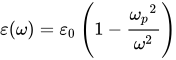
considered a dielectric constant, depending on the frequency. Further in §61, the question of the energy of the electric and magnetic fields in dispersing media is considered. In this case, it is concluded that for the energy of such fields
, (one)

which has an exact thermodynamic meaning in ordinary media, in the presence of dispersion, this cannot be interpreted. These words mean that knowledge of real electric and magnetic fields in a dispersing medium is not enough to determine the difference in internal energy per unit volume of a substance in the presence of fields in their absence. After that, a formula is given that gives the result for calculating the specific energy of electric and magnetic fields in the presence of dispersion
. (2)

Therefore, the conclusion that it is impossible to interpret formula (1) as the internal energy of electric and magnetic fields in dispersing media is correct. However, this fact does not lie in the fact that such an interpretation in the considered media is generally impossible. It consists in the fact that in order to determine the specific energy value as a thermodynamic parameter in this case, it is necessary to correctly calculate this energy, and it will be shown below that for this it is necessary to take into account not only the electric field that accumulates potential energy, but also the conduction electron current , due to the presence of mass, they accumulate kinetic energy of the movement of charges. This will be shown by the example of the dielectric constant of plasma-like media. Non-dissipative plasma-like media are considered media in which charges can move without loss [5] . As a first approximation, such media can include superconductors, free electrons, or ions in vacuum (hereinafter, conductors). For electrons in these media in the absence of a magnetic field, the equation of motion is:
, (3)
Where and - mass and charge of an electron, - electric field strength, - the speed of movement of the charge. Using the expression for current density


, (four)

from (3) we obtain the conduction current density
. (five)
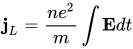
In relation (4) and (5), the quantity represents electron density. By entering the notation

, (6)

we find
. (7)
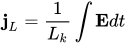
In this case, the value represents the specific kinetic inductance of charge carriers [6] . Its existence is due to the fact that a charge, having a mass, has inertial properties. For the case of harmonic fields relation (7) is written:


. (eight)
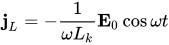
Hereinafter, for the mathematical description of electrodynamic processes, in most cases, instead of complex quantities, trigonometric functions will be used so that the phase relationships between vectors representing electric fields and current densities are clearly visible. From relation (7) and (8) it can be seen that represents inductive current since its phase is delayed with respect to the electric field intensity by an angle . If the charges are in vacuum, then when finding the total current, the bias current must also be taken into account


.

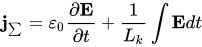
It can be seen that this current is capacitive in nature, because his phase on ahead of the phase of the electric field. Thus, the total current density will be
,
or
. (9)

If the electrons are in the material medium, then the presence of positively charged ions should also be taken into account. However, when considering the properties of such media in rapidly varying fields, due to the fact that the mass of ions is much larger than the mass of electrons, their presence is not taken into account. In relation (9), the value in brackets represents the total reactive conductivity of a given medium and consists, in turn, of capacitive and inductive conductivity


.

Relation (9) can be rewritten in another way:
,

Where - plasma frequency. Value
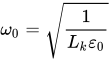
,

and there, as Landau points out, depends on the frequency of the dielectric constant of the plasma, which is accepted in all existing works on plasma physics. If we consider any medium, including plasma, then the current density (in the future we will abbreviate simply the current) will be determined by three components that depend on the electric field. The resistive loss current will be in phase with the electric field. The capacitive current determined by the first derivative of the electric field in time will be ahead of the electric field in phase by . This current is called the bias current. The conduction current, determined by the integral of the electric field in time, will lag behind the electric field in phase by . All three of these current components will be included in the second Maxwell equation and there can be no other current components. Moreover, all these three components of the currents will be present in any non-magnetic environments in which there are heat losses. Therefore, it is quite natural to determine the dielectric constant of any medium as the coefficient facing the term, which is determined by the time derivative of the electric field in the second Maxwell equation. It should be borne in mind that the dielectric constant cannot be a negative value. This is due to the fact that through this parameter the energy of electric fields is determined, which can only be positive. Another point of view is also true. Relation (9) can be rewritten in another way:

and enter another math symbol
.

Thus, you can write:
,

or
.

What should be done if at our disposal there are quantities and , and we need to calculate the total specific energy of the dielectric. Here we should use the first part of formula (6.2)


,
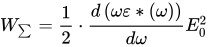
where do we get
.

We obtain the same result using the formula
.
![{\ displaystyle W = {{\ frac {1} {2}} _ {}} {{\ frac {d \ left [{\ frac {1} {\ omega {L_ {k}} * (\ omega)} } \ right]} {d \ omega}} _ {}} E_ {0} ^ {2}}](https://wikimedia.org/api/rest_v1/media/math/render/svg/5541561d3dea88444913e00966ff63153eb2a461)
The above relations show that the specific energy consists of the potential energy of electric fields and the kinetic energy of charge carriers. When considering any media, the ultimate task is to find the wave equation. In this case, this task has already been practically solved. Maxwell's equations for this case have the form:
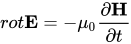
, (ten)

Where and - dielectric and magnetic permeability of vacuum. The system of equations (10) completely describes all the properties of nondissipative plasma-like media. From it we get


. (eleven)

For the case of time-independent fields, equation (11) goes over to the London equation
,
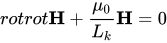
Where - London penetration depth. Thus, we can conclude that the equations of London, being a special case of equation (11), do not take into account displacement currents in the medium. Therefore, they do not make it possible to obtain wave equations describing the processes of propagation of electromagnetic waves in superconductors. For electric fields, the wave equation in this case is as follows:

{\ displaystyle ro {t _ {}} ro {t _ {}} {\ bf {E}} + {\ mu _ {0}} {\ varepsilon _ {0}} {\ frac {{\ partial ^ {2} } {\ bf {E}}} {{\ partial _ {}} {t ^ {2}}}} + {\ frac {\ mu _ {0}} {L_ {k}}} {\ bf {E }} = 0} .
 .
.For constant electric fields, you can write:
.

Consequently, constant electric fields penetrate the superconductor in the same way as magnetic ones, decreasing exponentially. The current density in this case grows according to the linear law
.
Thus, data have been obtained characterizing the process of propagation of electromagnetic waves in plasma-like media.
Notes
- ↑ Ginzburg V.L. Propagation of electromagnetic waves in a plasma. - M .: Science. 1967 - 684 s.
- ↑ Akhiezer A.I. Plasma Physics M: Nauka, 1974 - 719 p.
- ↑ Tamm, I.E. Fundamentals of the theory of electricity, Moscow: Nauka, 1989--504
- ↑ Landau L.D., Lifshits E.M. Electrodynamics of continuous media. M: Fizmatgiz, 1973.- 454 p.
- ↑ Aleksandrov A.F., Bogdankevich L.S., Rukhadze A.A. Oscillations and waves in plasma media. Ed. Moscow University, 1990.- 272 p.
- ↑ Mende F.F., Spitsyn A.I. Surface impedance of superconductors. Kiev, Naukova Dumka, 1985 .-- 240 p. http://fmnauka.narod.ru/poverkhnostnyj_impedans_sverkhprovodnikov.pdf
Literature
- Guildenburg V. B. Plasma resonance in the laboratory and the upper atmosphere // Sorov Journal of Education. - 2000. - T. 6 , No. 12 . - S. 86-92 .
- Mende FF Kinetic Inductance of Charges and Their Role in Classical Electrodynamics (English) = Kinetic Induktance Charges and its Role in Classical Electrodynamics. // Global Journal of Researches in Engineering: J General Engineering. - 2014 .-- Vol. 3 , no. 5 . - P. 51-54 . Archived on November 21, 2016.
- Mende, F.F. Dubrovin, A.S. Special Features of Reactive Elements and Flows of Charged Particles // Journal of Engineering Physics. - 2016. - No. 11 . - S. 13-21 .
- S. Gordyunin. Ideal conductors and kinetic inductance // Quantum . - M .: Bureau "Quantum", 1996. - No. 4 . - S. 40-41 . (inaccessible link)