
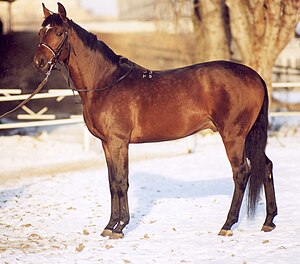
The Trakenen horse is a horse-harnessed sport breed of horses bred in Germany .
This is the only half-breed horse breeding to be kept clean.
Content
Breed History
In 1732, on the territory of East Prussia in the village of Trakenen, the Trakenen stud farm of the same name was opened, in which at that time there were more than one and a half thousand horses. The main objective of this stud farm was to provide the Prussian army with excellent cavalry horses: frisky, unpretentious and hardy. Crossing was attended by local small forest-type mares (seagulls) and stallions of eastern blood - Arab , Berberian , Turkish, Persian, Neapolitan and Spanish. Later, crossbreeding began to be carried out with stallions of purebred English breed . Even two Don stallions Aybar and Baku were brought as producers. From the second half of the 19th century , only stallions of Arabian and thoroughbred horse breeds were allowed to be producers, as well as their various crossbreeds and half-breed stallions that meet certain requirements: large stature, long body, strong legs, long straight neck, as well as productive movements and good manners. Also, starting from the second half of the 19th century, stallions were tested in smooth races, which were then replaced by steeples and parfors hunting . Mares were tested in agricultural and transport work. In those years, on many well-known steeple chases in Europe, it was the Trakenen horses that won. So a type of large, pedigree, massive horse was created, which during the 20th century was widespread in many countries of the world.
After World War II, the Trackenen breed in Germany was on the verge of extinction. A large number of horses either died during evacuation to Western Europe, or was captured by Soviet troops . So during the three-month evacuation of Trakenen to Western Europe, only 1,000 horses reached the site. There is such evidence that after all the numerous and heavy movements of the livestock (139 goals - on the train and more than 700 - on their own), under the leadership of Dr. Ernst Elert, the evacuated production team was located in Gradice , Neustadt and Perlin [1] .
There is a version [ where? ] that initially there was an idea to create a new breed - the Kirov one, "mixing" traces and other trophy horses. However, this fashionable idea was then abandoned and continued to breed Trakenen horses clean. They were taken to the cavalry, border troops , sports societies of the country of the Soviets . The breed was supervised by the Institute of Horse Breeding ( MZIK ) and personally by Professor V.O. Witt. The fate of the Trakens was under the scrutiny of S. M. Budenny . The existence of the breed was compromised after the disbandment of the cavalry in 1953. Under Khrushchev, whole horse factories went under the knife
In 1956, the smallest number of Trakenen horses was recorded in the entire history of the breed: 602 mares and 45 stallions. The breed was saved thanks to enthusiasts who kept in their stables Trakenen horses, which were the national pride of Germany.
In the 1960s, German horse breeders decided to retrain the Traken breed from cavalry to sport. And since horses of this breed from the very beginning have proven themselves in classical sports ( show jumping , dressage and eventing ) from the best side, interest in this breed has increased not only in Germany, but also in other European countries and even in the USA . The Trakenen breed at this time was already bred clean. In addition to Trakenen, purebred trackenens began to be bred in the Ganshu stud farm just organized in 1965. The greatest influence on the breed of German trackenes was made by the Albatzon stallions born in 1955 from Albatross, the Ganshu Altgesell pets from Altzilber, the Almanac from Abendstern, as well as the stallions bred in Poland and the USSR Tower, Labyrinth, Vespažen, Colombo, Trafaret and Eol.
Modern Trakenen Horse
Today the Trakenen horse is the only breed of sports horses in Germany that is bred without the addition of extraneous blood. As producers use only stallions of Trakenensky, as well as Arabian, thoroughbred horse breeds and their crosses. The Trakenen horse, bred in Germany, can always be recognized by a peculiar stigma: the horns of an elk on the left thigh.
Growth at the withers of a trakenen horse is 162-165 centimeters. Average measurements of Trakenen horses:
- stallions 166.5 - 195.3 - 21.1 cm;
- mares 164.6 - 194.2 - 20.2 cm
The most common colors are bay , black , red and gray . Less often, roan and karaka .
A Trakenen horse is bred throughout Germany, today the number of this breed is approximately 2,500 mares and 270 stallions. It is bred in other countries - France, Denmark, USA, Poland, New Zealand, England, Croatia, Russia. When making mares in the studbook, a ten-point evaluation system is used separately: type, body, limbs, stride, lynx, gallop, and general impression. Stallions are subject to even more stringent selection. Only 3% of the total number of stallions receive permission to operate as a producer. In the breed today there are lines of Dampfross, Fetish, Ararad, Pythagoras and a purebred riding Pasteur.
Sporting Achievements
The Trakenen horse is an excellent sports horse for a rider of any level. The horses of the Trakenen breed, having a balanced character and free, productive movements, in recent decades have numerically dominated in the countries of Europe and America in all classical equestrian sports, showing good results, especially in competitions in dressage and overcoming obstacles. In world-class equestrian sports, representatives of this breed achieve tremendous success in dressage, show jumping and eventing. The most famous dressage trakenen is the Russian stallion Pepel, in which honored master of sports Elena Petushkova became the Olympic champion in the team event and the world champion in dressage. The most famous competition horse was the gray Abdullah, who played for the US team and won the 1984 Olympics . It is noteworthy that in the world ranking of the best dressage breeds, the Traken breed is divided into two categories: "German" and "Russian" trained, and the latter often stand higher.
Trakenen horse in Russia
For the first time, Trakenen horses in Russia appeared before the Great Patriotic War. In large quantities they were brought back in 1925. The stallions went to the cavalry, and the best mares were covered with purebred stallions mainly in the stud farm. The first cavalry army. However, the offspring from these mares could not be saved: due to the difference in contents in Germany and Russia at that time, many of the mares aborted. The second time the Trakenensky breed entered the territory of our country in 1945. These horses were collected by the stud farm them. Kirov , located in the Rostov region. The affiliation of many of these horses to the Trakenens breed was established only by Tauris, since the documents for the horses were lost. The origin of almost all the horses was established, and they were included in the breeding work. Until now, the largest stud farm breeding "Russian trakenen" is the stud farm them. Kirov.
The average measurements of Russian Trakenen horses are as follows:
- stallions 167.4 - 195.1 - 21.4 cm
- mares 163.6 - 192.3 - 20.8 cm.
The suits are bay, black, brown, karak and red, less often gray, there are no other stripes. A large number of Russian tragenes showed excellent performance in equestrian sports at all levels. The stallion Ash is especially famous, who became the Olympic champion in 1972, and also won many European and world competitions. Among modern trakenes, Al Passal, who spoke in show jumping and Dressage, spoke in dressing. Some of the Trakenen stallions, born in Russia and then sold abroad, perfectly demonstrated their athletic qualities in the hands of European, including German athletes. Among these horses are Prince, Biotope, Harpoon, Chlorophyll (aka Waitaki). The largest lines of Russian Trakenen horses are the line of Pythagoras, Pilger, Parsival and the Arabian stallion of the Surf.
In Russia, the Trakenens breed is bred in the Moscow KZ , the stud farm them. Kirov, Kaliningrad stud farm , Experimental stud farm , as well as in the stud farm them. Dovatora in Belarus.
Notes
Literature
- Kambegov B., Balakshin O., Khotov V. “Horses of Russia”. Complete Encyclopedia. M: RIC MDK, 2002
- Politova M. "Sports breeds of horses of Europe". St. Petersburg: Scythia, 2003
- Watson M., Lyon R., Mongomery S. “Horses” M.: Profizdat, 2001