Kantua buxolistnaya [3] ( lat. Cantua buxifolia ) - flowering shrub plant . Belongs to the family of cyanosis ( Polemoniaceae ) [4] , a type species of the genus Cantua ( Cantua ).
| Cantua towed | |||||||||||||||||||||
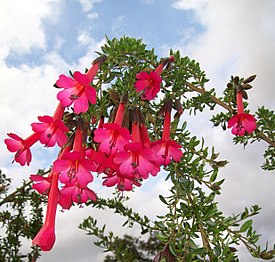 Flowering plant in peru | |||||||||||||||||||||
| Scientific classification | |||||||||||||||||||||
|---|---|---|---|---|---|---|---|---|---|---|---|---|---|---|---|---|---|---|---|---|---|
| |||||||||||||||||||||
| International scientific name | |||||||||||||||||||||
Cantua buxifolia juss . ex lam. [2] , 1785 | |||||||||||||||||||||
| Synonyms | |||||||||||||||||||||
| |||||||||||||||||||||
The Latin scientific name of the genus is derived from the Peruvian word ccantu [5] , in Quechua qantua , qantuta [6] , in Bolivia kantuta [7] . The plant is known as the " Inca flower" [3] .
Range and Description
Cantua tuciferous grows in the high valleys of the Yungas of Peru and Bolivia at an altitude of 2500 to 4000 meters above sea level [8] . It is also grown as an ornamental plant; in terms of endurance and cultural practices, it is equated to wintering fuchsias [3] . In 1848, it was first grown from seeds collected in the Peruvian Andes by , in Great Britain [9] .
In the wild, an evergreen shrub grows up to 5 m tall, has a straight strong trunk, simple leaves [8] . The branches of the plant with brushes of bright red, purple tubular flowers, but also white or yellow. Inflorescences bear from several or more flowers on pedicels of different lengths [3] [8] . Pollinated mainly hummingbirds [4] .
Usage
It was used as an ornamental plant by the Incas, who contributed to its cultivation throughout the empire and dedicated to the sun god [* 1] ; thus he became known as the “flower of the Incas” [8] .
The flower is the emblem of Peru [8] , as well as one of the national symbols of Bolivia and is painted on the flag of the country [* 2] .
Fig. L. Constance (1853)
Ollantaytambo District
Peru
Comments
- ↑ Flowers are currently used in religious ceremonies.
- ↑ "Artículo 6. II. Los símbolos del Estado son la bandera tricolor rojo, amarillo y verde; el himno boliviano; el escudo de armas; la wiphala; la escarapela; la flor de la kantuta y la flor del patujú." Constitution of Bolivia Archived October 24, 2017 on Wayback Machine
Notes
- ↑ For the conventionality of specifying the class of dicotyledons as a superior taxon for the plant group described in this article, see the APG Systems section of the Dicotyledonous article .
- ↑ . Botanique ... 1: 603. 1785
- ↑ 1 2 3 4 Artsybashev, 1941 , p. 79.
- ↑ 1 2 Tsvelev, 1981 .
- ↑ Quattrocchi, 2012 , p. 783.
- ↑ Teofilo Laime Ajacopa, Diccionario Bilingüe Iskay simipi yuyayk'ancha. La Paz, 2007 Quechua-Spanish dictionary
- ↑ Constitution of Bolivia (unavailable link) . Date of treatment May 29, 2017. Archived October 24, 2017.
- ↑ 1 2 3 4 5 Heim, 2014 , P. 88.
- ↑ Some botanical highlights in the Gardens January 2017 (link not available)
Sources
- Ornamental gardening: latest achievements / D. D. Artsybashev. - M .: Selkhozgiz, 1941 .-- 346 p.
- Tsvelev N. N. Family of the Sinyukhovye (Polemoniaceae) // Plant Life : in 6 tons / hl. ed. A. L. Takhtadzhyan . - M .: Education , 1981. - T. 5. Part 2: Flowering plants / ed. A. L. Takhtadzhyana. - S. 390-393. - 512 s. - 300,000 copies.
- Heim, Edgar. Flora of Arequipa, Peru : An Illustrated Field Guide for Nature Lovers. - Norderstedt: Herstellung und Verlag, 2014 .-- 118 p. - ISBN 978-3-7347-3299-7 .
- Quattrocchi, Umberto. CRC World Dictionary of Medicinal and Poisonous Plants . - CRC Press, 2012 .-- 4019 p. - ISBN 978-1-4200-8044-5 .