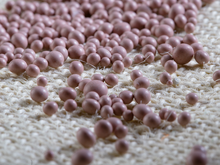

Azofoska (nitroammofoska, NPK) is a complex, solid, complex, granular nitrogen-phosphorus-potassium fertilizer. Contains phosphorus in a fully water soluble form. It is used for pre-sowing (main) and sowing (planting) application, as well as for top dressing, regardless of soil type.
Azofoska refers to nitroammophosphates, contains three active substances: nitrogen, phosphorus and potassium. The mass fraction of trace elements and the percentage of water content vary from brand to brand. Basic conditions: the content of nitrogen, phosphorus and potassium is approximately equal, friability always corresponds to 100%.
There are dosages of NPK 16:16:16, NPK 19-9-19, NPK 22:11:11, recommended for different types of soils.
NPK 16:16:16 - the classic dosage used on soils in which there is no shortage of trace elements;
NPK 19-9-19 - in this dosage phosphorus is included in a smaller amount, it is used for soils rich in mobile phosphorus;
NPK 22:11:11 - has a large amount of phosphorus and nitrogen, due to which it is possible to restore the fertility of many "dead" soils.
Content
- 1 Physical characteristics
- 2 Application
- 3 Production
- 4 See also
- 5 Literature
- 6 References
Physical Characteristics
- Azofosk fertilizer is non-toxic and non-explosive, however, it refers to fire hazardous difficult to combustible substances;
- does not react in the furnace at 900 ° C.
- the air suspension does not ignite or explode if it enters a spiral heated to 1000 ° C at a dust concentration of 260 g / cu.
- is a weak oxidizing agent and can activate the combustion of organic substances at a temperature of 800–900 ° C.
- azofoska is highly soluble in water, it is ballastless fertilizer. The nutrients it may contain more than 55%.
- has low hygroscopicity and caking. The low moisture content allows the product to disperse well, which facilitates the mechanized application of fertilizer to the soil.
Application
Azofoska is used in agriculture in the main (autumn) and sowing applications, as well as for foliar feeding of cereals, potatoes, sugar beets and other crops. The action of azofoski is best manifested with prolonged use of fertilizers in crop rotation. At the same time, a significant positive effect is observed not only from direct introduction into the first year, but also from the aftereffect in the subsequent period. As a fully water-soluble fertilizer nitroammofosk can be used in fertigation.
In the soil, the azofosk (nitroammophosk) dissociates into various ions: nitrate ion NO3–, ammonium ion - NH4 +, phosphate ions - H2PO4-, HPO42- and PO43-.
Azofoska is used on all types of soils: sod-podzolic soil, chernozems, chestnut soils and gray soils.
Production
The raw materials for the production of azofosks are extraction or thermal phosphoric acid, weak nitric acid and potassium salts. Technological schemes differ in the methods of neutralizing phosphoric and nitric acids.
The process of phosphate decomposition with nitric acid is based on the reaction
Ca 5 F (PO 4 ) 3 + 10HNO 3 = 3H 3 PO 4 + 5Ca (NO 3 ) 2 + HF (2.5.6),
as a result of which a nitric acid extract is formed - a solution containing calcium nitrate and free phosphoric acid. There are a number of methods for further processing the nitric acid extract. In many processes, the hood is neutralized with ammonia to produce ammonium phosphates (NP fertilizers). If potassium salts (KCl, K 2 SO 4 ) are added to it before granulating the neutralized pulp, then a triple NPK fertilizer is obtained - nitroammophoska.
Nitroammofoska brand 17:17:17 is obtained as a result of the introduction as a potassium component of potassium chloride. With the introduction of potassium sulfate, a mark of 16:16:16 is obtained.
See also
- Chemistry
- Fertilizer
Literature
- Kochetkov V.N. Phosphorus-containing fertilizers. Handbook, Moscow: Chemistry, 1982.
- Evenchik S.D., Brodsky A.A. Technology of phosphate and complex fertilizers, M .: Chemistry, 1987
- Pozin M.E. et al. Technology of mineral salts (fertilizers, pesticides, industrial salts, oxides and acids), part 1, 4th edition corrected, L., Chemistry Publishing House, 1974
Links
- http://studopedia.org/1-8444.html