Reichenau Monastery ( German: Kloster Reichenau ) is a Benedictine monastery on the island of Reichenau on Lake Constance . Along with the St. Gallen Abbey and the monastery in Fulda, it belongs to the most significant monuments of the Carolingian era in Germany . In the monastery are the churches of St. Mary and Mark, St. Peter and Paul and St. George, built in the IX-XI centuries. The monastery preserved the mural, considered the oldest in Germany.
| Monastery | |
| Monastery of Reichenau | |
|---|---|
| Kloster reichenau | |
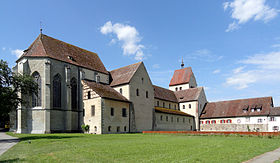 Monastery of Reichenau | |
| A country |  Germany Germany |
| Isle | Reichenau |
| Denomination | Catholicism |
| Diocese | |
| Type of | male |
| Architectural style | |
| Founder | Bishop St. Pyrmine |
| Established | 724 year |
| Date of Abolition | 1803 year |
| Building | |
| church of st. Mary and Mark • Church of St. Peter and Paul • St. George | |
| Famous inhabitants | Herman from Reichenau |
The monastery was included in the UNESCO World Heritage List in 2000 .
It was founded in 724 by the bishop of St. Pyrmine in predominantly pagan for that period of time Alemania . According to legend Pirmin, having arrived on the island of Reichenau, expelled water snakes from it. Where his foot stepped onto the island, a spring scored.
The first heyday of the monastery falls on the VIII-IX centuries. - The period of Christianization of Alemania. Under Abbot Heyton, the monastery established relations with Byzantium , in it they studied the Greek language . According to the “Book of Sisters” of the Reichenau Monastery in the 870s. St. Methodius the Apostle of the Slavs , expelled by his opponents from Moravia to Swabia , as well as his Greek satellite missionaries, stayed in it. Most likely, it was in Reichenau that the “ Bavarian geographer ” (the traditional name for the place of later storage in Munich ) was compiled - a catalog of ethnonyms of Central and Eastern Europe, where Russia ( Ruzzi ) and a number of Slavic and Baltic tribes unknown from other sources are mentioned. Abbot of the Reichenau Monastery in the 40s. IX century was Valafrid Strabo .

The second cultural heyday of Reichenau dates back to the Otton Renaissance . Thanks to the patronage of Ottones I and II , the school of book miniatures of the Reichenau Monastery became famous. In the XI century, the famous medieval scholar and music theorist Herman from Reichenau and Berno from Reichenau (abbot of the monastery in 1008-48) lived and worked in the monastery.
The monastery was secularized in 1803 . In 2001, a small group of Benedictine monks settled on the island.
Links
- Carolingian culture at Reichenau and St. Gall (digitization of St. Gallen manuscripts and manuscripts of the Reichenau monastery)
| UNESCO World Heritage Site , Object No. 974 Russian • English • fr. |
- Media files related to Reichenau Monastery in Wikimedia Commons
- Wikimedia Commons has media related to Reichenau's Book Miniature School