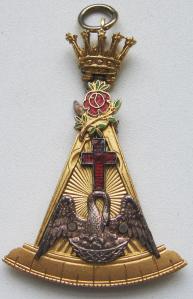
Knight of the rose and the cross - 18 ° in the Ancient and accepted Scottish charter . The first mention of the appearance of this degree dates back to 1765 [1] .
Content
Rosicrucian Degree Versions
According to Jean-Pierre Bayard [2] , at the end of the 18th century, two Masonic statutes inspired by the Rosicrucianism arose: the Revised Scottish Statute , widespread in central Europe, where the presence of the Golden and Pink Cross was significant, and the Ancient and Accepted Scottish Statute , which was the first time began to practice in France, in which the 18 ° is called "Knight of the rose and the cross."
The transition from operational to speculative Freemasonry occurred between the end of the XVI century and the beginning of the XVIII century. The two earliest speculative freemasons about whom written evidence exists are Sir Robert Morey and Elias Ashmole . Robert Vanloo states that the Rosicrucianism of the early 17th century had a significant influence on Anglo-Saxon Freemasonry. Hans Schick sees in the writings of Jan Comenius ( 1592 - 1670 ) the ideal of nascent English Freemasonry until the founding of the First Great Lodge of England in 1717 . Comenius was in England in 1641 .
The alchemist Samuel Richter, who in Wroclaw in 1710 under the pseudonym Syncerius Renatus (“Sincerely Converted”) [3] published the work “The True and Complete Preparation of the Philosopher's Stone of the Brothers from the Golden and Pink Cross”, founded the Golden Order in Prague at the beginning of the 18th century. and the pink cross as a hierarchical secret society that has an inner circle, identification marks and secret alchemical studies, materials on which were issued only to those who reached high degrees, that is, fell into that same inner circle. In 1767 and 1777, under the leadership of Hermann Fiktulda, society was significantly reformed due to political pressure. Its members stated that the leaders of the Rosicrucian order invented Freemasonry, and that only they knew the secret meanings of Masonic symbols.
According to this legend, the Rosicrucian order was founded by the followers of the Egyptian sage Hormuz and who emigrated to Scotland under the name "Builders from the East." After that, the original order disappeared and, presumably, was restored by Oliver Cromwell as Freemasonry. In 1785 and 1788, the Society of the Golden and Pink Cross published The Secret Figures of the Rosicrucians of the 16th and 17th Centuries.
The German Grand National Mother Bed Three Globes , led by Johan Christoph von Wöllner and General Johann Rudolf von Bischoffverder, came under the influence of the golden and pink cross. Many Freemasons became Rosicrucians, and Rosicrucianism was established in many lodges. In 1782, at the Wilhelmsbad Convention, the Old Scottish Lodge of Frederick the Golden Lion in Berlin earnestly asked Ferdinand, Prince of Braunschweig , and other Freemasons to submit to the Golden and Pink Cross, but to no avail.
After 1782, this highly secret society added Egyptian, Greek, and Druidic mysteries to its alchemical system [4] . A comparative study of what is known about the Golden and Pink Cross clearly shows how enormous influence this order had on the creation of some modern initiative societies.
According to the Masonic historian Marconi de Negre [5] , who, together with his father Gabriel Marconi, established the Masonic charter of Memphis , based on the earlier ( 1784 ) alchemical and hermetic studies of the Rosicrucian scholar Baron de Westerod [6] , which was also distributed in the 18th century ideas of the society of the Golden and Pink Cross (we can say that the Order of the Golden and Pink Cross was the inner core, apparently not related to the Memphis charter, but completely guiding it).
According to this legend, the Rosicrucian order was founded in 46, when the Alexandrian Gnostic sage Hormuz and six of his supporters were converted by one of the apostles of Jesus Mark . Their symbol, as they say, was a red cross crowned with a rose, which indicates a rose and a cross. According to this point of view, Rosicrucianism supposedly appeared through the cleansing of the Egyptian mysteries by the higher teaching of early Christianity [7] .
According to Maurice Magre 's book “Mages, Prophets, and Mystics,” Rosencruise is the last descendant of the 13th century German family of Germelshausen. Their castle is located in the Thuringian forest on the border with Hesse and they accepted the teachings of the Albigenses . The whole family was exterminated by Landgraf Konrad of Marburg from Thuringia, except for the youngest son, who was then 5 years old. He was secretly led away by a monk, an adept Albigensian from Languedoc, and placed him in an Albigensian monastery, where he studied and met four brothers, with whom he later founded the Rosicrucian brotherhood. Conclusions Magre allegedly obtained from unidentified oral sources.
Around 1530 , more than 80 years before the publication of the first manifesto, the Association of the Cross and the Rose already existed in Portugal in the monastery of the Order of Christ ( Convento de Cristo ), in the homeland of the Knights Templar , in fact, the Order of Christ is the successor to the Templar Order in Portugal . Three bosetes were, and now are, in the cache of the initiation room. The rose is clearly visible in the center of the cross [8] [9] .
There is also a secondary work of Paracelsus, “Prognosticatio Eximii Doctoris Paracelsi” ( 1530 ), containing 32 predictions with allegorical illustrations surrounding the mysterious text, referring to the image of a double cross on a blossoming rose; these are some examples that prove that the “Brotherhood of the Rose and the Cross” existed much earlier than 1614 [10]
Legend of a degree
The initiate is still in search of the truth and the lost word, and in his travels over the years he learns about the three virtues that should be guided - faith, hope and mercy . In addition, the essence of the New Law [11] [12] is explained to him.
Degree Lessons
The lessons of this degree are that a person must build a new temple in his heart, in which the Lord is worshiped in truth and in spirit; and also that a new law of love is needed, understandable and binding on all people everywhere on Earth. This degree confirms the principles of universality and tolerance in the broadest interpretation. The degree of the rose and the cross teaches three basic tenets: the unity, immutability and good of God; the immortality of the soul and the inevitability of the final defeat and eradication of evil, injustice and grief by the deliverer, or the Messiah, who will certainly come, if he has not yet come.
- Albert Pike [11] [12]
See also
- Ancient and accepted Scottish charter
- Great Sovereign Inspector General
- High prince of royal mystery
- Grand Inspector Inquisitor
- Knight kadosh
- Supreme Chosen and Perfect Freemason
- Grand Master Architect
- Master Chosen Nine
- Secret master
Notes
- ↑ Jean-Émile Daruty, Recherches sur le Rite Écossais Ancien Accepté (1879). Reproduction intégrale de l'édition de 1879 précédée d'un Hommage à Jean-Emile Daruty par Alain Bernheim, Éditions Télètes - 2002
- ↑ Jean-Pierre Bayard, Les Rose-Croix, MA Éditions, Paris, 1986
- ↑ Nicholas Goodrick-Clarke, The Occult Roots of Nazism , p. 59
- ↑ Bayard, Jean-Pierre, Les Rose-Croix , MAÉdition, Paris 1986
- ↑ de Negre, EJ Marconis (1849), Brief History of Masonry
- ↑ Nesta Webster's, Secret Societies and Subversive Movements, London, 1924, p. 87 and note 37
- ↑ Further research in Legend and Mythology: Ormus by Sol, The Book of THoTH, 2004
- ↑ Macedo, António de (2000), Instruções Iniciáticas - Ensaios Espirituais , 2nd edition, Hughin Editores, Lisbon, ISBN 972-8534-00-0 , p. 55
- ↑ Gandra, J. Manuel (1998), Portugal Misterioso ( Os Templários ), Lisbon, pp. 348—349
- ↑ Stanislas de Guaita (1886), Au seuil du Mystère
- ↑ 1 2 A. Pike Morality and the Dogma of the Ancient and Accepted Scottish Statutes of Free Masonry, Volume II, pp. 325-366
- ↑ 1 2 Jackson, ACF (1980). "Rose Croix: A History of the Ancient & Accepted Rite for England and Wales" (rev. Ed. 1987). London: Lewis Masonic.
Literature
- S.P. Karpachev The Art of Freemasons. Reference Monograph, Outpost, 2015, ISBN 978-5-990-54931-9 , p. 266
- A. Pike. Morality and Dogma of the Ancient and Accepted Scottish Statutes of Free Masonry II Volume II, pp. 325-366.
- Waite A. « . “ A New Encyclopedia of Freemasonry (the Great Art of Masons) and Related Sacraments: Their Rituals, Literature, and History. ” - St. Petersburg: Publishing House "Lan", 2003;
- S. P. Karpachev “Secrets of the Masonic orders. The rituals of free masons. " - M .: Yauza-press, 2007;